



Your crypto business is hemorrhaging money every time a customer gets stuck in KYC limbo. Manual identity checks are slow, error-prone, and turning away qualified buyers before they even get started.
At Web3 Enabler, we’ve seen how KYC automation in Salesforce transforms this mess into a frictionless process. Real-time verification, automated document analysis, and compliance checks built right into your workflow mean faster onboarding and happier customers.
Why Your KYC Process Is Costing You Money
Manual Processes Drain Revenue and Create Chaos
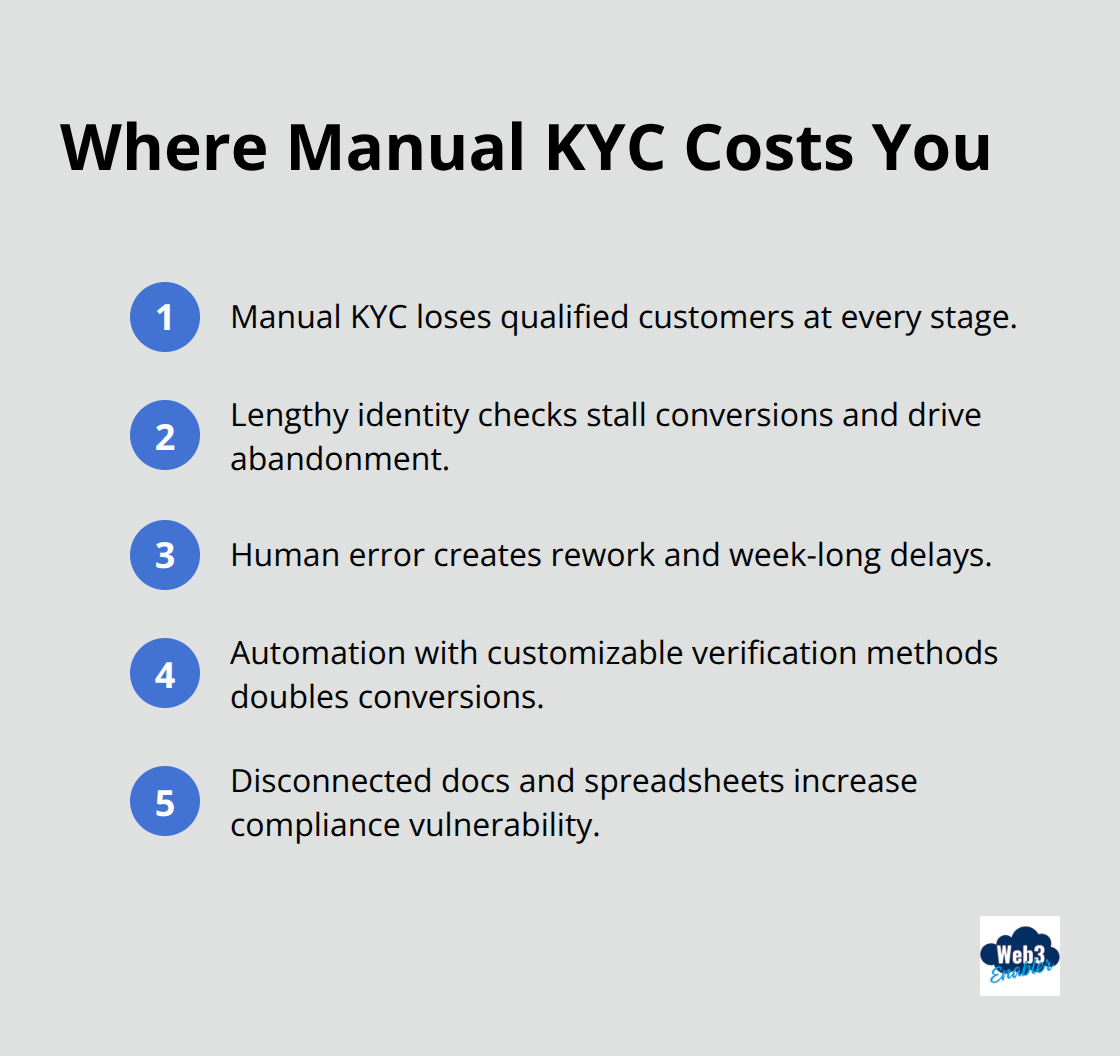
The numbers tell a brutal story. Crypto exchanges that rely on manual KYC processes lose qualified customers at every stage. A major crypto management platform experienced this firsthand: conversion rates stalled because customers abandoned their accounts during lengthy identity verification. Once the platform automated its KYC workflow with customizable verification methods, conversion rates doubled.
That’s not a marginal improvement-that’s the difference between a thriving business and one that leaves cash on the table.
Manual processes introduce human error at scale. Staff members miss documents, misfile information, or apply compliance rules inconsistently. Each mistake creates rework, delays onboarding by days or weeks, and forces compliance teams to investigate and remediate issues that automation would have caught instantly. When you manually collect documents, store them across spreadsheets and email, and cross-check them against sanctions databases, you’re not just slow-you’re vulnerable.
Inadequate Identity Checks Enable Real Fraud
The FTC reported that over 46,000 people lost more than 1 billion dollars in digital assets between 2021 and March 2022, many through accounts that slipped through inadequate identity checks. These weren’t theoretical losses-they represent real customers whose funds vanished because verification processes failed to catch bad actors.
Regulators now treat crypto exchanges as money services businesses under the Bank Secrecy Act, which means KYC compliance isn’t optional. The SEC, FinCEN, and CFTC made this clear in their 2019 joint statement. Proposed rules requiring wallet-owner data for transfers above 3,000 dollars and FinCEN reporting for daily totals above 10,000 dollars show that enforcement only tightens.
Automation Enforces Compliance by Design
Automated KYC systems keep you compliant by design. They enforce verification steps consistently, log every action with audit trails, and flag risks in real time so your compliance team acts before violations happen. Your platform documents every decision, making regulatory audits straightforward instead of nightmarish.
Speed directly drives revenue in crypto. Customers expect instant or near-instant onboarding. A platform that takes three days to verify identity loses customers to competitors who finish in minutes. Automated workflows verify identity, collect documents, and screen against watchlists simultaneously. Real-time verification means your qualified customers start trading immediately, not next week.
This is where Salesforce-native solutions change the game. Your identity verification integrates directly into the platform your team already uses, eliminating data silos and manual handoffs.
How Salesforce Transforms Your KYC Stack
Centralize Everything in One Place
Salesforce Financial Services Cloud brings your entire KYC operation into a single system. Customer identity data, verification history, document uploads, and risk assessments all live where your sales and service teams already work daily. This eliminates scattered spreadsheets, email chains, and separate compliance tools that slow traditional workflows. Your compliance team stops hunting across multiple platforms and starts making faster, better-informed decisions.
Real-Time Verification Runs in Parallel
Real-time identity verification integrates directly into your onboarding flow through AppExchange connectors and APIs. When a customer submits their government ID and proof of address, Salesforce automatically triggers verification checks against multiple data sources at once. Document AI analyzes submissions instantly, flagging missing information or quality issues before your team touches anything.

Selfie liveness and recognition checks confirm the person matches their ID without manual review. Phone and email verification completes in seconds. These verification methods run simultaneously rather than one after another, meaning your platform completes full identity checks in minutes instead of days.
Compliance Checks Happen Automatically
Compliance checks run automatically as part of the workflow, not after onboarding finishes. Watchlist screening, PEP checks, and adverse media scans execute the moment identity data enters the system. If a customer matches a sanctions database or appears on a high-risk list, your workflow pauses and routes the case to your compliance team with all relevant context already gathered. Audit trails capture every action, every decision, and every timestamp. Regulators reviewing your compliance program see a complete record of how your platform verified each customer and applied your risk policies consistently.
AI-Powered Risk Signals and Monitoring
Salesforce’s AI-powered Einstein tools analyze customer risk signals in real time, flagging unusual patterns that might indicate fraud or money laundering. CRM Analytics lets your compliance team monitor onboarding metrics, conversion rates, and verification bottlenecks from a single dashboard. Your team spots problems immediately rather than discovering them during monthly reviews. Role-based access controls mean your sales team sees customer status, your compliance team sees risk assessments, and your legal team accesses audit trails, with each group accessing only what they need.
Security and Third-Party Integrations
Security features including multi-factor authentication and data encryption protect sensitive identity information against breach. Salesforce complies with 40 international standards including GDPR and CCPA, handling the regulatory complexity so your team focuses on customer verification. Integration with DocuSign streamlines e-signature collection for consent forms and disclosures.
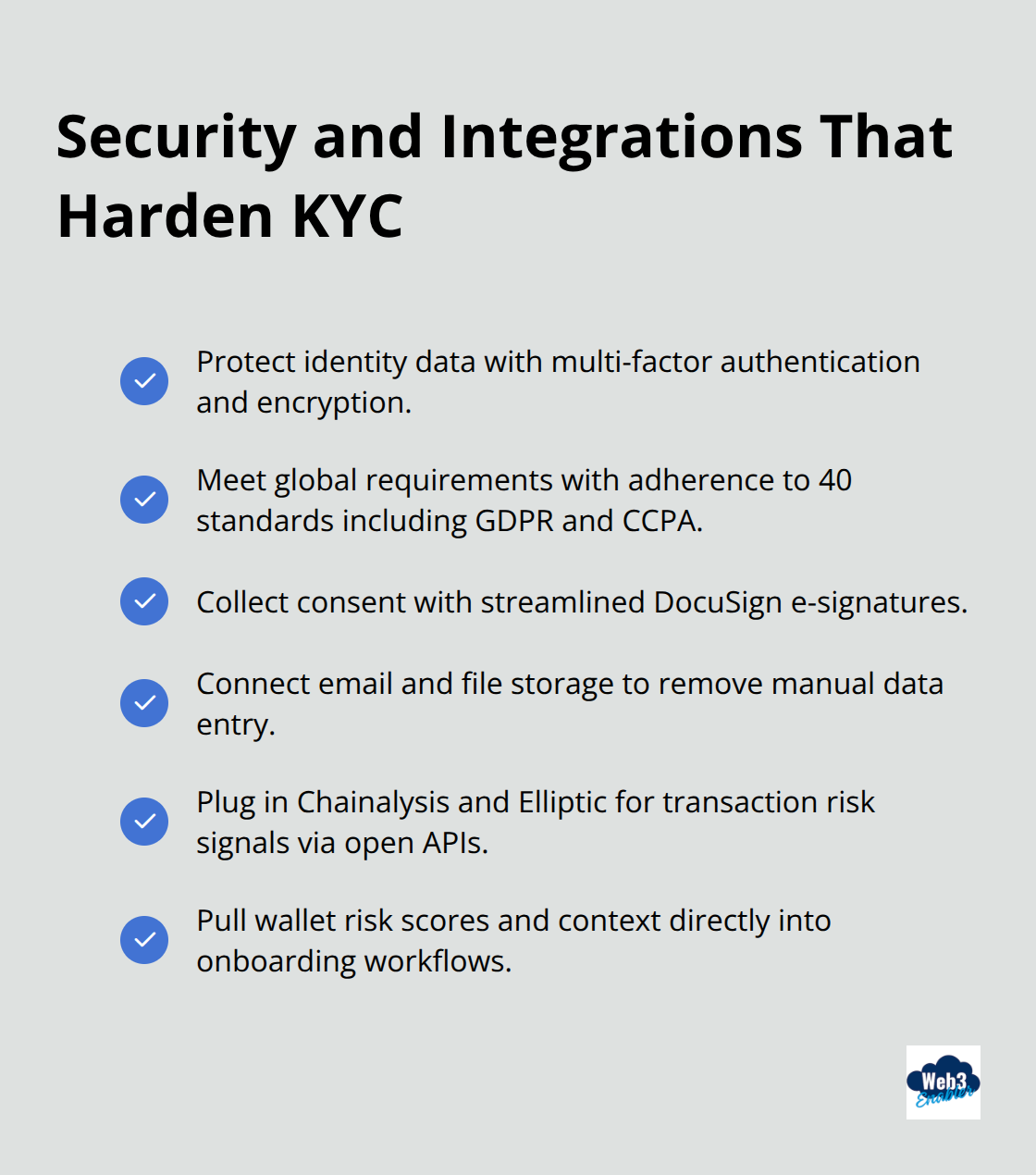
Your existing email and file storage systems connect seamlessly, eliminating manual data entry between platforms. When you need advanced screening from specialized providers like Chainalysis or Elliptic for transaction monitoring, Salesforce’s open API architecture connects these tools directly into your workflow. Your onboarding process pulls wallet risk scores and transaction context automatically, enriching your customer risk assessment without requiring your team to log into separate systems.
The speed and accuracy you gain from this integrated approach directly translates into higher conversion rates and lower compliance risk. But automation only delivers results when your team knows how to measure success. The next section shows you exactly what improved KYC systems look like in practice.
What Numbers Prove About Automated KYC
Automation in KYC delivers measurable business outcomes that go far beyond compliance checkboxes. A major crypto management platform that implemented automated identity verification with customizable verification methods saw conversion rates double. That platform had customers abandoning accounts during manual verification steps. Once real-time checks replaced the multi-day slog, qualified buyers completed onboarding immediately instead of disappearing to competitors. The difference between manual and automated KYC isn’t incremental improvement-it’s the gap between capturing revenue and leaving it on the table. Crypto businesses operating in 2026 cannot afford manual identity verification. Your competitors are already processing customers in minutes while your team still works through document backlogs.
Speed Translates Directly Into Customer Acquisition
Onboarding time matters more in crypto than almost any other industry because customers expect instant access. When your platform takes three days to verify identity, customers switch to exchanges that complete verification in five minutes. Automated workflows eliminate this friction through parallel identity checks rather than sequential ones. Document AI analyzes submissions instantly, selfie liveness checks confirm identity in seconds, and watchlist screening executes simultaneously with PEP database checks. Real-time verification means your qualified customers start trading immediately. Salesforce-native solutions accelerate this further because verification integrates directly into your existing CRM rather than requiring manual handoffs between disconnected systems. Your sales team sees customer status in real time, your compliance team flags risks instantly, and your legal team accesses complete audit trails without hunting through email or spreadsheets.
Compliance Risk Drops When Processes Run Consistently
Manual KYC processes introduce human error at scale. Staff members miss documents, apply compliance rules inconsistently, or fail to catch high-risk customers during initial screening. These mistakes create rework, delay onboarding, and expose your platform to regulatory enforcement. Automated systems enforce verification steps consistently across every customer, eliminating the human variability that regulators scrutinize during audits. Every action gets logged with timestamps, creating audit trails that demonstrate your platform applied compliance controls uniformly. When regulators review your KYC program, they see complete documentation of how you verified each customer and applied your risk policies. This transparency reduces enforcement risk significantly because your compliance posture is provable rather than disputable.
Customer Retention Improves When Verification Feels Frictionless
Customers hate slow identity verification, but they hate rejection even more. Manual KYC processes create situations where customers get stuck in limbo for days while your team manually reviews documents or investigates edge cases. Automated workflows resolve most verification decisions instantly and route genuinely high-risk cases to your compliance team with all context already gathered. This means your team spends time on actual risk assessment rather than administrative work. Customers experience faster decisions and clearer communication about their status. When a customer needs to provide additional information, your system requests it immediately rather than waiting for your team to notice the gap days later. This responsiveness builds trust and reduces the frustration that causes customers to abandon their accounts midway through onboarding.
Final Thoughts
KYC automation in crypto through Salesforce eliminates the friction that costs you customers and creates compliance headaches. Your platform no longer needs to choose between speed and safety-automated identity verification, real-time document analysis, and built-in compliance checks happen simultaneously, meaning qualified customers complete onboarding in minutes while your team maintains complete audit trails for regulators. Manual processes belong in the past.
Salesforce Financial Services Cloud fits directly into your existing stack because your team already uses Salesforce daily. You don’t bolt on another disconnected tool that creates data silos and manual handoffs; your identity verification integrates natively through AppExchange connectors and APIs. Your compliance team sees risk signals in real time, your sales team tracks customer status without hunting through email, and your legal team accesses complete audit trails instantly. This integration means faster decisions, fewer errors, and measurable improvements in both conversion rates and compliance posture.
The regulatory environment only tightens from here. Proposed rules requiring wallet-owner data for transfers above $3,000 and FinCEN reporting for daily totals above $10,000 signal that enforcement will intensify as crypto volumes grow. Platforms that implement KYC automation crypto Salesforce today build compliance infrastructure that adapts to tomorrow’s rules, while platforms still relying on manual processes will scramble to catch up. Explore how Salesforce-native blockchain solutions can streamline your identity verification and accelerate your customer onboarding.