


Most businesses managing digital assets operate without a clear inventory system. This creates hidden costs, compliance risks, and slower decision-making across your organization.
At Web3 Enabler, we’ve seen firsthand how proper digital asset inventory management transforms operations. The companies that get this right save time, reduce errors, and gain the visibility they need to move faster.
Why Digital Assets Matter to Your Bottom Line
The Hidden Cost of Disorganization
Losing track of digital assets costs money every single day. Your team wastes time hunting for files across disconnected systems, hemorrhaging productivity in the process. You cannot prove what you own during an audit, exposing your organization to penalties or legal liability.
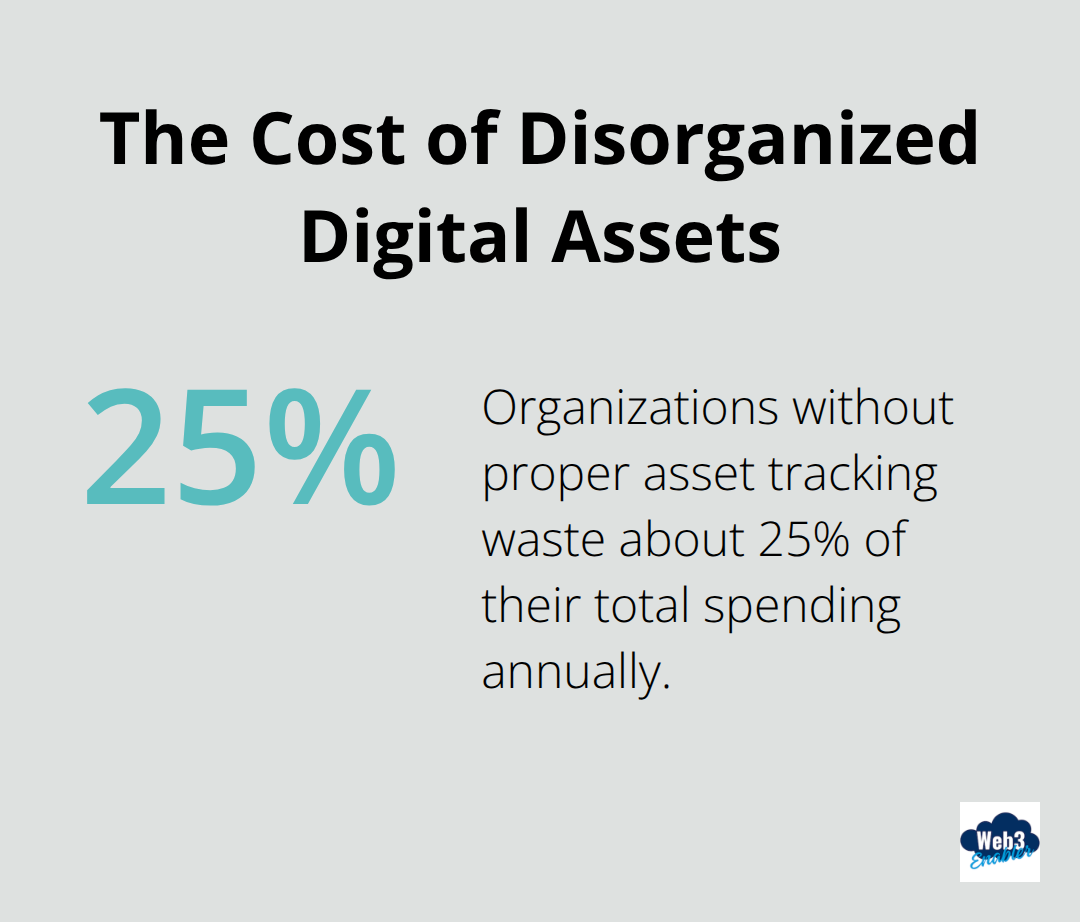
Decisions rely on outdated information instead of real-time data, leading to expensive mistakes. Companies without proper asset tracking waste about 25% of their total spending annually. That figure represents real money walking out the door, not a minor inefficiency.
Real-Time Visibility Transforms Operations
Real-time visibility into your digital assets fundamentally changes how you operate. Your finance team knows exactly which vendors have received payment and which transactions remain pending, reconciling accounts in hours instead of days. Your compliance team pulls a complete audit trail in minutes, avoiding the scramble that costs thousands in consultant fees. Your operations team spots underutilized software licenses or redundant cloud subscriptions, cutting waste immediately.
The Difference Between Knowing and Guessing
Companies winning this battle do not guess about what they own or where it lives-they know. They see every asset, every transaction, every change the moment it happens. This visibility lets them make decisions based on facts instead of assumptions. You move faster, you spend less, and you operate with confidence knowing your records are accurate and defensible. The alternative is chaos masquerading as normal business, where spreadsheets multiply, duplicate records pile up, and nobody truly understands your asset landscape.
The companies that transform their operations share one thing in common: they treat asset inventory as a strategic function, not an afterthought. This shift in perspective opens the door to the practices that actually work.
How to Build a System That Actually Works
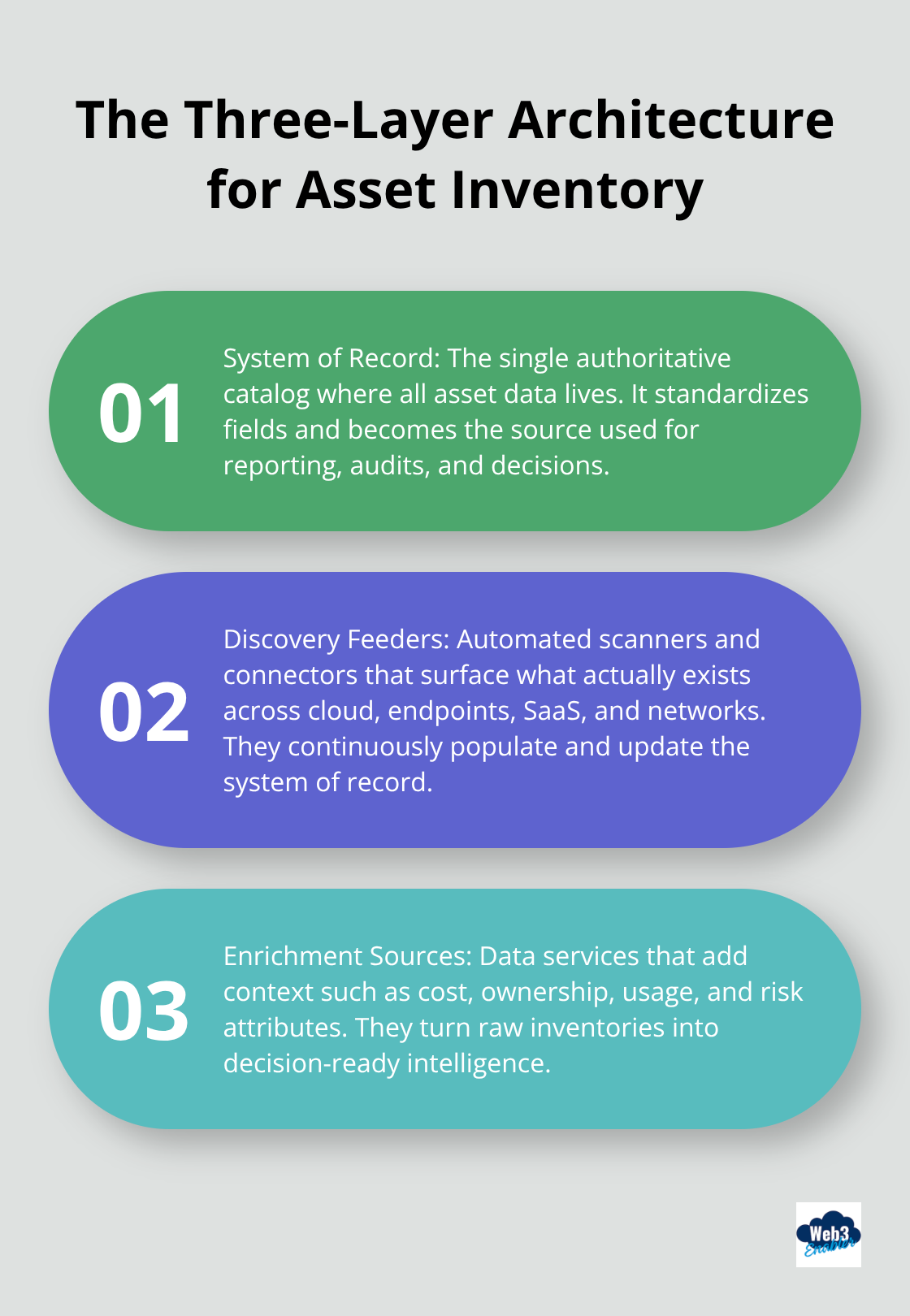
Start with a single source of truth. Your organization needs one authoritative record where all asset data lives, and every other system feeds into it. This could be your existing ITAM platform, CMDB, or a dedicated asset management tool, but the key is choosing one and committing to it. Everything else-your cloud consoles, endpoint management tools, SaaS dashboards, identity platforms-becomes a discovery feeder that continuously reports what exists. Without this anchor, you end up with conflicting data across spreadsheets and disconnected systems, and nobody knows which version is correct. The data architecture matters more than the specific tool. You need three layers working together: the authoritative system of record at the center, discovery feeders that reveal what’s actually present in your environment, and enrichment sources that add context like cost data, ownership information, and usage patterns. This layered approach transforms raw asset lists into decision-ready intelligence that your finance, compliance, and operations teams can actually use.
Automate Everything That Can Be Automated
Manual reconciliation is where asset management fails. Stop assigning people to hunt through spreadsheets and compare records across systems. Instead, set up automated discovery scans on a regular schedule-daily for cloud environments where things change constantly, weekly for on-premises infrastructure if your environment is stable. Define exactly what needs continuous discovery versus ongoing inventory based on what decisions you’re trying to support. If you’re optimizing cloud costs, you need real-time visibility into who owns what and how it’s configured. If you’re managing hardware lifecycles, you need accurate data on when devices were purchased and their current status. The difference matters because it shapes your data collection strategy. Once discovery runs automatically, your next priority is eliminating manual data entry. Use bulk ingestion to load assets, apply consistent metadata automatically, and leverage AI-assisted tagging to improve searchability without human effort. Set up automated reconciliation between your system of record and your discovery feeders to catch discrepancies immediately-missing assets, duplicates, or outdated configurations. Schedule these reconciliation jobs to run outside business hours, and flag exceptions for your team to investigate rather than forcing them to manually verify thousands of records.
Ownership and Access Control Stop Being Optional
Every asset needs a clear owner, and every person needs specific access rights tied to their role. This is not bureaucracy-it’s the difference between knowing who authorized a purchase and having no accountability. Assign ownership at the asset level, not just at the system level. Your cloud subscription has an owner, your SaaS licenses have owners, your digital files have owners. When something goes wrong or a decision needs to be made, you know exactly who to contact. For access control, implement granular permissions that prevent unauthorized changes while allowing legitimate users to do their jobs. Someone in your finance department should not be able to delete asset records, but they should be able to view cost data and generate reports. Your IT team needs to update device configurations, but they should not have visibility into sensitive financial asset details. Most asset management platforms support role-based access control-use it. Document your access policy in writing so people understand why they have the permissions they do. When team members change roles or leave the organization, update their access immediately. This sounds obvious, but many organizations leave former employees with active accounts or fail to adjust permissions when someone moves to a different department. Conduct quarterly audits of who has access to what, and remove permissions that no longer make sense. Your audit trail should show every change-who modified what asset, when they did it, and what changed. This creates accountability and gives you the evidence you need if regulators or auditors ask questions.
Maintain Data Quality Through Continuous Hygiene
Asset inventory systems deteriorate without active maintenance. Scheduled scans must run on time, failed agents need immediate attention, and discovery scopes require adjustment when new networks or tenants appear. Remove unknown or duplicate records that accumulate over time, and reconcile your system of record with HR, finance, and service desk data to catch discrepancies before they compound. This ongoing hygiene work prevents the slow decay that turns a useful system into an unreliable mess. The effort you invest in data quality today pays dividends when you need to make a critical business decision or face an audit. Teams that treat data maintenance as a regular operational task (not a one-time project) maintain systems they can actually trust.
What Happens When Your Data Sources Don’t Talk to Each Other
Most organizations already own the tools they need to track digital assets-they just don’t work together. Your cloud provider reports one inventory, your endpoint management tool reports another, your SaaS management platform shows something completely different, and your finance system has yet another version of the truth. Reconciling these disconnected sources manually wastes hundreds of hours annually. The real problem isn’t that you lack data-it’s that you have too much conflicting data and no systematic way to merge it.
Map Every Data Source in Your Environment
Start by identifying every data source that touches your asset landscape. Cloud consoles, identity platforms, endpoint agents, SaaS dashboards, ITSM platforms, and financial systems all generate asset information. Each one sees a different slice of your environment. Your job is deciding which sources feed into your system of record and in what order. If your ITAM platform is your source of truth, then cloud discovery feeds into it, not the other way around.
Set up integration pipelines that pull data from each source on a defined schedule-hourly for cloud environments where resources spin up and down constantly, daily for on-premises infrastructure. Use automated data mapping and transformation to convert formats and standardize naming conventions as data flows in. This prevents the duplicate records and mismatched fields that destroy data quality. Test your integrations thoroughly before going live, and monitor them continuously afterward. Failed integrations silently create gaps in your inventory, and you won’t know until an audit reveals missing assets.
Stop Data Decay Before It Starts
Data accuracy deteriorates the moment you stop actively maintaining it. Stale records accumulate, duplicate entries multiply, and conflicting information creates confusion about what’s actually deployed. The solution is treating data maintenance as an operational responsibility, not a one-time cleanup project.
Schedule automated data reconciliation jobs that compare your system of record against your discovery sources and flag discrepancies for investigation. Establish clear rules for how conflicts get resolved-if your cloud console shows an instance that your system of record doesn’t, create it automatically or route it to your IT team for approval depending on your risk tolerance. Remove records marked as unknown or unidentified after a defined period, typically 30 to 60 days. Unknown assets usually represent failed deployments, testing environments, or resources that nobody remembers provisioning. Keeping them clutters your inventory and makes audits harder.
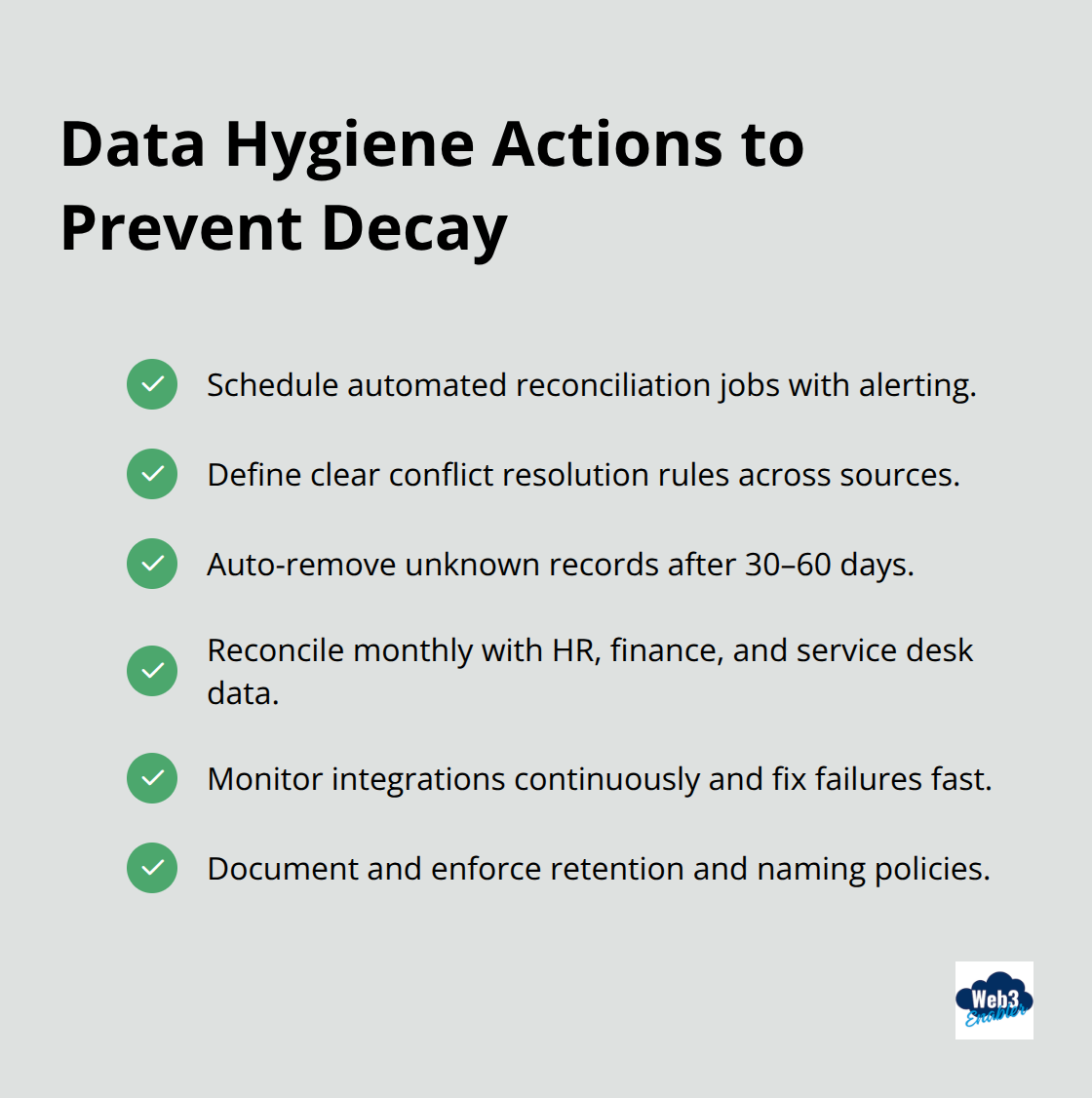
Reconcile your asset data monthly against HR records to catch employee departures, against finance records to verify what you’re actually paying for, and against service desk tickets to ensure deprovisioning happened. These cross-functional reconciliations catch problems that internal asset systems miss entirely.
Scale Your Operations Without Breaking Your System
When your team grows from managing hundreds of assets to managing tens of thousands, your manual processes collapse. Scaling requires automation at every step. Implement bulk ingestion capabilities so your team uploads thousands of assets at once rather than entering them individually. Configure automated discovery to run without human intervention, and set retention policies that automatically archive or delete assets based on age or status.
Create dashboards that surface critical metrics-how many assets lack owners, which systems haven’t reported data recently, what percentage of your inventory is verified versus estimated. These visibility tools let your team spot problems before they cascade. Assign clear ownership for data governance so someone owns the discovery schedule, someone owns the reconciliation process, and someone owns the data quality standards. Without explicit ownership, maintenance falls through the cracks and your system degrades.
Document your data governance policies in writing and train your team on them. When people understand why they’re following a process, they execute it better and catch edge cases that written procedures miss.
Final Thoughts
Getting your digital assets inventory right transforms how your organization operates. Companies that win treat asset management as a business function, not an IT checkbox. They know what they own, where it lives, and who bears responsibility for it-and that clarity cuts costs, accelerates decisions, and keeps auditors satisfied.
Start where you are by picking one authoritative system as your source of truth, connecting your discovery sources to it, and committing to regular reconciliation and cleanup. Automate everything possible so your team focuses on decisions instead of data entry, and assign clear ownership so someone stays accountable for keeping your inventory accurate and current. If you manage treasury operations or cross-border payments alongside your digital assets, Web3 Enabler brings real-time visibility into on-chain transactions and settlements directly within Salesforce, giving your finance team the same clarity you build for your asset inventory.
Audit your current state by mapping your data sources, identifying gaps in your inventory, and selecting your system of record. The effort you invest now pays dividends every single day your organization operates with accurate, current digital assets inventory data.