


Your sales team handles millions in deals every year, yet payment records live scattered across email threads and spreadsheets. Sales Cloud blockchain changes that by bringing transaction visibility directly into your CRM.
We at Web3 Enabler built this integration so your team can track payments, verify deals, and close faster-without wrestling with new systems or complex processes.
How Blockchain Transforms Your Sales Operations
Your sales team manages deals across multiple time zones, currencies, and payment systems. When a customer in Singapore commits to a contract worth $500,000, that transaction bounces between email confirmations, bank wires, and spreadsheet tracking. Blockchain eliminates this fragmentation by recording every transaction in real-time on an immutable ledger accessible directly from Sales Cloud.
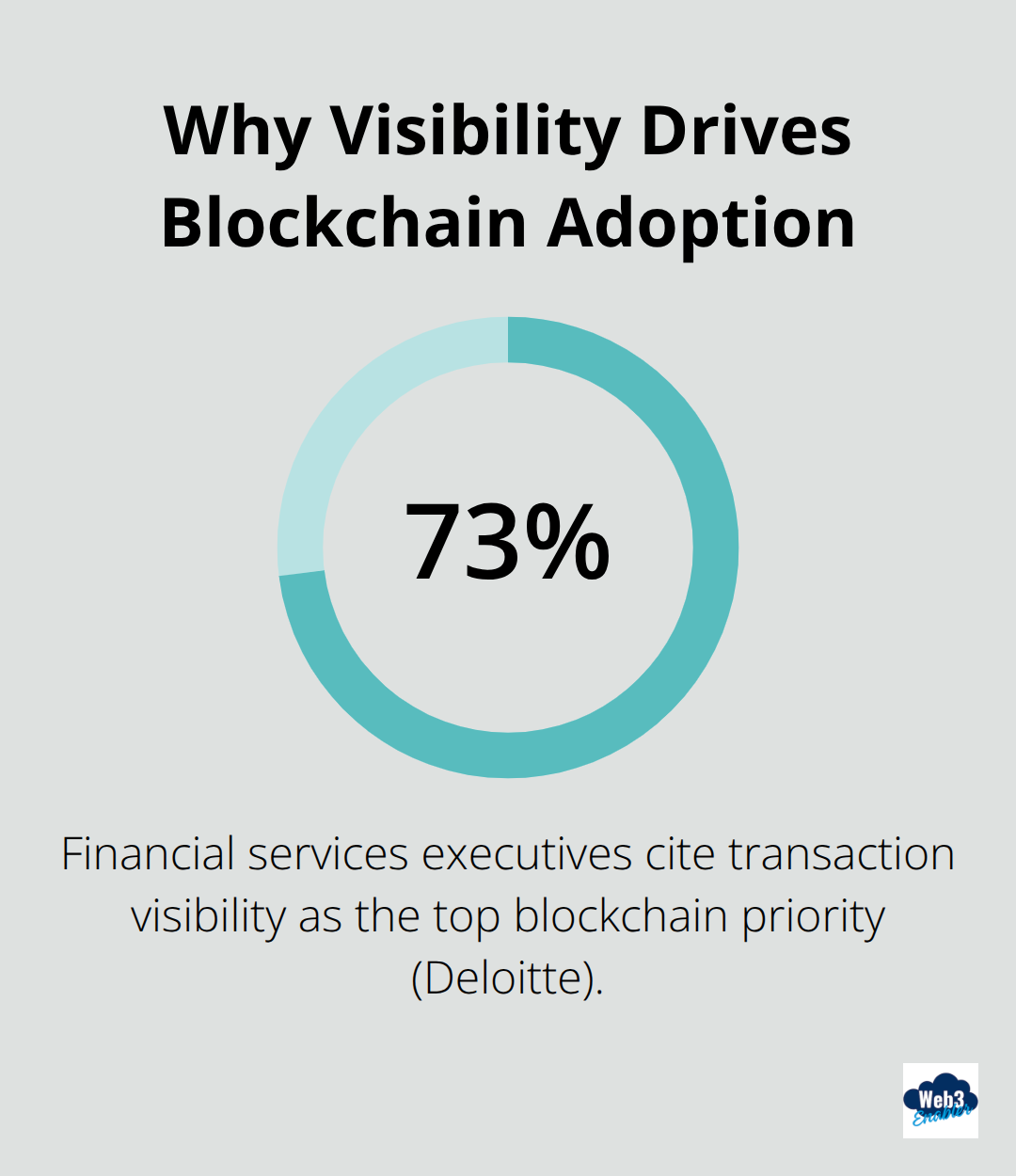
According to research from Deloitte, 73% of financial services executives cite transaction visibility as their top priority for blockchain adoption, yet most still rely on batch processing that creates 24-48 hour settlement delays. With blockchain integrated into your CRM, your team sees payment status, customer wallet balances, and transaction history the moment a deal closes. This visibility extends across global teams automatically, so your London office and Tokyo office access identical payment records without reconciliation delays. Your compliance officer gains immediate audit trails without requesting reports from finance, and your sales reps stop chasing customers for payment confirmations because the blockchain provides cryptographic proof of settlement.
Trust Gets Built Faster When Customers See Proof
Customers increasingly demand transparency about payment processing and fund movement. Blockchain creates immutable transaction records that customers can independently verify, shifting trust from promises to provable facts. When you send an invoice for cross-border services, your customer sees the exact moment payment settles on-chain and can verify it themselves through public blockchain explorers. This transparency reduces payment disputes by eliminating the gray zone between payment initiation and final settlement. Your team no longer needs to tell a customer their payment is processing somewhere in the banking system for three to five days. Instead, you show them the transaction recorded on the distributed ledger with a timestamp and confirmation status. For industries like professional services or software licensing, payment disputes consume significant annual revenue, directly impacting your bottom line.
Verification Becomes Automatic, Not Manual
Your current deal verification process involves your sales rep sending the contract to legal, legal sending it to finance, finance confirming payment terms, and someone manually entering that confirmation back into Sales Cloud. Blockchain automates this chain by encoding deal terms directly into payment transactions. When a stablecoin payment arrives from a customer, the blockchain records not just the amount but the associated contract reference, payment terms, and settlement conditions. Your CRM automatically flags any transaction that deviates from agreed terms without requiring a human to spot the discrepancy. This automation catches compliance issues before they become problems. A payment that violates your company’s geographic restrictions or customer risk thresholds gets flagged instantly rather than discovered during monthly reconciliation. Your team closes deals faster because verification happens in parallel with payment processing rather than sequentially afterward.
Real-Time Compliance Tracking Replaces Batch Reviews
Compliance teams typically review transactions in batches, sometimes days after settlement occurs. Blockchain changes this timeline by recording every transaction with full context the moment it settles. Your compliance officer accesses complete audit trails directly from Sales Cloud without waiting for finance to compile reports. Each transaction carries its contract reference, customer details, and settlement proof on the distributed ledger, making regulatory reviews faster and more thorough. This real-time approach reduces the risk window where non-compliant transactions go undetected.
Settlement Speed Accelerates Your Cash Flow
Traditional payment processing creates artificial delays between deal closure and cash availability. Blockchain settlements occur in minutes rather than days, meaning your finance team reconciles transactions faster and your cash flow improves immediately. Your sales team stops waiting for payment confirmation emails and starts tracking actual settlement status in real-time. This acceleration matters most for cross-border deals where traditional banking adds multiple days of processing time.
With transaction visibility, trust, and verification now operating at blockchain speed, your sales organization gains a competitive advantage that extends beyond individual deals. The next section explores how your team applies these capabilities to specific payment scenarios that matter most to your business.
Where Your Sales Team Actually Uses Blockchain Payments
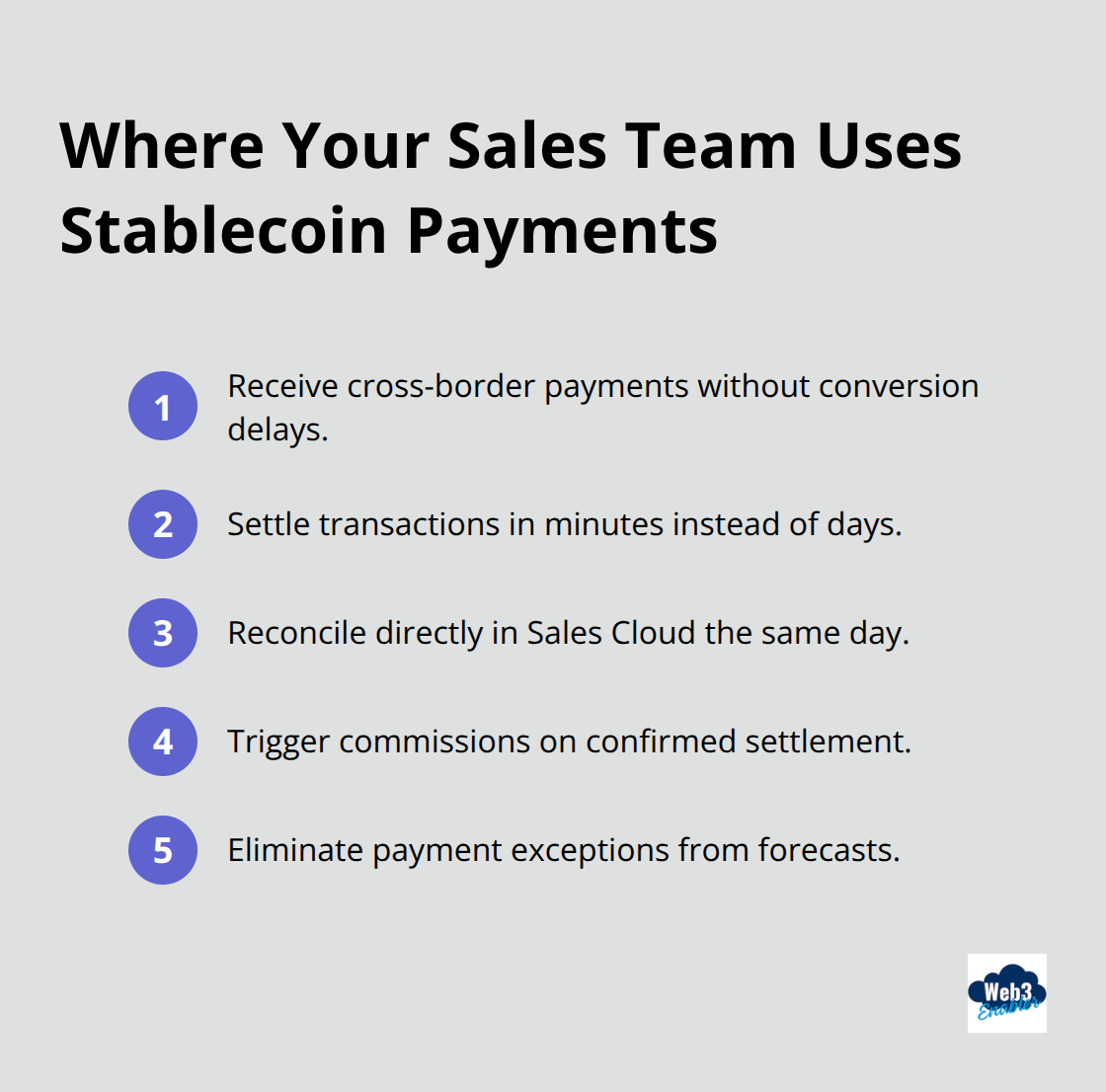
Your sales organization operates in a world where cross-border deals happen constantly, yet payment processing still moves at banking speeds. Stablecoins change this equation entirely. When your team closes a deal with a customer in Hong Kong, you accept payment in USDC or USDT immediately without currency conversion delays or intermediary bank fees. Your customer sends stablecoins directly to your wallet, the transaction settles in minutes on the blockchain, and your finance team reconciles it in Sales Cloud the same day instead of waiting three to five business days for wire transfers to clear. This acceleration matters most for your sales compensation calculations and commission payouts, which now trigger based on actual settlement rather than pending payment status. Your team stops managing payment exceptions where deals appear closed but cash hasn’t arrived yet, eliminating a significant source of forecast inaccuracy.
Settlement Speed Collapses When Blockchain Replaces Banking
Your current process involves your customer initiating a wire transfer through their bank, which routes through correspondent banks, clearing houses, and your receiving bank before funds appear in your account. Each step introduces delay and potential failure points. Blockchain removes these intermediaries entirely. A stablecoin payment settles with finality in under five minutes, and your Sales Cloud immediately reflects the transaction with full cryptographic proof that cannot be reversed or disputed. This speed becomes your competitive advantage when you quote faster payment terms than competitors still waiting for bank processing. Your sales team quotes 24-hour settlement instead of five-day settlement, closing deals that competitors lose because customers prefer immediate certainty. For enterprise customers managing cash flow tightly, this difference determines which vendor they select.
Immutable Records Eliminate Payment Disputes
Your immutable transaction records stop payment disputes before they start. When a customer claims they never sent payment or disputes the amount, the blockchain provides mathematical proof of what actually occurred, visible to both parties simultaneously. This transparency frees your team to focus on new revenue rather than payment reconciliation. Your finance team no longer spends hours investigating whether a payment actually arrived or tracking down missing wire confirmations. The distributed ledger shows exactly what happened, when it happened, and who initiated it-with no possibility of alteration or disagreement about the facts.
Customers Verify Payment Themselves
Building customer confidence requires showing them proof, not promises. Blockchain gives you that proof automatically. When you send an invoice for services rendered, your customer verifies payment settlement themselves without trusting your word or waiting for your confirmation email. They watch their stablecoin balance decrease in real-time, see the transaction recorded on the distributed ledger with their own transaction hash, and access complete proof of payment that persists forever. This transparency particularly matters for relationships where trust hasn’t been fully established yet. A new customer evaluating your company sees immediate payment confirmation rather than entering a period of uncertainty waiting for your finance team to acknowledge receipt.
International customers especially value this certainty because they avoid the gray zone where payment has left their account but hasn’t reached yours yet. Your immutable transaction history also creates a permanent record that supports future negotiations. When discussing renewal terms or volume discounts, you reference the exact payment history recorded on-chain, eliminating disputes about past behavior or commitment levels. This permanent, verifiable record transforms how you build long-term customer relationships-trust becomes something you demonstrate through data rather than assert through words.
Real-Time Visibility Across Global Operations
Your sales teams operating across multiple time zones now access identical payment records without reconciliation delays. Your London office and Tokyo office see the same transaction status simultaneously, eliminating the coordination problems that plague traditional banking systems. Your compliance officer gains immediate audit trails without requesting reports from finance, and your sales reps stop chasing customers for payment confirmations because the blockchain provides cryptographic proof of settlement. This unified visibility means your entire organization operates from a single source of truth about what payments have actually settled and what remains pending.
The ability to see real-time payment status directly in Sales Cloud transforms how your team manages deals and forecasts revenue. Rather than waiting for finance to confirm receipt, your sales reps track settlement status the moment a customer initiates payment. This visibility extends beyond individual transactions to show patterns in customer payment behavior, settlement preferences, and timing-information that helps your team predict cash flow and adjust sales strategies accordingly. With this foundation of transparent, fast, and verifiable payments in place, your organization can now explore how blockchain integration within Salesforce itself removes the technical complexity that typically accompanies payment modernization.
Building Blockchain Into Your Sales Workflow
Your Sales Cloud runs on standard Salesforce objects that your team understands and uses daily. Adding blockchain capabilities means integrating payment settlement data into those same objects without forcing your team to learn new systems or switch between platforms. Blockchain connectivity lives inside your CRM rather than requiring external tools or API management. Your sales reps see transaction status directly in opportunity records, account pages, and deal timelines without leaving Sales Cloud.
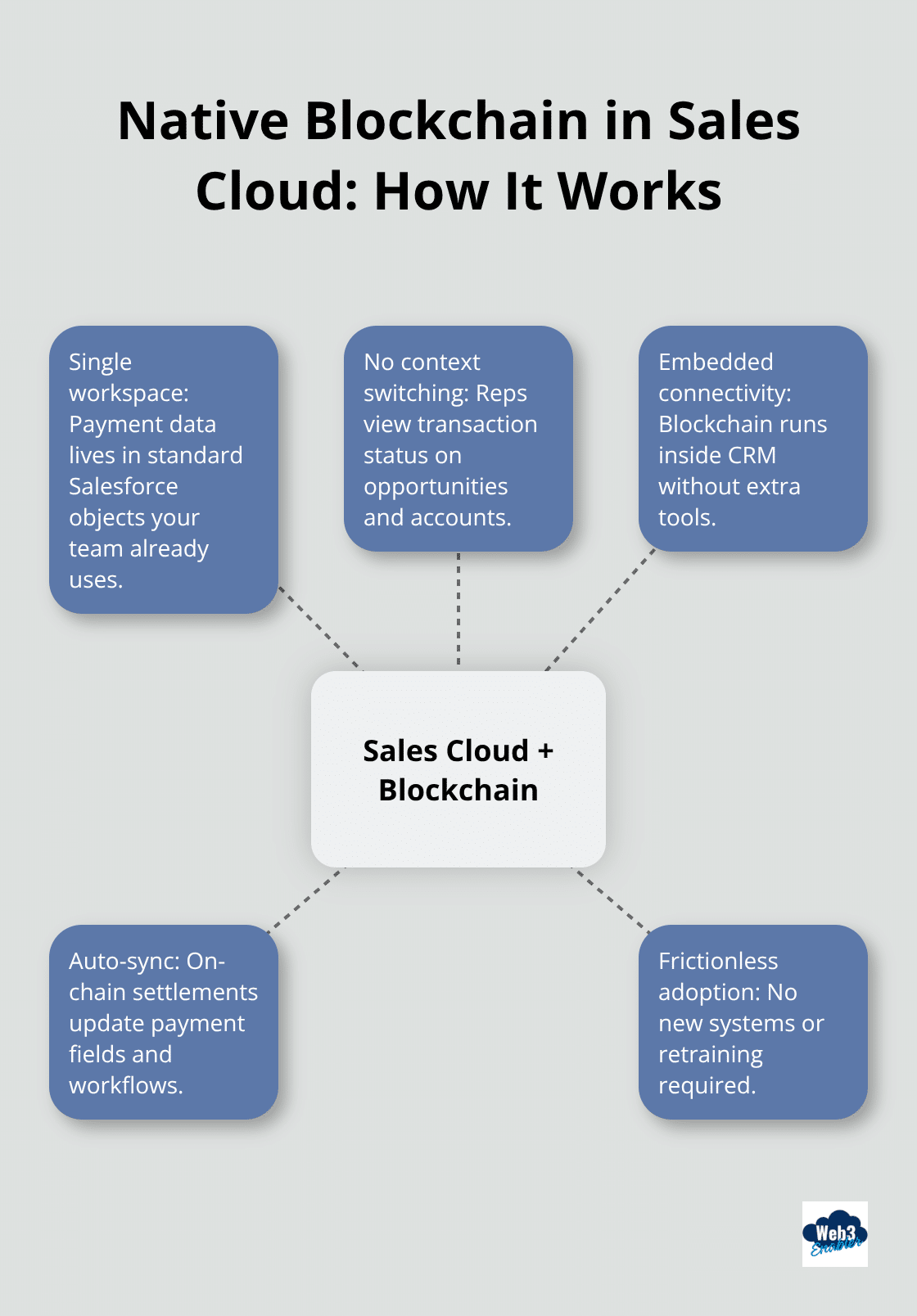
When a customer payment settles on-chain, that transaction automatically syncs back to your opportunity record, updating the payment status field and triggering any downstream workflows your team already configured. This native approach eliminates the friction that kills most payment modernization initiatives. Your team stops copying transaction data between systems, stops manually updating payment status, and stops relying on finance to tell them when deals actually close. The blockchain settlement happens, your CRM updates automatically, and your sales rep moves to the next opportunity.
Automatic Synchronization Replaces Manual Data Entry
Your current process likely involves your finance team receiving payment confirmation from the bank, logging into Sales Cloud, finding the correct opportunity record, and manually updating the payment status field. This manual step introduces delays and creates opportunities for data entry errors. With blockchain integrated natively into Salesforce, that manual step disappears entirely. When a stablecoin payment settles on the distributed ledger, the platform automatically captures the transaction details and maps them to your corresponding opportunity record based on contract reference or customer identifier. The payment amount, settlement timestamp, transaction hash, and all relevant blockchain data flow directly into standard Salesforce fields without requiring human intervention. Your sales forecast updates in real-time because closed deals reflect actual settlement rather than pending payment status. Your finance team gains immediate visibility into which deals have actually converted to cash, eliminating the reconciliation delays that plague traditional payment processing. Your sales compensation calculations trigger based on verified blockchain settlement rather than banking confirmations, meaning your top performers receive payment faster when they close deals.
Compliance Tracking Stays Within Salesforce
Compliance and audit requirements typically force organizations to maintain separate transaction logs outside their CRM, creating duplicate data and audit complexity. All blockchain transaction details record directly into your standard Salesforce objects, specifically the transaction history fields and custom objects your compliance team already monitors. Every stablecoin payment, every settlement confirmation, and every contract reference stores in Salesforce itself, accessible through your existing audit trails and governance workflows. Your compliance officer runs standard Salesforce reports to see complete payment histories, contract terms, and settlement proofs without accessing external blockchain explorers or maintaining separate audit databases. This consolidation reduces your compliance burden significantly. Salesforce’s native audit trail feature captures every change to transaction records, creating an immutable log of who viewed payment data, when they viewed it, and what actions they took. Your organization maintains single-source-of-truth auditability without managing multiple systems or training compliance staff on blockchain explorers. When regulators request proof of payment settlement or transaction history, you generate reports directly from Sales Cloud using tools your team already knows, demonstrating compliance without requiring specialized blockchain expertise.
Real-Time Visibility Transforms Deal Management
Your sales reps now track settlement status the moment a customer initiates payment, rather than waiting for finance to confirm receipt. This visibility extends beyond individual transactions to show patterns in customer payment behavior, settlement preferences, and timing-information that helps your team predict cash flow and adjust sales strategies accordingly. Your London office and Tokyo office see the same transaction status simultaneously, eliminating the coordination problems that plague traditional banking systems. Your compliance officer gains immediate audit trails without requesting reports from finance, and your sales reps stop chasing customers for payment confirmations because the blockchain provides cryptographic proof of settlement. This unified visibility means your entire organization operates from a single source of truth about what payments have actually settled and what remains pending.
Final Thoughts
Your sales organization now operates with blockchain capabilities that transform how you manage payments and close deals. Sales Cloud blockchain integration brings settlement verification, transaction transparency, and compliance tracking directly into the CRM your team uses every day, eliminating the need to switch between systems or wait for finance confirmations. Your sales reps see payment status in real-time, your compliance officer accesses complete audit trails instantly, and your entire organization operates from a single source of truth about which deals have actually closed.
The competitive advantage comes from speed and certainty that your competitors cannot match. While other teams still wait for banking confirmations and manage payment exceptions, you quote faster settlement terms and close deals with customers who demand immediate payment proof. Your sales forecast reflects actual blockchain settlement rather than pending status, your cash flow improves because stablecoin payments settle in minutes instead of days, and your global teams coordinate seamlessly without reconciliation friction. Your customer relationships strengthen because payment transparency replaces payment uncertainty, and your compliance burden shrinks because transaction records live in Salesforce itself rather than scattered across external systems.
Web3 Enabler makes this integration possible as a certified Salesforce ISV Partner, offering the only native blockchain platform on the Salesforce AppExchange that combines blockchain technology with Salesforce’s CRM and financial data layers. Your organization can accept and send stablecoin payments, streamline global settlements, and gain real-time visibility into on-chain transactions without leaving Sales Cloud, creating a unified environment where finance, compliance, and operations teams collaborate seamlessly.