


Revenue Cloud blockchain is reshaping how companies handle revenue recognition and settlement. Instead of waiting days for transactions to clear, you get real-time visibility and instant settlement across borders.
We at Web3 Enabler built Blockchain Payments for Salesforce to make this seamless. Your finance and operations teams can now automate the entire process while cutting costs and eliminating intermediaries.
How Blockchain Reshapes Revenue Recognition and Settlement
Real-Time Visibility Eliminates Settlement Delays
Blockchain fundamentally changes how your finance team sees revenue. Instead of waiting three to five days for bank transfers to clear, you gain real-time visibility the moment a transaction occurs. This matters because working capital locked in settlement delays costs money. According to the Future Is Onchain report by BCG with IBM contributions, institutions report improved capital efficiency and reduced reconciliation needs as on-chain capabilities expand. When you process revenue through blockchain, every transaction creates an immutable record that flows directly into your Revenue Cloud environment. Your accounting team stops chasing payment confirmations across email threads and spreadsheets. They see settled transactions in real time, which means your cash position stays accurate.
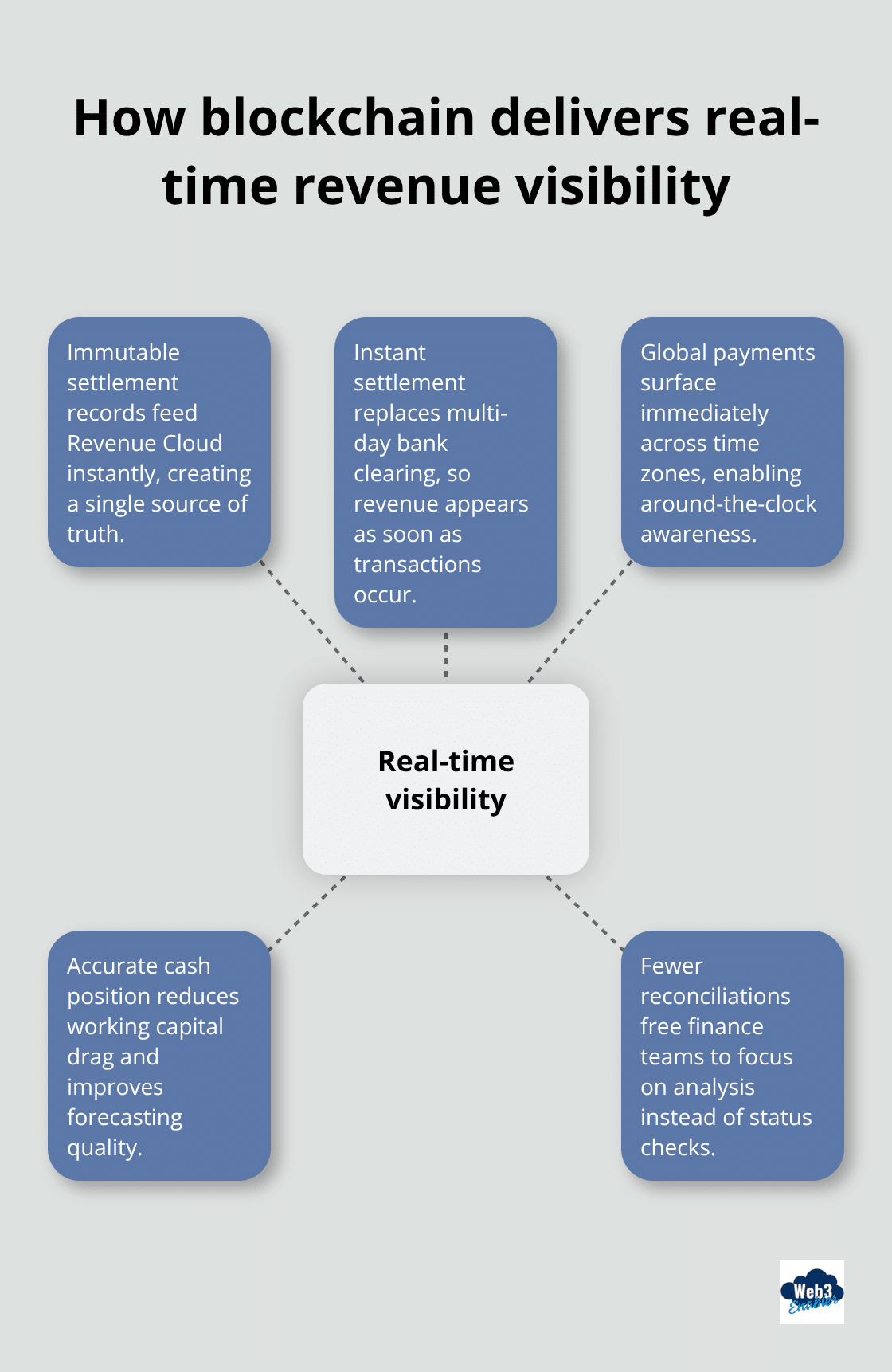
This visibility extends globally-if a customer in Singapore pays at 2 AM your time, you know about it instantly rather than waiting for morning reconciliation calls with your bank.
Automation Removes Manual Revenue Processes
Automating revenue recognition on blockchain eliminates manual intervention entirely. Traditional revenue processes require someone to match invoices with payments, then manually record the transaction in your GL. Blockchain removes that friction. When a payment hits your wallet, the transaction data automatically flows into Revenue Cloud, triggering recognition according to your revenue rules. This happens in seconds, not days. The immutable transaction records on blockchain also strengthen your audit trail. Regulators and external auditors see a complete, tamper-proof record of every revenue event with timestamps and cryptographic proof of settlement. This reduces audit friction significantly.
Accelerated Cash Conversion Across Borders
Your cash conversion cycle accelerates because settlement happens on-chain instantly rather than through banking rails. For global operations, this acceleration compounds. A company processing revenue across ten countries no longer juggles ten different settlement timelines and currency conversions. Stablecoin settlements eliminate forex volatility risk, so a dollar received today remains a dollar when it settles, not ninety-five cents. This stability matters for treasury planning and cash forecasting. Web3 Enabler built Blockchain Payments for Salesforce to make this integration native to your Revenue Cloud objects, so your finance team works within tools they already know rather than toggling between disconnected systems. Your next step involves understanding how these on-chain capabilities streamline your broader treasury operations and unlock new efficiencies in cross-border payment flows.
Streamlining Treasury Operations with On-Chain Settlements
Eliminating Intermediaries Cuts Costs and Accelerates Payments
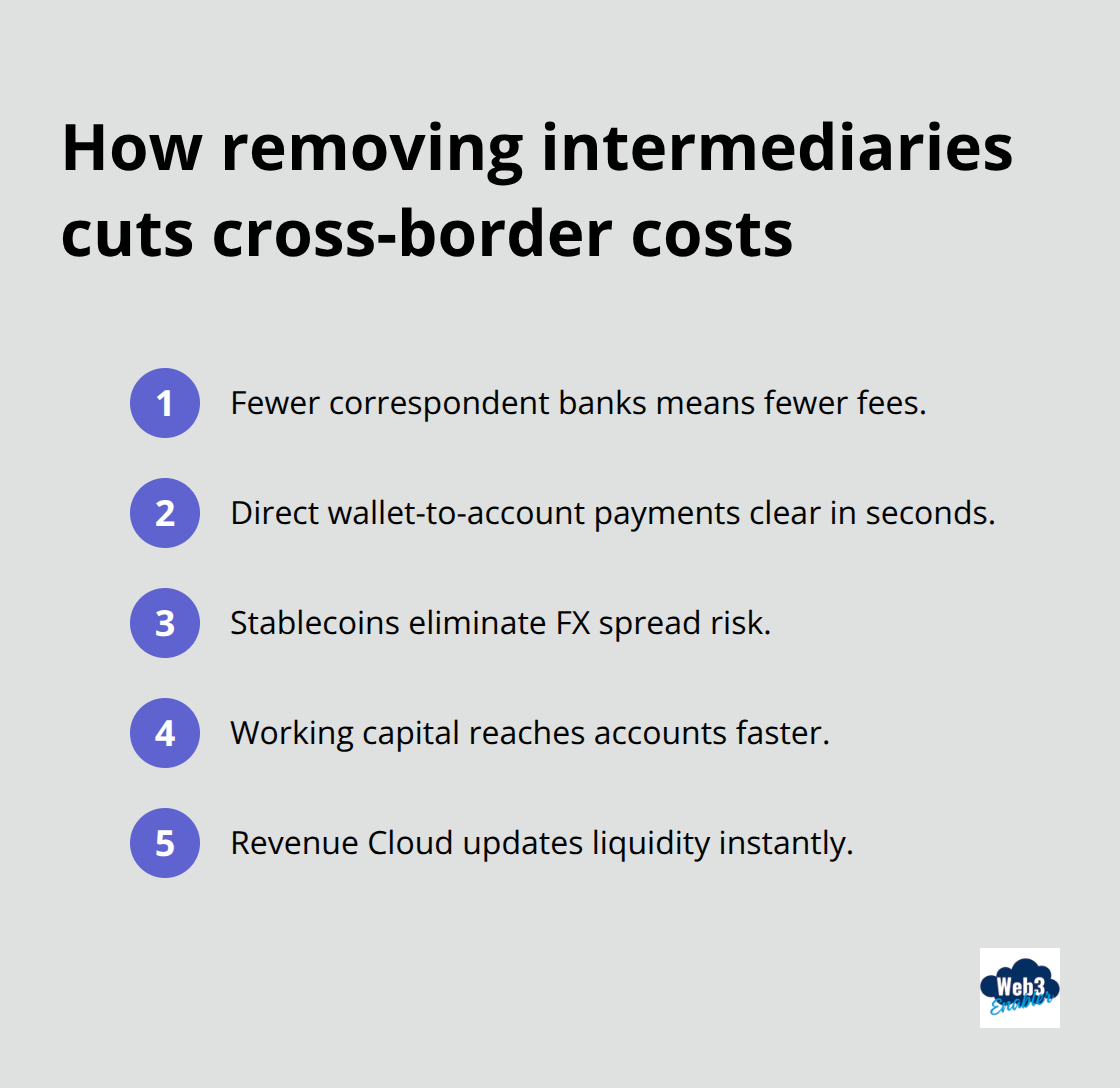
On-chain settlement removes the financial intermediaries that slow your treasury operations. Traditional cross-border payments route through correspondent banks, each extracting a fee and adding processing delays. When you settle revenue through blockchain, the payment moves directly from customer wallet to your company account in seconds, with no intermediaries taking cuts along the way. Blockchain settlement reduces infrastructure costs for financial institutions implementing these capabilities. For treasury teams managing global operations, this means your working capital reaches your account faster, eliminating the cash drag that comes from waiting three to five days for bank transfers. Your European subsidiary receives payment from a Middle Eastern customer-traditional banking adds currency conversion spreads, correspondent bank fees, and settlement delays. On-chain settlement with stablecoins eliminates that spread entirely and completes in minutes. Your cash position updates in Revenue Cloud immediately, giving your CFO accurate liquidity visibility for daily treasury decisions.
Stablecoins Provide Settlement Certainty
Stablecoins remove cryptocurrency price volatility from your settlement equation. A dollar received in USDC remains a dollar when it settles, not ninety cents. This stability lets your treasury team forecast cash flows with confidence rather than hedging against crypto swings. Your team stops worrying about whether a payment received today will lose value before it clears tomorrow. This certainty transforms how you plan working capital and manage liquidity across regions.
Real-Time Liquidity Visibility Transforms Treasury Planning
Treasury teams typically maintain manual spreadsheets tracking cash positions across bank accounts, payment processors, and regional subsidiaries. On-chain settlements feed transaction data directly into Revenue Cloud, creating a single source of truth for your global cash position. Your team sees every payment instantly as it settles, rather than waiting for bank statements or processor reports. This visibility eliminates reconciliation work entirely. When you settle revenue on-chain, the transaction record is immutable and timestamped, so your accounting team stops chasing confirmation emails and bank statements. The reconciliation that traditionally takes hours happens automatically through native Salesforce objects. Your finance team moves from reactive reconciliation to proactive liquidity management, knowing your exact cash position across every geography in real time. This accuracy improves working capital efficiency significantly. Companies that implement on-chain settlement report faster cash conversion cycles because they stop holding excess reserves to cover the uncertainty of settlement timing. Your liquidity becomes more predictable, which means you can invest idle cash more confidently or reduce short-term borrowing costs. Blockchain Payments for Salesforce integrates directly into Revenue Cloud, so your treasury and accounting teams work within tools they already know rather than toggling between disconnected systems for settlement visibility and reconciliation.
Automation Handles Reconciliation Without Manual Intervention
Your accounting team no longer chases payment confirmations across email threads and spreadsheets. When a payment settles on-chain, the transaction data automatically flows into Revenue Cloud, triggering your reconciliation rules without human intervention. This automation removes errors that creep into manual processes and frees your team to focus on strategic treasury decisions rather than administrative work. The immutable records on blockchain also strengthen your audit trail significantly. Regulators and external auditors see a complete, tamper-proof record of every settlement event with timestamps and cryptographic proof. This reduces audit friction and accelerates your external assurance processes.
Your next step involves understanding how these on-chain capabilities integrate directly into your Revenue Cloud workflow, allowing your finance and operations teams to automate the entire revenue process while maintaining full compliance and control.
Integrating Blockchain Payments into Your Revenue Cloud Workflow
Native Salesforce Objects Track On-Chain Transactions
Your Revenue Cloud environment already tracks every revenue event, customer payment, and billing detail. Blockchain Payments for Salesforce extends that native capability directly into on-chain settlement, so your finance team stops toggling between disconnected systems. When a customer payment settles on-chain through stablecoins, the transaction data flows automatically into your Revenue Cloud objects without manual intervention. Your revenue recognition rules trigger instantly based on the immutable settlement record, so revenue hits your books the moment the blockchain confirms the transaction.
This integration matters because your accounting team works within Salesforce-the system they already know-rather than learning new tools or managing separate ledgers. The transaction appears in your standard revenue objects with full auditability, timestamps, and cryptographic proof of settlement. Your GL updates automatically, your revenue recognition follows your configured rules, and your audit trail contains tamper-proof evidence of every step.
Compliance Reporting Strengthens Through Immutable Records
For companies processing revenue across multiple regions, this native integration eliminates the reconciliation bottleneck entirely. A customer in London pays in USDC, the payment settles instantly on-chain, Revenue Cloud recognizes the revenue according to your ASC 606 policies, and your accounting team sees the transaction in their standard Salesforce workflow. No manual matching, no email confirmations, no three-day settlement delays.
Your compliance reporting also strengthens because every on-chain transaction creates an immutable record that flows directly into your reporting objects. When auditors request revenue settlement evidence, you show them timestamped, cryptographically signed blockchain records tied directly to your GL entries. This eliminates the manual document collection that typically slows audit processes.
Unified Finance and Operations Eliminate System Silos
A unified finance and operations environment means your teams stop managing revenue, treasury, and settlement through separate systems. When on-chain payments integrate natively into Revenue Cloud, your finance team gains real-time visibility into which customers have paid, which payments settled, and what your current cash position looks like across all geographies. Your operations team automates settlement workflows without engineering involvement-your Salesforce administrator configures the payment flows within Revenue Cloud, and blockchain handles the execution.
Your treasury team manages liquidity based on actual, settled cash rather than pending transactions and bank forecasts. This unified approach transforms how your company operates. Instead of your CFO waiting for morning bank statements to understand yesterday’s cash position, they log into Revenue Cloud and see real-time settled transactions across every region.
Automation Reduces Reconciliation Overhead at Scale
Your accounting team stops spending hours on reconciliation and focuses on strategic financial planning. Your operations team automates what used to require manual intervention. This efficiency compounds as your transaction volume grows. A company processing fifty global transactions daily through traditional banking requires significant reconciliation effort. The same fifty transactions settling on-chain through Blockchain Payments for Salesforce require zero reconciliation because the immutable settlement record matches your GL automatically.

As you scale revenue operations internationally, this automation becomes your competitive advantage-your team operates with less headcount overhead while maintaining tighter financial controls than competitors still managing manual processes. Your Salesforce administrator configures the payment flows, your blockchain infrastructure handles execution, and your accounting team focuses on strategic decisions rather than administrative work.
Final Thoughts
Revenue Cloud blockchain transforms how your finance team operates by eliminating settlement delays and replacing manual reconciliation with automated processes. Your accounting team stops chasing payment confirmations across email threads while your treasury operations accelerate across borders without intermediary costs or currency conversion spreads. These structural shifts compound as your transaction volume grows, giving your CFO accurate liquidity visibility instead of relying on forecasts and bank statements.
Early adoption creates competitive advantage because your team operates with less overhead while maintaining tighter controls than competitors still managing manual processes. Your Salesforce administrator configures payment flows within Revenue Cloud using native objects, and your customers pay in stablecoins that eliminate forex volatility from your settlement equation. The blockchain infrastructure handles execution automatically, so you gain real-time visibility and faster cash conversion without rebuilding your finance operations from scratch.
Web3 Enabler brings blockchain-powered payments directly into your Revenue Cloud environment, making this transition seamless for your team. Your organization gains instant settlement, automated reconciliation, and real-time liquidity visibility without leaving Salesforce, positioning you to lead as on-chain revenue becomes standard across your industry.