
Blockchain integration with Salesforce CRM is revolutionizing how businesses manage customer relationships and data. At Web3 Enabler, we’ve seen firsthand how this powerful combination enhances security, transparency, and efficiency.
This guide will walk you through the process of seamlessly integrating blockchain into your Salesforce CRM, from understanding the benefits to overcoming common challenges. Get ready to transform your customer relationship management and stay ahead in the digital age.
Why Blockchain Matters for Salesforce Users
Enhancing Data Integrity and Trust
Blockchain technology transforms how businesses handle data, and its integration with Salesforce CRM changes the game. At its core, blockchain functions as a decentralized, immutable ledger that records transactions across a network of computers. For Salesforce users, this translates to improved security, transparency, and efficiency in managing customer data and interactions.
The integration of blockchain into Salesforce CRM significantly improves data integrity. Each transaction recorded on the blockchain receives a time-stamp and cryptographic security, making alterations or deletions nearly impossible. This level of data immutability proves crucial for industries dealing with sensitive information or complex supply chains.
A pharmaceutical company using Salesforce with blockchain integration can track a drug’s entire lifecycle (from manufacturing to distribution). This transparency not only helps maintain regulatory compliance but also builds trust with customers and partners.
Streamlining Processes with Smart Contracts
Smart contracts represent another powerful feature of blockchain integration. These self-executing contracts with predefined rules automate various processes within Salesforce.
Picture a sales process where contract terms, pricing, and delivery schedules execute and update automatically in Salesforce once certain conditions are met. This not only accelerates transactions but also minimizes the risk of errors and disputes.
Improving Customer Experience
Blockchain integration can significantly enhance the customer experience by providing a single, reliable source of truth. In the insurance industry, for example, claims processing becomes more efficient by storing policy information and claim history on the blockchain. This allows for faster verification and payout, leading to higher customer satisfaction.
Real-World Applications
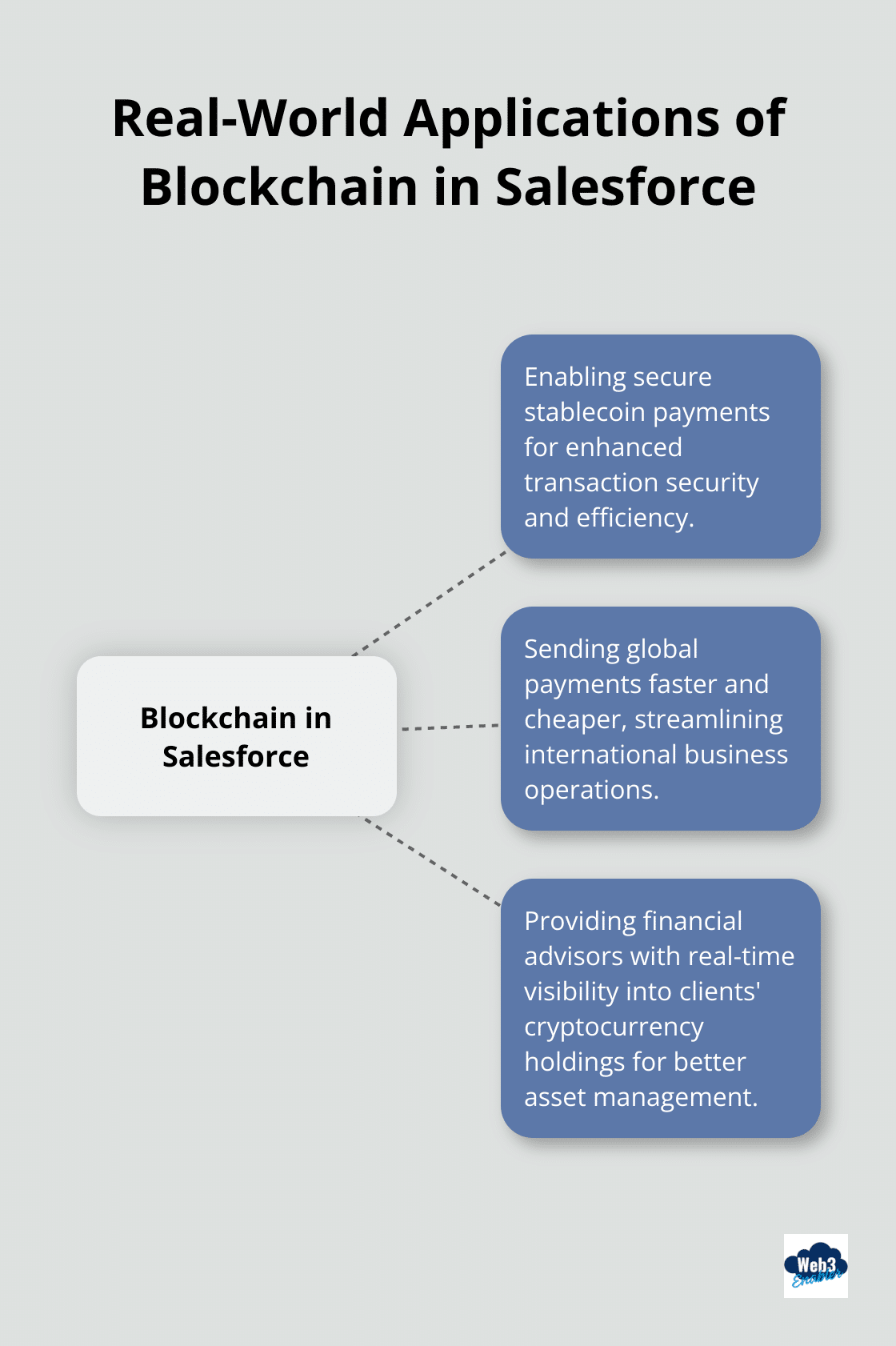
The possibilities for blockchain integration with Salesforce are vast and impactful. Some real-world applications include:
- Enabling secure stablecoin payments
- Sending global payments faster and cheaper
- Providing financial advisors with real-time visibility into clients’ cryptocurrency holdings
These applications demonstrate how blockchain integration with Salesforce not only improves internal processes but also opens up new business opportunities and revenue streams.
As we move forward, it’s clear that blockchain integration with Salesforce represents a fundamental shift in how businesses manage relationships and data. The next step involves understanding how to implement this powerful technology in your own Salesforce environment. Let’s explore the steps to integrate blockchain into Salesforce and unlock its full potential for your business.
How to Integrate Blockchain into Salesforce
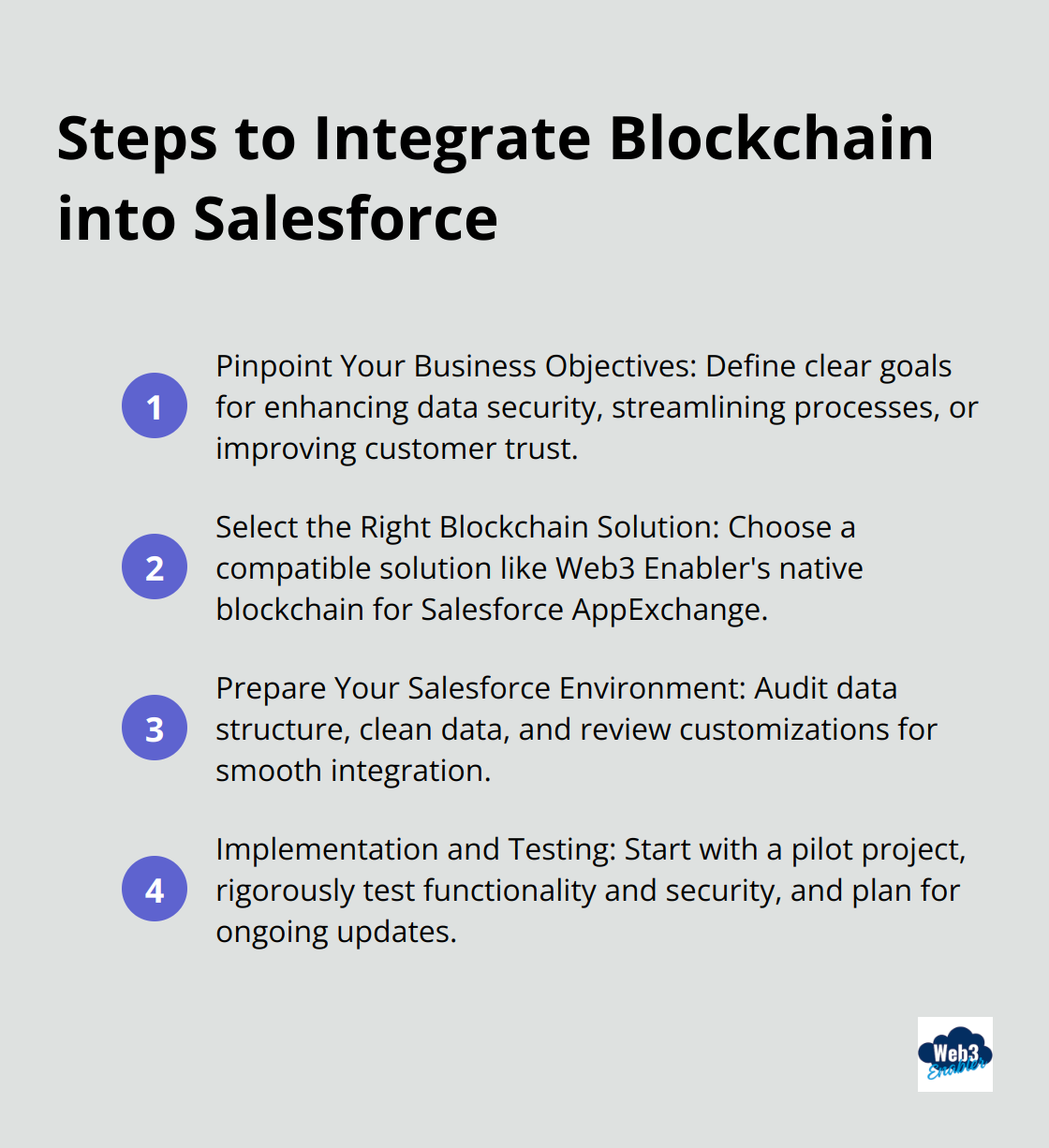
Pinpoint Your Business Objectives
The integration of blockchain into Salesforce starts with a clear definition of your business goals. Do you want to enhance data security? Streamline supply chain management? Improve customer trust? Your specific objectives will shape the entire integration process.
A financial services firm might prioritize secure transaction logging, while a manufacturer might focus on supply chain transparency. Specificity in your goals will guide your choice of blockchain solution and integration strategy.
Select the Right Blockchain Solution
The selection of an appropriate blockchain solution for your Salesforce integration is a critical decision. Several options exist, but Web3 Enabler offers the only native blockchain solution on the Salesforce AppExchange. This native integration ensures seamless compatibility and reduces implementation complexities.
When you evaluate solutions, consider factors like scalability, security features, and compatibility with your existing Salesforce setup. Don’t limit your assessment to the technology alone – examine the provider’s track record and support services. A solution backed by robust support can significantly impact your integration journey.
Prepare Your Salesforce Environment
The preparation of your Salesforce environment is a step that many underestimate. Start with an audit of your current data structure and processes. Identify which data you will move to the blockchain and how this will affect your existing workflows.
Clean your data before migration (inconsistent or duplicate data can cause issues during integration). Use Salesforce’s built-in data management tools to standardize and deduplicate your data.
Review your Salesforce customizations as well. Some may require adjustments to work effectively with blockchain. This presents an excellent opportunity to streamline your Salesforce setup, removing unnecessary complexity that could hinder integration.
Implementation and Testing
The implementation phase brings theory into practice. Start with a pilot project that focuses on a specific use case. This approach allows you to test the integration in a controlled environment and make necessary adjustments before full-scale deployment.
During implementation, pay close attention to how blockchain interacts with your existing Salesforce processes. Do smart contracts execute as expected? Does data flow smoothly between Salesforce and the blockchain?
Rigorous testing is essential. Test not just for functionality, but also for performance under various load conditions. Security testing is particularly important – ensure that the integration doesn’t create new vulnerabilities in your system.
The integration of blockchain into Salesforce is not a one-time event but an ongoing process. Plan for regular reviews and updates to keep your integrated system aligned with evolving business needs and technological advancements.
As you move forward with your blockchain integration, you’ll likely encounter various challenges. In the next section, we’ll explore common hurdles in blockchain-Salesforce integration and provide strategies to overcome them.
Navigating Blockchain-Salesforce Integration Hurdles
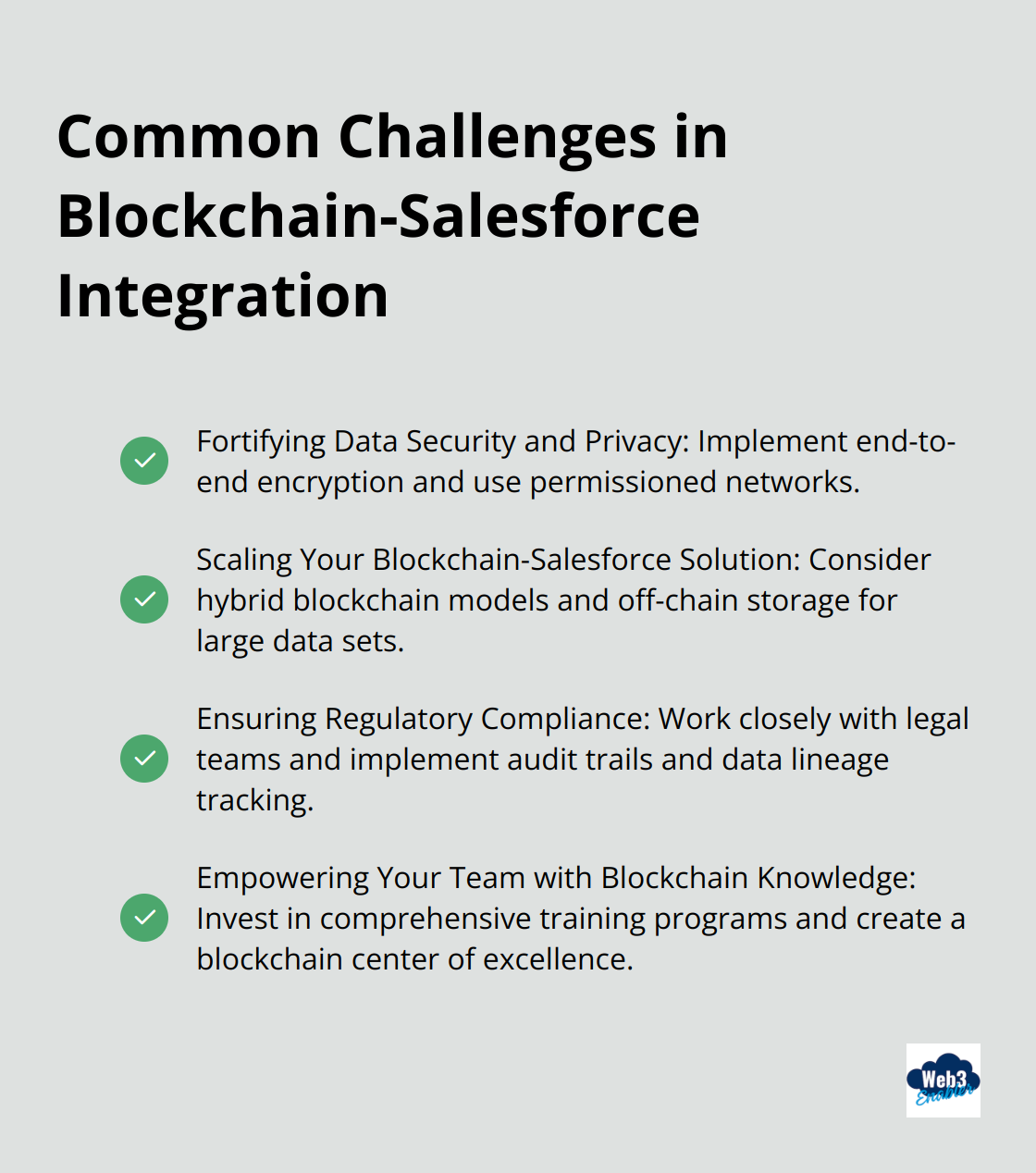
Fortifying Data Security and Privacy
Data security takes center stage when integrating blockchain with Salesforce CRM. While blockchain enhances security through its immutable nature, the integration points between blockchain and Salesforce can become vulnerable.
To address this, implement end-to-end encryption for data in transit between Salesforce and the blockchain network. Use Salesforce Shield for an extra layer of security, encrypting sensitive data at rest.
For privacy concerns, use blockchain’s permissioned networks. These networks allow you to control who can access and validate transactions, ensuring that sensitive customer data remains confidential.
Overcome privacy concerns by clearly defining which data goes on the blockchain and which stays in Salesforce (ensuring compliance with data protection regulations).
Scaling Your Blockchain-Salesforce Solution
Scalability becomes a critical consideration as your blockchain-integrated Salesforce system grows. Traditional blockchain networks can struggle with high transaction volumes, potentially slowing down your CRM processes.
To manage this, consider implementing a hybrid blockchain model. This approach combines the security of a public blockchain with the scalability of a private one. You could use a private blockchain for day-to-day transactions and periodically anchor this data to a public blockchain for added security.
Another effective strategy involves using off-chain storage for large data sets. Store only the hash of the data on the blockchain, with the full data securely stored off-chain. This significantly reduces blockchain bloat and improves performance.
Ensuring Regulatory Compliance
Regulatory compliance presents a moving target in the blockchain world. Different jurisdictions have varying regulations regarding blockchain use, especially in sectors like finance and healthcare.
Stay ahead of the curve by working closely with your legal team to understand the regulatory landscape. Implement features like audit trails and data lineage tracking within your integrated system to demonstrate compliance.
For financial services firms, consider solutions that already comply with regulations like KYC and AML. Web3 Enabler’s native blockchain solution for Salesforce, for example, is designed with these compliance requirements in mind.
Empowering Your Team with Blockchain Knowledge
The success of your blockchain-Salesforce integration heavily depends on your team’s understanding of the technology.
Invest in comprehensive training programs for your team. This should cover not just the technical aspects of blockchain, but also its business implications. Try partnering with blockchain education providers or leveraging online courses from platforms like Coursera or edX.
Create a blockchain center of excellence within your organization. This team can serve as internal consultants, helping different departments understand how blockchain can solve their specific challenges within the Salesforce ecosystem.
Final Thoughts
Blockchain integration with Salesforce CRM revolutionizes customer relationship management and data handling. This powerful combination enhances security, transparency, and efficiency across various industries. It improves data integrity, streamlines processes with smart contracts, and elevates customer experiences to new heights.
The journey to successful integration requires careful planning and execution. It involves selecting the right blockchain solution, preparing your Salesforce environment, and addressing challenges such as data security and regulatory compliance. As more businesses recognize the potential of this technology, we expect to see innovative applications emerge across industries.
Web3 Enabler offers comprehensive solutions tailored to the Salesforce ecosystem. We empower organizations to leverage blockchain technology for secure payments, improved compliance, and streamlined automation. Take the first step today and transform your approach to customer relationship management in the digital age.