



Digital assets taxation has become increasingly complex as crypto investments gain mainstream adoption. The IRS treats different digital assets with varying rules that can significantly impact your tax liability.
We at Web3 Enabler see investors struggling with compliance requirements and missing optimization opportunities. This guide breaks down the essential tax strategies every digital asset investor needs to know.
How Are Your Digital Assets Actually Taxed?
The IRS classifies digital assets as property, not currency, which creates specific tax obligations that many investors misunderstand. When you sell Bitcoin for $50,000 that you bought for $30,000, you owe capital gains tax on the $20,000 profit. The IRS requires you to report every transaction, including purchases with crypto or payments received in digital assets.
Every Trade Triggers Tax Consequences
Trading one cryptocurrency for another triggers a taxable event – you cannot defer taxes through crypto-to-crypto swaps. When you exchange Ethereum for Bitcoin, the IRS treats this as selling your Ethereum at fair market value and purchasing Bitcoin. This rule catches many investors off guard who assume only cash sales create tax liability.
Capital Gains Rates Depend on Your Timeline
Your holding period determines your tax rate and can save you thousands. Assets held over one year qualify for long-term capital gains rates of 0%, 15%, or 20% based on your income bracket. Short-term holdings face ordinary income tax rates up to 37%. A $100,000 gain taxed as short-term could cost $37,000, while the same long-term gain might only cost $15,000 for most investors (depending on your tax bracket).
Mining and Staking Create Dual Tax Events
Mining and staking rewards get taxed as ordinary income when you receive them, then generate capital gains or losses when you sell. If you mine Bitcoin worth $40,000 and later sell it for $45,000, you pay ordinary income tax on the initial $40,000 and capital gains tax on the $5,000 appreciation.
New Reporting Requirements Change Everything
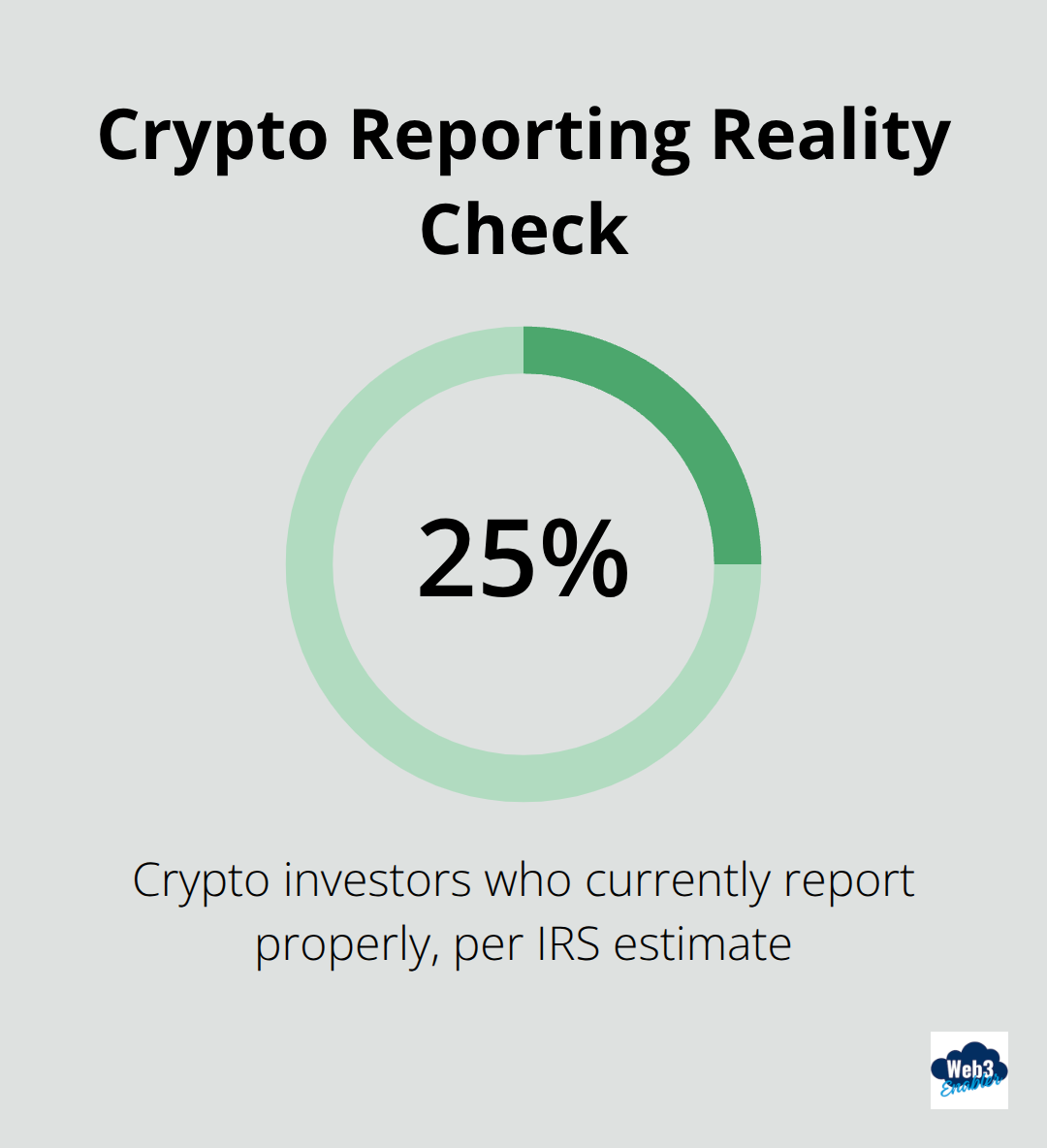
Starting in 2025, exchanges must report crypto transactions on Form 1099-DA, similar to stock brokers. The IRS estimates only 25% of crypto investors currently report properly, but this new requirement makes tax evasion nearly impossible. Exchanges will report gross proceeds but not cost basis until 2026, leaving you responsible for accurate record-keeping. DeFi transactions remain unreported by third parties, making detailed documentation essential for your next tax filing season.
What Records Do You Need for Crypto Tax Compliance?
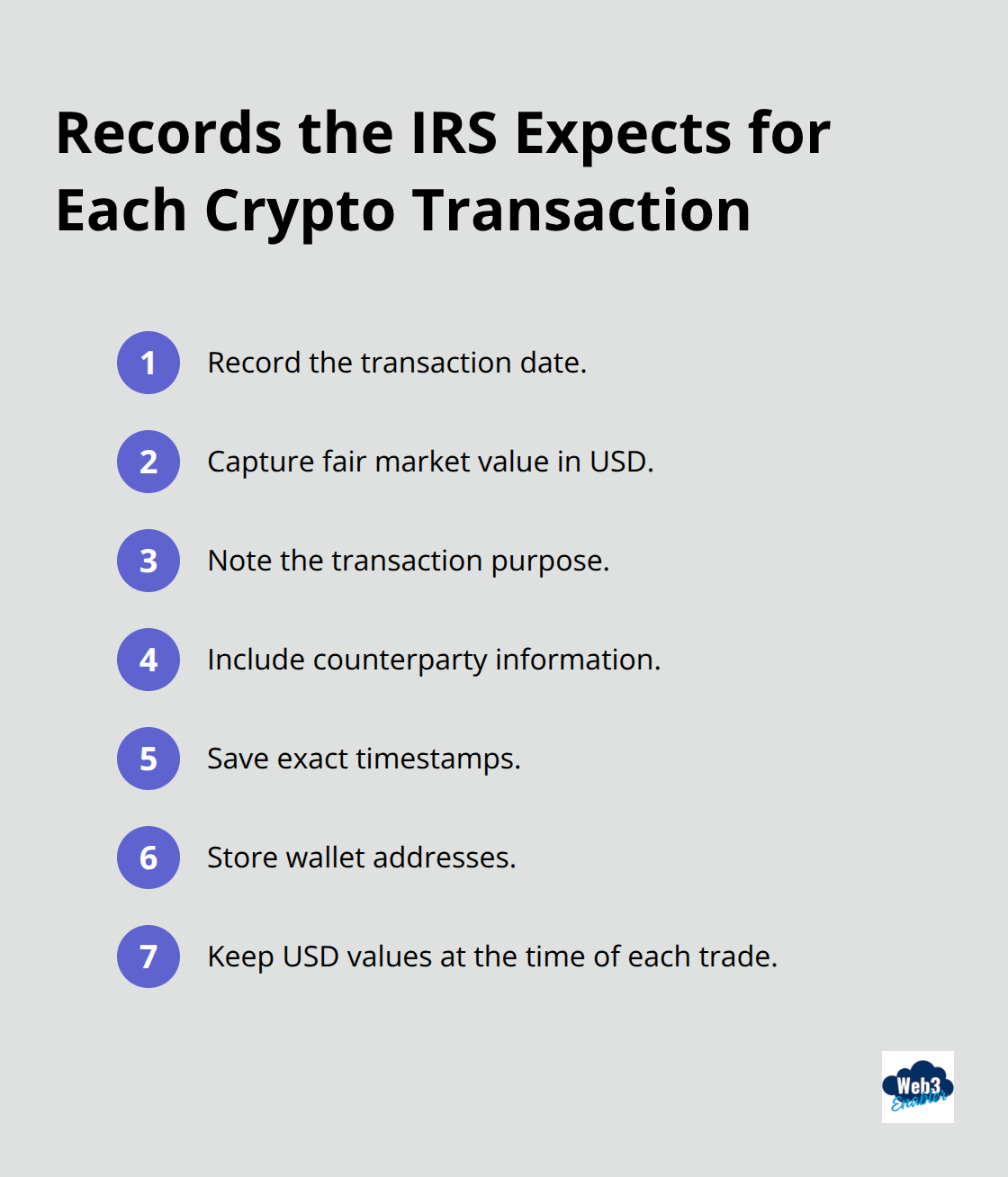
Proper documentation separates smooth tax filings from IRS audits. The IRS demands detailed records for every digital asset transaction, including the date, fair market value in USD, transaction purpose, and counterparty information. Your exchange statements alone won’t meet these requirements – you need transaction-level documentation that shows exact timestamps, wallet addresses, and USD values at the time of each trade.
Most investors underestimate this requirement and face significant penalties when the IRS questions undocumented transactions.
Document Every Transaction From Your First Purchase
Your cost basis calculation determines your entire tax liability, which makes accurate records essential from day one. The FIFO method that most investors use can create higher tax bills compared to specific identification methods, but you must choose your method consistently across all transactions.
When you receive crypto through mining, staking, or payments, record the fair market value immediately – this becomes your cost basis for future sales. The new Form 1099-DA reports (starting in 2025) will only show gross proceeds, which leaves cost basis calculations entirely in your hands.
Exchanges like Coinbase and Kraken provide transaction history, but you bear responsibility for records from all platforms, including DeFi protocols that don’t report to the IRS. Document wallet-to-wallet transfers between your own accounts to avoid double taxation, and keep records of any crypto used for purchases since these trigger taxable events at fair market value.
File Forms 8949 and Schedule D Before April Deadline
Your crypto transactions require specific tax forms beyond your standard 1040. Form 8949 captures individual transaction details while Schedule D summarizes your total capital gains and losses. The IRS expects these forms by April 15th, with extensions available until October 15th if you pay estimated taxes owed.
Starting in 2026, you’ll receive Form 1099-DA by February 17th for the previous tax year, but you still need complete records for accurate reports. Keep documentation for at least three years after you file (though the IRS recommends seven years for significant transactions).
These record requirements set the foundation for smart tax strategies that can significantly reduce your crypto tax burden.
How Can You Minimize Your Crypto Tax Bill
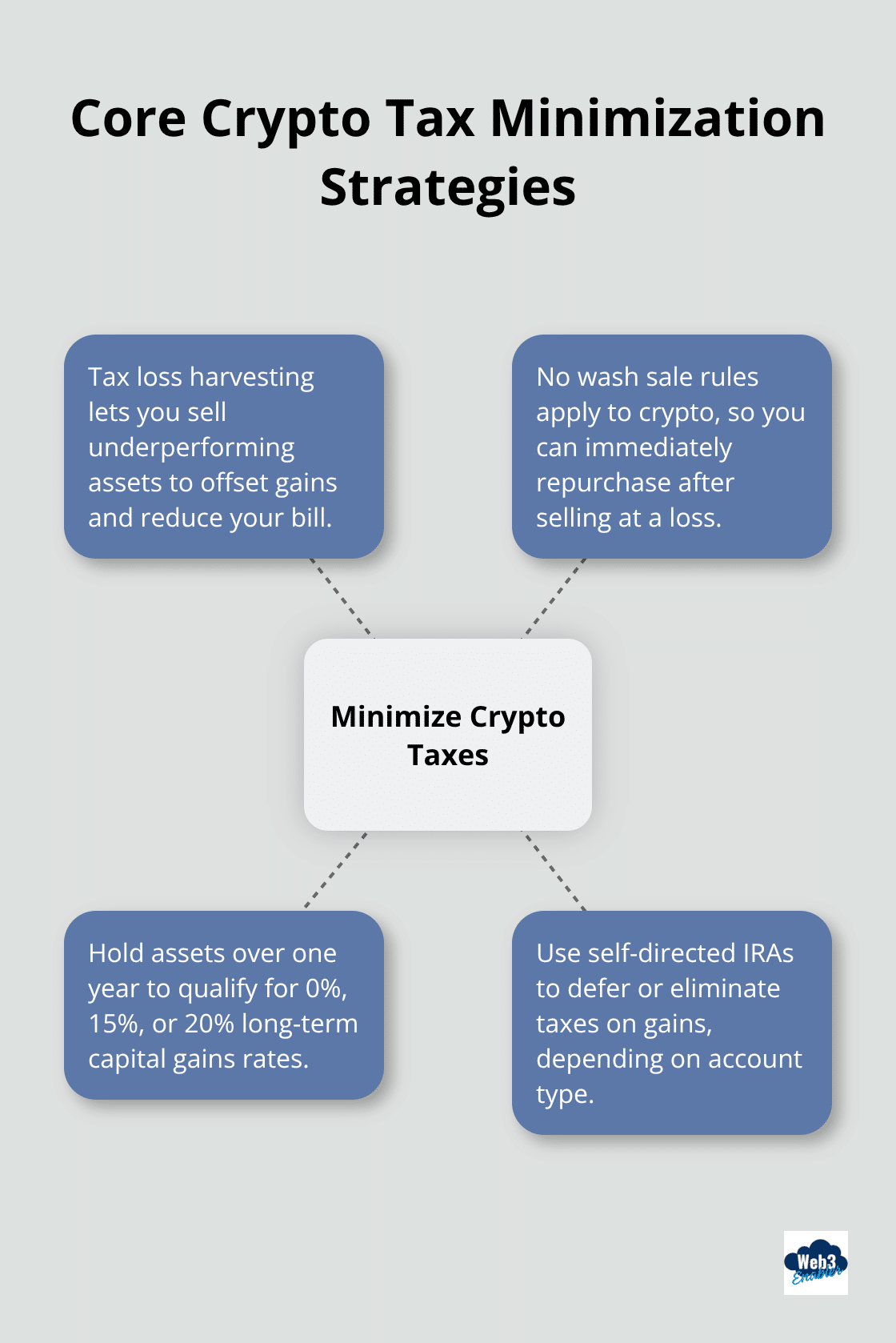
Smart tax strategies save crypto investors thousands annually, but timing and method selection matter more than most realize. Tax loss harvesting stands as your most powerful tool – you sell underperforming assets to offset gains from profitable trades. Unlike stocks, crypto has no wash sale rules, which means you can immediately repurchase the same asset after you sell for a loss. This creates unique opportunities to capture losses while you maintain your position.
Harvest Losses Without Wash Sale Restrictions
Crypto investors enjoy significant advantages over traditional stock traders. You can sell Bitcoin at a loss on Monday and repurchase it Tuesday without triggering wash sale rules that would disallow the tax deduction. This flexibility allows aggressive tax planning – you sell positions with unrealized losses before year-end to offset your trading gains.
A $50,000 loss can offset $50,000 in gains, plus you can deduct an additional $3,000 against ordinary income annually. Excess losses carry forward indefinitely (creating future tax benefits). The key lies in timing these sales strategically while you maintain your desired crypto allocation.
Hold Assets Over One Year for Dramatic Tax Savings
The difference between short-term and long-term capital gains rates creates massive planning opportunities. A $100,000 gain held 11 months faces up to 37% ordinary income tax rates, costing $37,000. The same gain held 13 months qualifies for long-term rates of 0%, 15%, or 20% based on your income bracket.
Most investors pay 15% long-term rates, reducing that $100,000 gain tax to $15,000 – a $22,000 savings for waiting two additional months. Plan your exit strategies around these holding periods, especially for large positions approaching the one-year mark.
Use Retirement Accounts for Tax-Free Growth
Self-directed IRAs allow crypto investments with powerful tax advantages that most investors ignore. Traditional IRAs defer all taxes until retirement distributions, while Roth IRAs eliminate taxes on gains entirely. A $10,000 Roth IRA crypto investment that grows to $100,000 generates zero tax liability at withdrawal after age 59½.
This strategy works best for long-term believers in crypto adoption who can wait decades for distributions. Some providers like iTrustCapital specialize in crypto IRAs, though setup requires careful selection of qualified custodians and approved assets (with specific compliance requirements for each provider).
Final Thoughts
Digital assets taxation demands proactive planning and meticulous record-keeping to avoid costly mistakes. The new 2025 reporting requirements through Form 1099-DA mark a turning point where proper compliance becomes non-negotiable. Smart investors who implement tax loss harvesting, optimize their holding periods, and maintain detailed transaction records will significantly outperform those who treat crypto taxes as an afterthought.
Professional tax guidance becomes essential as regulations evolve rapidly. The IRS continues to refine digital asset rules, and you must stay current with these changes to protect yourself from penalties while you maximize tax efficiency. Consider working with tax professionals who specialize in cryptocurrency to navigate complex scenarios like DeFi transactions, staking rewards, and cross-chain transfers.
For businesses that manage digital asset operations, platforms like Web3 Enabler provide integrated solutions that streamline compliance and reporting within existing Salesforce workflows. As institutional adoption accelerates, proper systems for tracking and reporting digital asset transactions become a competitive advantage that supports both tax compliance and operational efficiency. The complexity of digital assets taxation will only increase as the market matures (making early preparation your best investment strategy).