


Financial institutions managing digital assets face a critical gap: their existing systems weren’t built for tokens, blockchain transactions, or modern custody workflows. Salesforce Financial Services Cloud closes this gap by bringing token management, compliance controls, and audit trails into a single platform.
We at Web3 Enabler have seen firsthand how this integration transforms operations. Your team can now track wallet balances, verify KYC/AML requirements, and maintain complete transaction records without switching between disconnected tools.
Seeing Your Clients’ Digital Assets in Real Time
Financial institutions need to see what their clients actually own across blockchain networks, and that visibility must happen inside Salesforce-not in a separate wallet tracker or blockchain explorer. Advisors can view client token holdings, wallet balances, and transaction history without leaving the CRM. The Digital Asset Wallet for Salesforce Financial Services Cloud pulls live on-chain movements into your Salesforce data objects, meaning portfolio dashboards update in real time as clients buy, sell, or transfer tokens. This matters because advisors at firms like RBC Wealth Management have reported transformed workflows when they can see crypto assets alongside traditional investments during client meetings. Your team stops manually checking external blockchain explorers and stops asking clients what they hold-the system shows you exactly what’s in their wallets and what it’s worth right now.
Real-Time Portfolio Reconciliation Without Manual Work
Reconciling on-chain transactions against client records used to require hours of manual checking. Your operations team would pull data from blockchain explorers, cross-reference wallet addresses, match transaction hashes to client accounts, and hunt for discrepancies. Automated reconciliation inside Salesforce eliminates this work entirely. When a client’s wallet receives a token transfer, the transaction syncs directly into Financial Services Cloud and matches against the client’s holdings record. If a discrepancy occurs (a missing transaction, a failed transfer, or a duplicate record), the system flags it automatically instead of waiting for someone to spot it in a spreadsheet. This reduces reconciliation time significantly and removes the window where transaction errors go unnoticed.
Unified Compliance Data Across All Transactions
Your compliance team now accesses the same real-time asset visibility your advisors see, so KYC records, transaction monitoring, and audit trails all stay synchronized without manual intervention. Compliance officers can track every token movement tied to a specific client account and verify that holdings match approved investment mandates. This synchronization prevents the common scenario where advisors see updated wallet balances but compliance teams work from stale records. The single source of truth eliminates reconciliation delays and strengthens your ability to respond quickly to regulatory inquiries.
Multi-Blockchain Tracking in a Single Platform
Most financial institutions now work with clients holding assets across Ethereum, Solana, Polygon, and other chains. Managing these separately means managing multiple systems. Web3 Enabler consolidates wallet data from multiple blockchain networks into unified client records within Financial Services Cloud. A single advisor can see that one client holds USDC on Ethereum, SOL on Solana, and USDC on Polygon-all in one place, all with current balances and transaction history. This unified view eliminates the operational friction of switching between chain explorers and reduces the risk of missing assets during account reviews or compliance checks. Your reporting becomes more accurate because you work from a single source of truth instead of aggregating data from multiple external sources.
Moving From Visibility to Verification
Real-time asset visibility sets the foundation, but your institution also needs to verify that clients actually own what the system shows. This verification step connects directly to your KYC and AML workflows, which we address in the next section on compliance controls.
Compliance Controls That Actually Work Inside Salesforce
Your institution cannot manage digital assets without controlling who accesses them and proving every transaction happened the way your records show. Salesforce Financial Services Cloud provides native compliance infrastructure built directly into the CRM, so your custody workflows, audit trails, and access controls exist in the same system where advisors manage client relationships. This eliminates the fragmentation that creates compliance risk: your custody data no longer lives in a separate system that compliance teams struggle to reconcile against client records.
Automated KYC and AML Verification at Every Transaction
KYC and AML verification workflows start at client onboarding and continue throughout the asset lifecycle. When a client initiates a token purchase or transfer, Financial Services Cloud triggers automated KYC checks against your internal data and external verification providers before the transaction executes. A client wanting to move USDC from a custodial wallet needs verification that their identity matches their account records and that their transaction aligns with their approved investment mandate. Salesforce enforces this automatically: if a client’s KYC status is incomplete or if the transaction amount exceeds their approved limits, the system blocks the action and routes it to your compliance team for review. This straight-through processing for low-risk transactions eliminates manual approval bottlenecks while catching higher-risk activity immediately.
Your compliance team no longer reviews every token transaction manually; instead, they focus on exceptions flagged by configured rules. Transaction monitoring runs continuously against your rule set, so if a client suddenly moves ten times their normal transaction volume or transfers assets to a new wallet address, the system alerts your compliance team automatically rather than waiting for a monthly review. Salesforce eliminates this friction by automating routine checks and letting your team focus on genuine risk assessment.
Immutable Audit Trails for Every Custody Action
Audit trails within Financial Services Cloud create an immutable record of every custody action. When a client’s token balance updates, when a transaction receives approval, when an advisor views a client’s wallet, or when compliance modifies a client’s KYC status, Salesforce logs the action with a timestamp, the user who performed it, and the specific change made. This granularity matters during regulatory examinations. When the SEC or FINRA asks your institution to prove that you monitored a specific client’s activity on a particular date, you can retrieve the exact record from Salesforce showing what happened, who authorized it, and whether it violated your policies.
Compliance officers generate audit reports directly from Financial Services Cloud without reconstructing data from multiple systems or relying on manual logs. The system maintains complete traceability for every custody decision, transaction approval, and compliance action. Your institution demonstrates regulatory compliance through native Salesforce objects and automation rather than through fragmented spreadsheets and external audit logs.
Role-Based Access Controls Enforce Custody Boundaries
Role-based access controls ensure that only authorized team members can view or modify custody data. An operations specialist might see client wallet balances and transaction history but lacks permission to approve large transfers. An advisor sees enough information to advise clients on their token positions but cannot initiate custody actions. A compliance officer accesses all custody records and modifies KYC status but cannot execute transactions. These permissions are enforced at the field level within Salesforce, so even if someone gains access to the database, they cannot view data outside their role’s authorization.
Your institution defines what each role can do, and Salesforce enforces those boundaries automatically. This prevents the common scenario where a departing employee or contractor retains access to sensitive custody information after their role changes. When your team adds a new advisor or removes a custody operator, their Salesforce permissions update immediately, and their access to digital asset records adjusts accordingly without manual intervention across multiple systems. Your custody operations maintain security through permission structures that adapt as your team evolves.
Moving Compliance From Reactive to Proactive
The combination of automated verification, continuous monitoring, immutable audit trails, and enforced access controls transforms your compliance function from reactive (reviewing transactions after they occur) to proactive (preventing non-compliant transactions before execution). Your compliance team shifts from manual data gathering and spreadsheet reconciliation to strategic risk assessment and policy refinement. This operational shift frees your compliance professionals to focus on evolving your institution’s policies as digital asset regulations change, rather than spending time on routine transaction reviews and audit log reconstruction.
As your institution scales digital asset custody, the next challenge emerges: proving to clients and regulators that your custody infrastructure itself is secure and trustworthy. This requires transparency into your operational controls and security measures, which we address in the following section on building trust through your custody infrastructure.
How Salesforce Custody Infrastructure Builds Institutional Trust
Your institution’s digital asset custody infrastructure must prove itself secure and auditable to clients, regulators, and auditors. Salesforce Financial Services Cloud accomplishes this through native objects designed specifically for custody workflows, immutable audit trails that satisfy regulatory examination standards, and automated compliance checks that prevent operational errors before they occur. These three elements work together to eliminate the fragmentation that typically creates custody risk. When your custody data lives inside Financial Services Cloud rather than scattered across wallets, ledgers, and separate compliance systems, your institution gains the transparency needed to demonstrate trustworthiness and the operational control needed to prevent incidents.
Native Salesforce Objects Eliminate Two-System Custody Risk
Financial institutions managing digital assets often layer external custody solutions on top of Salesforce, creating a two-system environment where advisors work in the CRM but custody data lives elsewhere. This separation introduces operational risk: wallet information updates in the external system but not in Salesforce, compliance teams review custody records that don’t match what advisors see, and audit trails exist in multiple places with no unified record. Building custody directly into Financial Services Cloud using native Salesforce objects for wallet balances, token holdings, and transaction records solves this problem. Your advisor viewing a client’s portfolio dashboard sees the same asset data your compliance team accesses when reviewing KYC requirements or monitoring transaction patterns. The single source of truth eliminates reconciliation delays and reduces the window where custody errors go undetected.
When Salesforce automatically logs every balance update, transaction approval, and compliance action within these native objects, your institution maintains complete traceability without exporting data to external audit systems or reconstructing timelines from fragmented logs. Your operations team stops managing spreadsheets of wallet addresses and transaction hashes; instead, they work with structured Salesforce records that enforce data consistency and link directly to client accounts. This structural difference transforms custody from a manual, error-prone process into an automated, auditable operation.
Automated Compliance Prevents Mistakes at the Point of Action
Most financial institutions discover custody errors during month-end reconciliation or regulatory examination, when the damage is already done and remediation becomes expensive. Salesforce automates compliance checks at the point of action, preventing non-compliant transactions before execution rather than flagging them after the fact. When a client initiates a token transfer, Financial Services Cloud checks their KYC status, transaction limits, approved asset list, and sanctions screening in real time. If any check fails, the system blocks the transaction and routes it to your compliance team with full context about why it failed.
This straight-through processing for compliant transactions eliminates approval bottlenecks while catching exceptions immediately. Your compliance team no longer reviews every custody action manually; instead, they focus on the small percentage of transactions that require judgment. Continuous transaction monitoring inside Salesforce runs your configured rules against every custody activity, so if a client’s behavior changes suddenly or matches a risk pattern you’ve defined, the system alerts your team automatically. This proactive approach reduces the compliance risk that emerges from manual reviews and delayed detection.
Immutable Audit Trails Satisfy Regulatory Examination Standards
Audit trails within Financial Services Cloud create an immutable record of every custody action. When a client’s token balance updates, when a transaction receives approval, when an advisor views a client’s wallet, or when compliance modifies a client’s KYC status, Salesforce logs the action with a timestamp, the user who performed it, and the specific change made. This granularity matters during regulatory examinations. When the SEC or FINRA asks your institution to prove that you monitored a specific client’s activity on a particular date, you can retrieve the exact record from Salesforce showing what happened, who authorized it, and whether it violated your policies.
Compliance officers generate audit reports directly from Financial Services Cloud without reconstructing data from multiple systems or relying on manual logs. The system maintains complete traceability for every custody decision, transaction approval, and compliance action. Your institution demonstrates regulatory compliance through native Salesforce objects and automation rather than through fragmented spreadsheets and external audit logs. Salesforce eliminates operational inefficiencies by embedding compliance checks into the transaction workflow itself, making it impossible for non-compliant activity to proceed undetected.
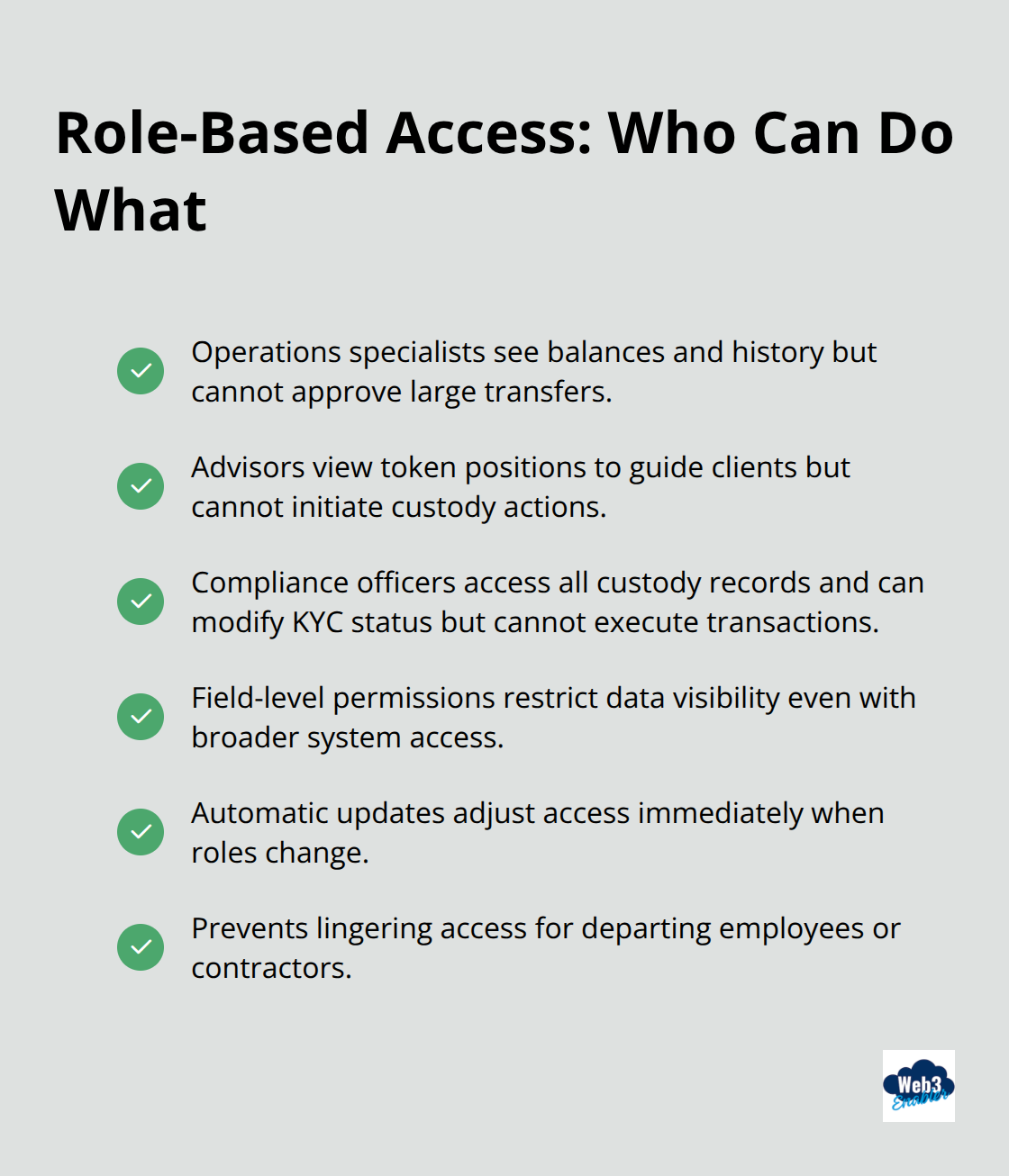
Role-Based Access Controls Enforce Custody Boundaries Automatically
Role-based access controls ensure that only authorized team members can view or modify custody data. An operations specialist might see client wallet balances and transaction history but lacks permission to approve large transfers. An advisor sees enough information to advise clients on their token positions but cannot initiate custody actions. A compliance officer accesses all custody records and modifies KYC status but cannot execute transactions. These permissions are enforced at the field level within Salesforce, so even if someone gains access to the database, they cannot view data outside their role’s authorization.
Your institution defines what each role can do, and Salesforce enforces those boundaries automatically. This prevents the common scenario where a departing employee or contractor retains access to sensitive custody information after their role changes. When your team adds a new advisor or removes a custody operator, their Salesforce permissions update immediately, and their access to digital asset records adjusts accordingly without manual intervention across multiple systems. Your custody operations maintain security through permission structures that adapt as your team evolves.
Final Thoughts
Managing digital assets in Financial Services Cloud transforms how your institution operates. Instead of juggling wallet trackers, compliance spreadsheets, and separate audit systems, your team works from a single platform where advisors see real-time client holdings, compliance teams enforce KYC and AML rules automatically, and every custody action creates an immutable audit trail. This consolidation eliminates the operational friction that creates compliance risk and slows your ability to serve clients.
Financial institutions modernizing their digital assets financial services workflows recognize that custody requires the same rigor as traditional operations. Salesforce provides the infrastructure to deliver that rigor without managing multiple disconnected systems. Native objects for wallet balances and token holdings, automated KYC and AML checks, role-based access controls, and immutable audit trails work together to create custody operations that are both efficient and auditable.
Your next step involves assessing your current custody infrastructure. Where does your digital asset data live today, and how do your compliance teams verify KYC requirements for token transactions? Web3 Enabler helps financial institutions implement this transformation by bringing native blockchain utility directly into Financial Services Cloud, enabling your team to manage digital assets, accept stablecoin payments, and maintain real-time visibility into on-chain transactions without leaving Salesforce.