



Traditional banking slows down global payments with intermediaries, high fees, and processing delays that cost companies millions annually. Crypto payments automation tools eliminate these friction points by settling transactions in minutes rather than days.
At Web3 Enabler, we’ve seen firsthand how companies across Africa and the Middle East use automated crypto payments to cut operational costs and accelerate cash flow. This guide shows you exactly how.
What Makes Crypto Payments So Much Cheaper Than Traditional Banking
Traditional cross-border payments drain corporate budgets through correspondent banking fees, intermediary markups, and currency conversion spreads that compound at each step. A company sending $100,000 to a supplier in Nigeria via SWIFT loses 3-5% to fees alone and waits 3-7 days for settlement. Crypto payments automation eliminates these leaks entirely. When you settle in stablecoins like USDC or USDT, transaction fees drop to under 1% and often below 0.1%, depending on the blockchain you use.
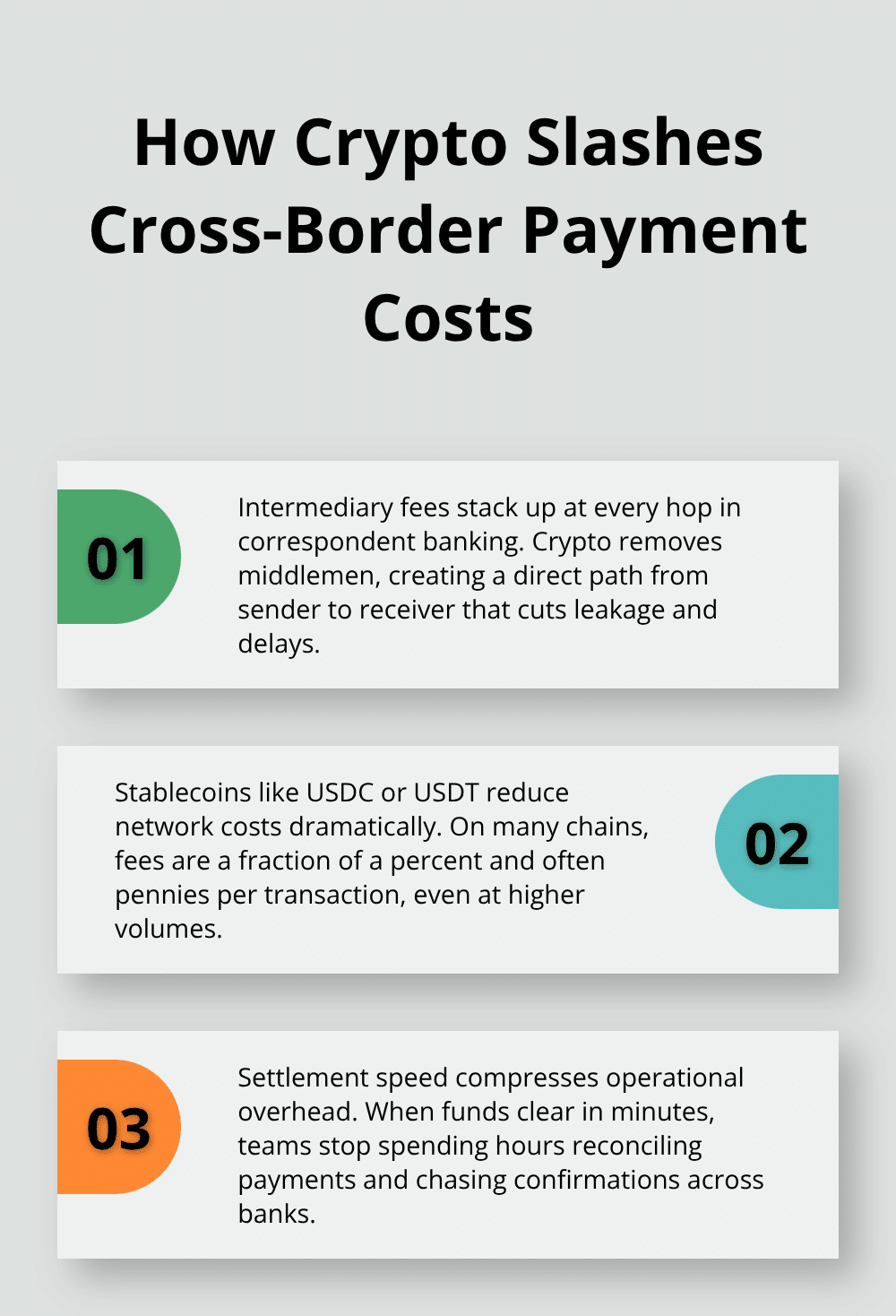
Stablecoin-powered payments can reduce reconciliation overhead, eliminate intermediaries, and enable transactions 24/7 across borders, while reducing settlement time from days to minutes. The real savings come from removing intermediaries. Traditional payments require multiple banks, clearing houses, and correspondent relationships to move money across borders. Each layer extracts fees and introduces delay. Crypto payments automation creates a direct path between sender and receiver, eliminating the middlemen entirely. For high-volume operations, this difference is enormous. A company processing $10 million monthly in cross-border payouts saves $400,000-$600,000 annually just on fees, plus gains the cash flow benefit of instant settlement instead of waiting days for funds to arrive.
Where Manual Processing Costs Hide
Manual payment processing remains one of the largest hidden costs in global finance. Finance teams spend hours reconciling invoices, confirming receipts, following up on stuck payments, and managing currency conversions across multiple systems and spreadsheets. Crypto payments automation removes this overhead through real-time settlement and transparent on-chain records. When a payment settles in seconds with full transaction visibility, your team spends zero time chasing confirmations or investigating delays.
Integration Amplifies Your Savings
Integration with your existing finance stack multiplies these savings significantly. Web3 Enabler connects blockchain payments directly into Salesforce, meaning your finance team manages crypto transactions within the same system where they handle contracts, vendor relationships, and payment records. No separate logins, no manual data entry between systems, no reconciliation delays. A company with 200 monthly supplier payments reduces payment processing time by 50 hours monthly just through automation and system integration. At a fully-loaded cost of $50 per hour, that amounts to $30,000 in annual labor savings before you count faster cash flow or reduced payment disputes.
Payroll Operations Across Borders
Crypto-enabled payroll systems process payments to contractors in 30+ countries instantly, with each contractor receiving funds in their preferred stablecoin or local currency equivalent. No more delays waiting for wire transfers to clear in each country. No more foreign exchange hedging costs. No more payment failures due to incorrect banking details in different regions. This speed and reliability transform how global companies manage contractor networks across Africa and the Middle East, where traditional banking infrastructure often introduces unpredictable delays. The next section shows how this real-time visibility and settlement capability extends beyond cost reduction to fundamentally reshape your payment operations.
Speed and Settlement Benefits of Automated Crypto Payments
Traditional banking makes you wait because the system itself moves slowly. A payment initiated Monday morning doesn’t clear until Thursday afternoon, even though the actual money transfer takes seconds. Your team spends those three days tracking confirmations, following up with banks, and managing cash flow uncertainty. Crypto payments automation eliminates this entirely. Transactions settle on-chain in minutes, not days, giving you immediate certainty about whether funds arrived.
Stablecoins like USDC and USDT settle within 2-5 minutes on most blockchains, compared to the 3-7 day standard for SWIFT transfers. This speed matters operationally. A payroll team processing 500 contractor payments across 15 countries no longer waits for staggered arrival times across different banking systems.
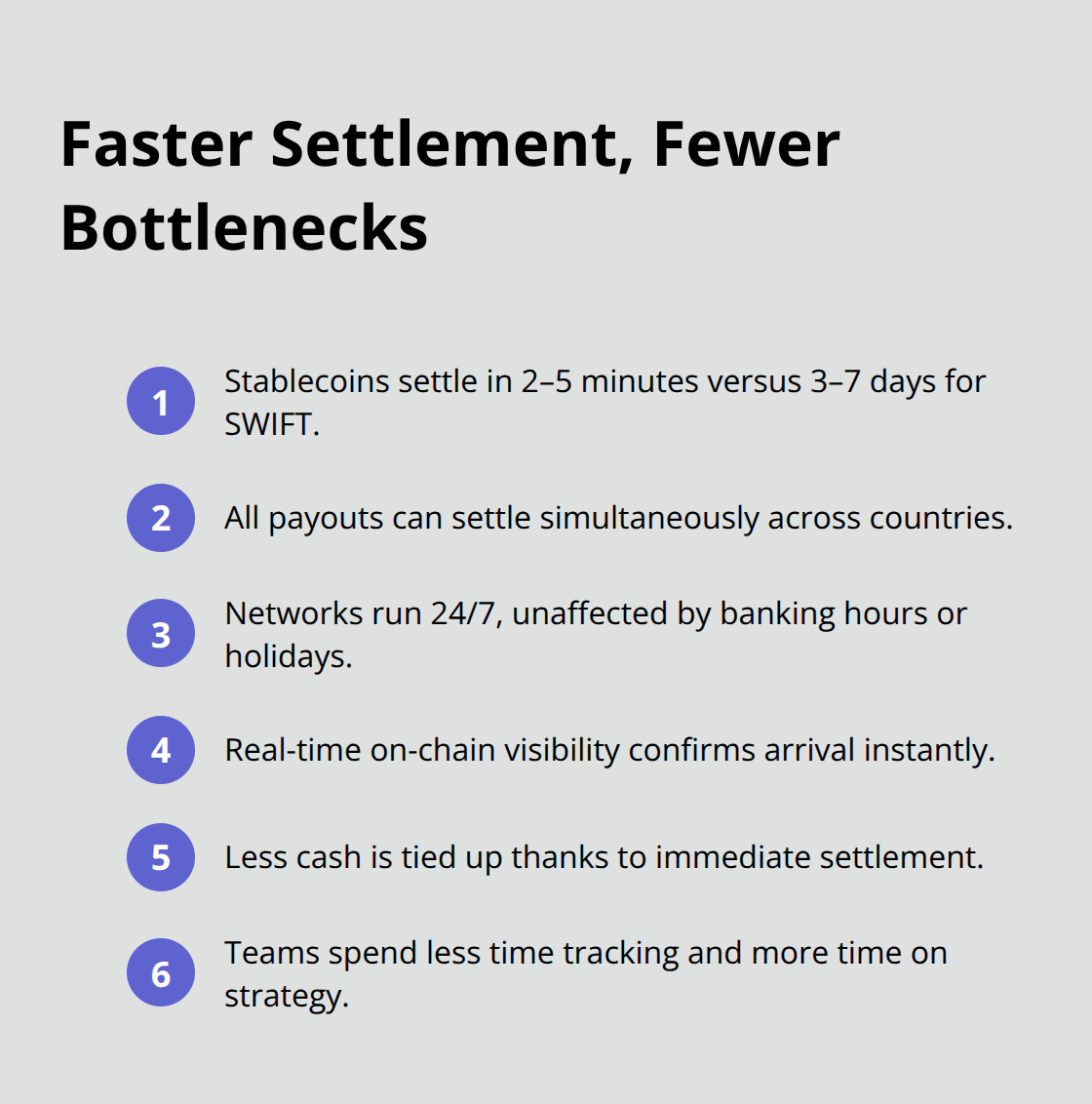
All payments settle simultaneously, eliminating the cash flow management nightmare of tracking which contractors received funds and which are still waiting. For companies with tight working capital, this difference between instant settlement and multi-day delays translates directly into operational flexibility and reduced liquidity needs.
Near-Instant Settlement Across Borders
Stablecoin transactions complete in minutes rather than days, which fundamentally changes how you manage global operations. A company in Lagos sends payments to contractors in Nairobi, Cairo, and Casablanca and all transactions settle simultaneously without waiting for any of those countries’ banking hours. Suppliers across Africa and the Middle East receive payments instantly, regardless of local holidays or banking schedules that would delay traditional wires.
This speed eliminates the cash flow uncertainty that plagues traditional international payments. You know exactly when funds arrive and when your suppliers can access them. No more guessing whether a payment cleared or remains stuck in a correspondent bank queue.
24/7 Payment Processing Without Banking Hours Restrictions
Banks close. Their systems shut down on weekends and holidays. A payment submitted Friday evening sits in a queue until Monday morning, then waits another 2-3 days for clearing. Crypto networks never sleep. Payments process continuously, 365 days a year, at any hour.
This matters most for international operations across multiple time zones. Your finance team can process payments at 3 AM on a Sunday and have them settle before your suppliers wake up Monday morning. Traditional banking forces you to work within banking hours; crypto payments work within your hours.
Real-Time Visibility and Tracking of Payment Status
Real-time visibility compounds these settlement benefits significantly. Finance teams track payment status through transparent on-chain records that update instantly. The moment a payment settles on-chain, your system reflects it. No separate dashboards, no email confirmations to manually log, no reconciliation delays.
A finance manager can see that a payment to a supplier in Nigeria settled at 2:47 AM their local time, funds confirmed and available immediately. This transparency eliminates the back-and-forth emails asking vendors whether they received funds and when they can expect payment. Vendors see funds arrive instantly, reducing payment disputes and strengthening supplier relationships.
For companies managing multiple currencies and payment corridors, this real-time visibility across all transactions prevents the reconciliation chaos that typically plagues global finance operations. Your team stops chasing confirmations and starts focusing on strategic work. This operational shift-from reactive payment tracking to proactive financial management-sets the stage for integrating these faster, cheaper payments directly into your existing business systems, which we explore next.
Integration with Existing Business Infrastructure
Your finance software stack already handles contracts, vendor data, payment approvals, and reconciliation. Adding crypto payments should integrate seamlessly into these workflows, not force your team to juggle separate platforms and manual data transfers. Web3 Enabler connects blockchain transactions directly into Salesforce, eliminating the friction of managing crypto payments outside your existing infrastructure. When a stablecoin payment settles on-chain, the transaction data flows automatically into your CRM, finance records, and reporting dashboards without manual intervention. A finance manager approves a supplier payment within Salesforce, the system routes it to the blockchain, and settlement confirmation appears in the same interface where the original vendor record lives.
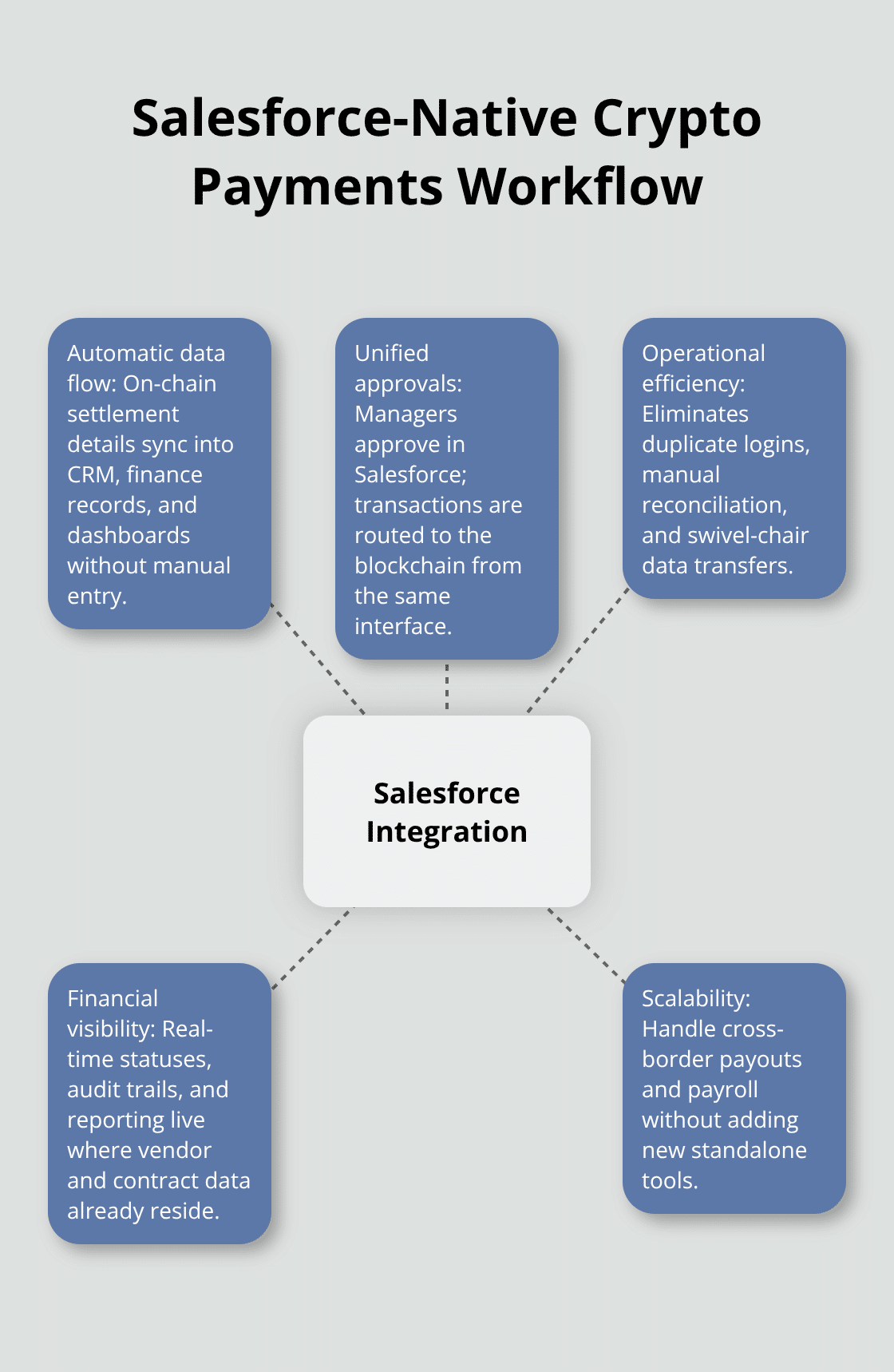
This native integration cuts the operational overhead that typically plagues crypto adoption. Teams no longer maintain separate spreadsheets tracking which payments went on-chain versus which cleared through traditional banking. No more manual entry errors between systems. No more time spent exporting data from one platform and importing it into another. For a company processing 100 monthly supplier payments across 15 countries, this integration eliminates roughly 30 hours of administrative work quarterly just from removing manual data reconciliation.
Payroll and Contractor Payments Across Africa and the Middle East
Global payroll becomes dramatically simpler when you process contractor payments in stablecoins through integrated infrastructure. A company with contractors in Nigeria, Kenya, Egypt, and the UAE can initiate all payments from a single interface, with each contractor receiving funds in their preferred stablecoin or local currency equivalent within minutes. Traditional payroll for these regions introduces multiple pain points: wire transfer fees, multi-day settlement delays across different banking systems, foreign exchange markups, and payment failures due to incorrect banking details that require manual investigation and reprocessing.
Crypto-enabled payroll eliminates these entirely. A contractor in Lagos receives USDC instantly, with zero wire fees and transparent on-chain confirmation. The same payment to Cairo settles simultaneously without waiting for Egyptian banking hours. Your finance team tracks all payments through real-time dashboards that show exactly which contractors received funds and when. This speed transforms contractor relationships, especially across regions where traditional banking introduces unpredictable delays that damage trust. Contractors know exactly when funds arrive and can plan their own finances accordingly, rather than waiting days and wondering whether payment got stuck in a correspondent bank queue.
Digital Asset Management Within Your Current Workflow
Managing cryptocurrency holdings should not require separate wallets, exchanges, or outside platforms that fragment your financial visibility. Web3 Enabler enables you to track digital asset balances, monitor investment returns, and execute transactions directly from Salesforce. A treasury team holding stablecoins for operational reserves or investment purposes can view positions in real-time, alongside traditional cash holdings and accounts receivable.
This unified visibility prevents the operational gaps that occur when crypto assets live in disconnected systems. A CFO reviewing quarterly liquidity can see total liquid assets in one dashboard rather than checking a bank account, then logging into a separate crypto exchange to view blockchain holdings. This integration matters especially for companies managing working capital across multiple currencies and payment corridors. When stablecoin reserves live within your finance infrastructure, you gain the same audit trails, approval workflows, and compliance documentation you use for traditional banking. Treasury operations accelerate because your team stops switching between systems, and payment execution speeds up because approval workflows exist within the same interface where payments originate.
FAQ: Crypto Payments Automation in Africa and the Middle East
Is automated crypto payment legal in Nigeria and Kenya in 2026?
Yes, the landscape has shifted from prohibition to formal regulation. In Nigeria, the Investments and Securities Act 2025 formally recognized digital assets, and by early 2026, the Central Bank of Nigeria launched a supervision pilot for licensed virtual asset providers. In Kenya, the Virtual Asset Service Providers Act was signed in late 2025, with the National Treasury and Central Bank of Kenya inviting public comments on the final 2026 regulations. This means businesses can now use automated tools within a clear, supervised framework rather than operating in a legal gray zone.
How does the UAE regulate stablecoin payments for businesses?
The UAE is a global leader in this space. In February 2024, the first licensed stablecoin pegged to the dirham launched under the MiCA-aligned framework. By February 2026, Ministerial Decision No. 336 formally designated Dubai’s Virtual Assets Regulatory Authority (VARA) as a competent authority for corporate tax purposes, while the Central Bank of the UAE expanded its oversight to include payment services using virtual assets. For businesses, this provides a dual-layer of security: federal-level banking oversight and Dubai-specific innovation standards.
What are the new South African reporting requirements for 2026?
If you are moving crypto across borders in South Africa, 2026 is a watershed year. The February 2026 Budget Speech announced that crypto assets are being brought into the formal exchange control framework. Additionally, the first mandatory reporting period for the Crypto-Asset Reporting Framework (CARF) began on March 1, 2026. Businesses must now capture detailed transaction data—including user identity, residence data, and tax identification numbers—to meet South African Revenue Service (SARS) standards.
Can I pay contractors in Egypt using stablecoins legally?
Egypt is moving toward a license-first digitization strategy. While the Central Bank of Egypt granted its first digital-native bank license in late 2025 (with services going live in 2026), the focus remains on formal governance. Automated payment tools are permitted provided they are deployed by licensed firms that maintain strict audit trails and compliance controls. This ensures that stablecoin payouts to Egyptian contractors are treated with the same regulatory rigor as traditional digital banking.
How do automated tools handle the different regulations across these regions?
Modern automation tools like Web3 Enabler use regional logic to manage compliance. For example, a payout from Salesforce to a contractor in South Africa will automatically trigger the required CARF data collection, while a payment to a UAE vendor will ensure the stablecoin used is a VARA-approved asset. By embedding these regional rules into your Salesforce workflow, you eliminate the risk of manual compliance errors when navigating the diverse regulatory requirements of Africa and the Middle East.
Final Thoughts
Crypto payments automation tools deliver three concrete advantages that reshape how global companies operate. They cut operational costs by eliminating intermediaries and reducing transaction fees from 3-5% to under 1%, while removing manual processing overhead that consumes dozens of hours monthly. They accelerate settlement from days to minutes, giving your finance team real-time visibility and eliminating the cash flow uncertainty that plagues traditional banking. They integrate directly into your existing infrastructure, meaning your team manages blockchain payments within Salesforce rather than juggling separate platforms.
For companies operating across Africa and the Middle East, these benefits compound significantly because traditional banking introduces unpredictable delays across different regional systems, foreign exchange markups at each step, and payment failures that require manual investigation. A contractor in Lagos receives stablecoins instantly while a simultaneous payment to Cairo settles without waiting for Egyptian banking hours. Your finance team tracks all transactions through unified dashboards that show exactly when funds arrived and where they went, with transparent on-chain confirmation that eliminates reconciliation delays and strengthens vendor relationships.
Starting with crypto payments automation requires choosing infrastructure that matches your operational scale and compliance requirements. Web3 Enabler provides native Salesforce integration for blockchain transactions, enabling your team to manage crypto payments, digital assets, and international contractor payments within your existing corporate environment. Transactions settle in seconds at a fraction of traditional costs, with full audit trails and approval workflows built into your finance infrastructure.