



Global payments move at a snail’s pace when you’re stuck with traditional banking infrastructure. Wire transfers take days, hidden fees pile up, and your finance team spends hours tracking transactions across multiple systems.
Cross-border stablecoin settlement changes that equation entirely. We at Web3 Enabler built Blockchain Payments for Salesforce specifically to eliminate these friction points, letting your teams settle international transactions in minutes instead of days-all without leaving their Salesforce workspace.
The Real Cost of Moving Money Across Borders
Intermediaries Drain Your Budget
Traditional cross-border payments force your organization through a maze of intermediaries, each taking a cut and adding delays. When you wire funds internationally, the transaction passes through your bank, a correspondent bank, and the recipient’s bank-sometimes with additional clearing houses in between. Traditional wire transfers take three to five business days on average, even though the actual movement of money happens in minutes. Your finance team loses visibility during those delays, making cash forecasting nearly impossible.
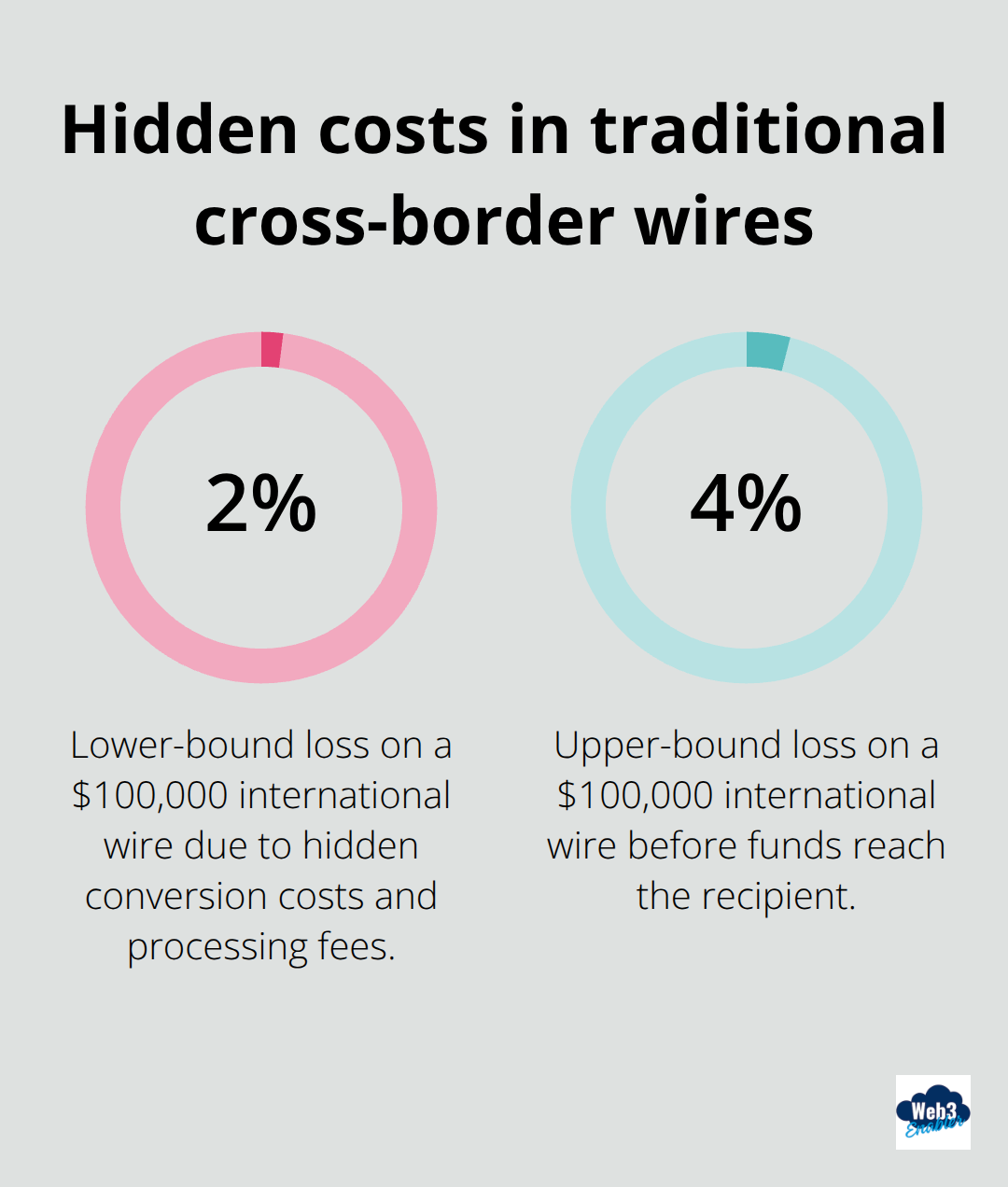
Currency conversion happens at multiple points in the chain, with each intermediary applying their own spread. A $100,000 wire transfer can easily lose 2–4% to hidden conversion costs and processing fees before it reaches your supplier or subsidiary. For organizations processing hundreds of cross-border transactions monthly, those hidden costs compound into six figures annually.
Compliance Creates Operational Silos
Compliance adds another layer of friction that most companies underestimate. Your team must manually verify sanctions lists, conduct KYC checks, and maintain separate audit trails across banking platforms and internal systems. Regulators expect real-time monitoring, yet traditional banking infrastructure only provides settlement confirmation after the transaction completes-leaving your compliance team scrambling to catch problems retroactively.
Large enterprises often maintain separate banking relationships in different regions just to manage regulatory requirements, multiplying operational overhead and creating visibility gaps. When your finance team works across multiple banking portals, spreadsheets, and disconnected systems, reconciliation becomes a time-consuming bottleneck that slows down your entire operation.
Speed Unlocks Working Capital Efficiency
Stablecoins settle in seconds across blockchains, enabling faster cross-border settlement without correspondent banking chains. This speed advantage matters because it translates directly into working capital efficiency-faster settlements mean your cash isn’t trapped in transit, improving liquidity management for global operations. Your treasury team gains the real-time visibility needed to forecast cash positions accurately and deploy capital more effectively across regions.
Stablecoin settlement eliminates the waiting period that traditional banking imposes, letting your organization move money when you need to, not when the banking system permits it. This shift from days to seconds fundamentally changes how you manage global payables, receivables, and subsidiary funding.
Why Stablecoins Settle Faster Than Traditional Banking
Stablecoin settlement operates on a fundamentally different timeline than traditional banking. When you send a stablecoin payment, the transaction completes on a blockchain in seconds-not days. There’s no correspondent bank queue, no clearing house delay, no waiting for business hours across time zones. The transaction becomes final the moment it confirms on-chain, giving your finance team immediate certainty about fund movement. This speed advantage becomes tangible when you manage global operations: a subsidiary in Singapore needs funding, a supplier in Poland requires payment, or a customer in Mexico wants to settle an invoice. Stablecoins eliminate the three-to-five-day limbo that traditional wires impose, letting your cash move at the speed of digital networks instead of banking infrastructure built for a slower era.
Cutting Out the Middlemen Reduces Real Costs
Traditional cross-border payments require multiple intermediaries, each extracting fees and applying currency spreads. Stablecoins collapse that chain dramatically. Instead of your bank, a correspondent bank, a clearing house, and the recipient’s bank all taking cuts, a stablecoin transaction moves directly from sender to receiver. The difference shows up immediately in your bottom line. Organizations processing cross-border payments report cost reductions of 40–60% when switching to blockchain-based settlement, according to industry analysis of enterprise adoption.
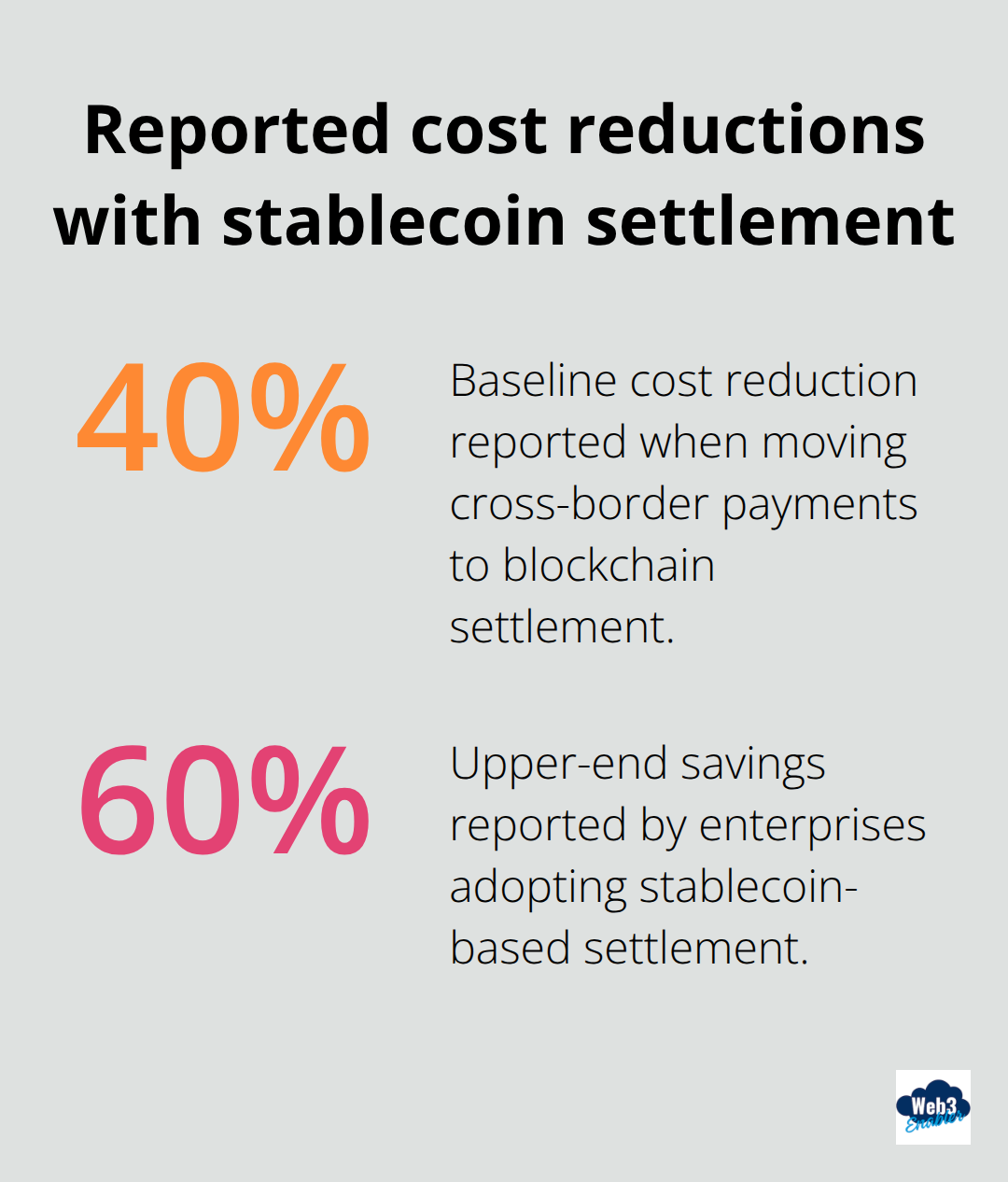
A $500,000 monthly payment volume that costs 3–4% through traditional banking suddenly costs under 1% with stablecoins. For a mid-market company processing $5 million in annual cross-border transactions, that shift saves $100,000–$150,000 yearly.
Real-Time Visibility Transforms Cash Management
Traditional wire transfers leave your finance team blind during settlement. You initiate a transfer and wait for confirmation days later, unable to forecast cash positions accurately or adjust liquidity strategies in real time. Stablecoin settlement changes this completely. The moment a transaction settles on-chain, your Finance Cloud and Revenue Cloud users see the updated balance. This real-time visibility enables your treasury team to manage working capital far more effectively. Instead of holding excess cash reserves to buffer the uncertainty of multi-day settlements, you deploy capital based on actual fund positions that update in seconds.
Your reconciliation process accelerates too-no more manual tracking across banking portals and spreadsheets. Settlement finality on-chain means your accounting records reflect actual cash positions immediately, eliminating the reconciliation delays that traditionally consume hours of finance team effort each month. When your teams work within Salesforce, they access settlement data directly alongside customer and transaction records (all in one unified environment), making cash management and reporting seamless.
Moving Beyond Traditional Constraints
Stablecoin settlement removes the geographic and temporal friction that traditional banking imposes. Your organization no longer waits for correspondent banks to process transactions during business hours in different time zones. Transactions settle around the clock, seven days a week, giving your global teams the flexibility to move money when business needs demand it, not when banking infrastructure permits it. This shift from days to seconds fundamentally changes how you manage global payables, receivables, and subsidiary funding-and it sets the stage for how modern enterprises can integrate these capabilities directly into their existing financial systems.
Staying in Salesforce While Settling Cross-Border Payments
Keep Your Teams in One Workspace
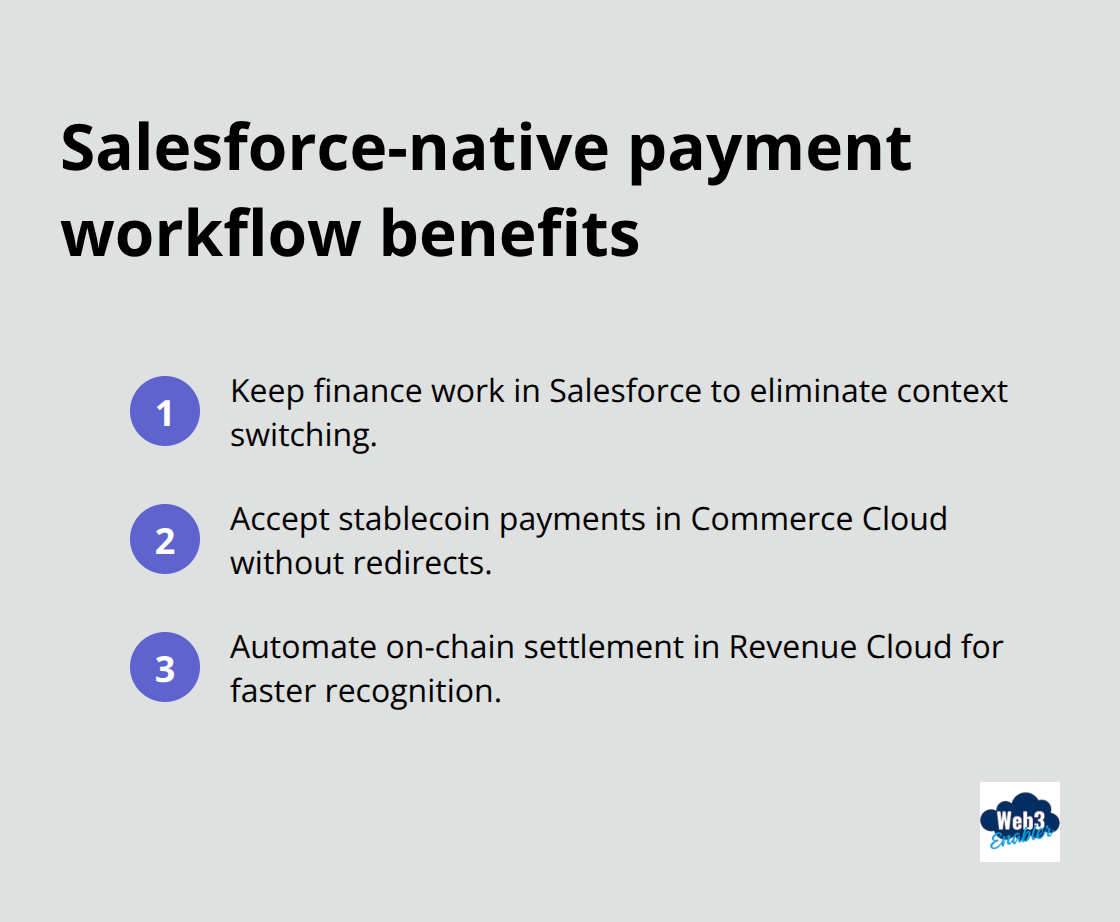
Your finance team loses productivity the moment they switch between Salesforce and a separate banking or blockchain platform. Context switching introduces friction that slows operations and creates compliance blind spots. Blockchain Payments for Salesforce eliminates that problem by keeping your teams within the same interface where they manage customers, revenue, and cash flow. Financial Services Cloud users see real-time wallet balances and digital asset positions alongside traditional client account data, giving advisors a complete picture of client liquidity in seconds. Commerce Cloud merchants accept stablecoin payments without redirecting customers to external payment processors or managing separate reconciliation spreadsheets. Revenue Cloud teams automate on-chain settlement confirmation directly into revenue recognition workflows, collapsing the gap between transaction completion and accounting record closure from hours to minutes.
Eliminate Manual Reconciliation Work
Native integration into Salesforce removes the manual reconciliation work that traditionally consumes up to 10 hours per week for treasury teams managing cross-border transactions. Settlement happens on-chain and your Salesforce records update automatically, so your finance team stops manually matching banking confirmations to invoice records. Instead, they access settlement finality directly through Salesforce dashboards, reducing errors and accelerating close cycles. For organizations processing $10 million or more in annual cross-border volume, this automation translates to real cost savings-your team deploys effort toward strategy and liquidity optimization instead of data entry.
Strengthen Compliance Through Unified Visibility
Real-time transaction visibility within Salesforce means your compliance team monitors all payment activity in a single system. You implement sanctions screening and AML controls through native Salesforce workflows rather than external platforms that create audit trail gaps. This unified approach prevents the fragmentation that typically undermines compliance effectiveness across multiple disconnected systems. Organizations adopting this approach report 40% faster payment processing and 60% reduction in reconciliation errors, according to early adopters integrating blockchain settlement into Salesforce environments.
Accelerate Your Close and Reporting Cycles
Settlement finality on-chain means your accounting records reflect actual cash positions immediately. Your teams no longer wait for banking confirmations that arrive hours or days after transactions complete. Revenue recognition happens faster, close cycles compress, and your finance team produces accurate reports without the delays that traditional banking imposes. This speed advantage compounds across your organization-faster closes mean faster decision-making, and faster decision-making means your leadership team responds to market conditions with current financial data instead of stale information.
Final Thoughts
Cross-border stablecoin settlement transforms how enterprises move money globally-shifting from days to seconds, eliminating multiple intermediaries, and replacing fragmented systems with unified visibility. Organizations that adopt this approach save 40 to 60 percent on transaction fees, reclaim operational efficiency that traditional banking consumed for decades, and gain real-time insight into cash positions. Your finance team stops context-switching between platforms, compliance monitors every transaction in real time, and accounting records reflect actual cash positions instantly.
The advantage multiplies when you integrate stablecoin settlement directly into Salesforce. Financial Services Cloud advisors see client digital assets alongside traditional holdings, Commerce Cloud merchants accept stablecoins without external payment processors, and Revenue Cloud teams automate settlement confirmation into revenue recognition workflows. This native integration eliminates the complexity that typically accompanies blockchain adoption, making cross-border payments as straightforward as managing any other Salesforce workflow.
Web3 Enabler brings this capability directly into your Salesforce environment as the only native blockchain payments platform on the Salesforce AppExchange. Your teams gain the ability to accept and send stablecoin payments, streamline global settlements, and access real-time visibility into on-chain transactions without leaving Salesforce. This is how modern enterprises handle global payments-with speed, transparency, and the operational simplicity that comes from staying within the systems your teams already use every day.