


Your finance team processes payments across borders every day. Yet traditional methods still drain time and money through slow settlements and hidden fees.
Blockchain payments in Salesforce change that equation. We at Web3 Enabler built native integration so your team accepts stablecoins, tracks transactions, and settles instantly-all without leaving your CRM.
Why Your Finance Team Is Losing Money on Cross-Border Payments
The True Cost of Traditional Wire Transfers
Traditional wire transfers and ACH payments still dominate corporate finance, but they carry a brutal cost structure. International wire transfers carry average fees of 6.49%, reaching 8.78% in sub-Saharan Africa, take three to five business days to settle, and leave your team with zero visibility until funds arrive. When you multiply that across dozens of transactions monthly, the expense becomes significant.
Stablecoin payments eliminate these friction points entirely. Settlement happens in minutes, not days, and costs drop to less than a dollar per transaction. Your liquidity improves because cash moves faster, and your finance team stops waiting for funds to appear in bank accounts.

Real-Time Visibility Transforms Reconciliation
Real-time visibility into transactions transforms reconciliation from a manual, error-prone process into an automated workflow. Instead of downloading bank statements and matching them against spreadsheets, your team sees every transaction on-chain immediately and tracks its status within Salesforce. This matters because treasury operations at enterprises lose significant time to reconciliation delays.
When you integrate blockchain payments directly into Financial Services Cloud or Revenue Cloud, transaction data flows automatically into your CRM objects. Your finance team eliminates manual entry and the mistakes that come with it. You gain instant clarity on settlement status, which reduces the operational risk that comes with traditional payment delays.
Stablecoins Solve the Volatility Problem
Stablecoins also solve the volatility problem that deters many enterprises from crypto payments. USDC and USDT maintain a 1:1 peg to the US dollar, so your team accepts payments without worrying about price swings. For global enterprises processing payroll, vendor payments, or client settlements across multiple currencies, this stability combined with instant settlement creates a competitive advantage.
Web3 Enabler built native integration into Salesforce specifically to address these pain points. Your finance team can send and accept stablecoins without leaving the CRM platform you already use daily. This unified environment means your operations, compliance, and finance teams collaborate seamlessly on payment workflows that previously required multiple disconnected systems.
How Blockchain Payments Work Inside Your Salesforce Environment
Your finance team already lives in Salesforce. Revenue Cloud tracks billing cycles, Financial Services Cloud manages client relationships and assets, Commerce Cloud powers transaction workflows. Stablecoin payments integrate directly into these platforms so your team accepts and sends USDC or USDT without switching tools. When a client pays an invoice in stablecoins through your Revenue Cloud system (with the new Blockchain Payments for Revenue Cloud AddOn), the transaction settles on-chain in minutes while the payment record automatically creates a Salesforce object that feeds into your reconciliation process. Your operations team sees the transaction status in real time, compliance has an auditable record, and finance recognizes revenue immediately instead of waiting three to five days for traditional settlement.
Native Integration Eliminates Friction for Your Team
We at Web3 Enabler built the only native blockchain platform available on the Salesforce AppExchange as a certified Salesforce ISV Partner. This matters because native integration removes the complexity of third-party middleware that requires API calls, custom coding, and separate system maintenance. When your team processes a stablecoin payment in Revenue Cloud, the transaction data flows directly into Salesforce objects without manual entry or external dashboards. Your finance controller sees settlement status in the same interface where they manage traditional invoices. Commerce Cloud merchants accept stablecoins at checkout, and the payment immediately syncs to their customer records and revenue forecasts.
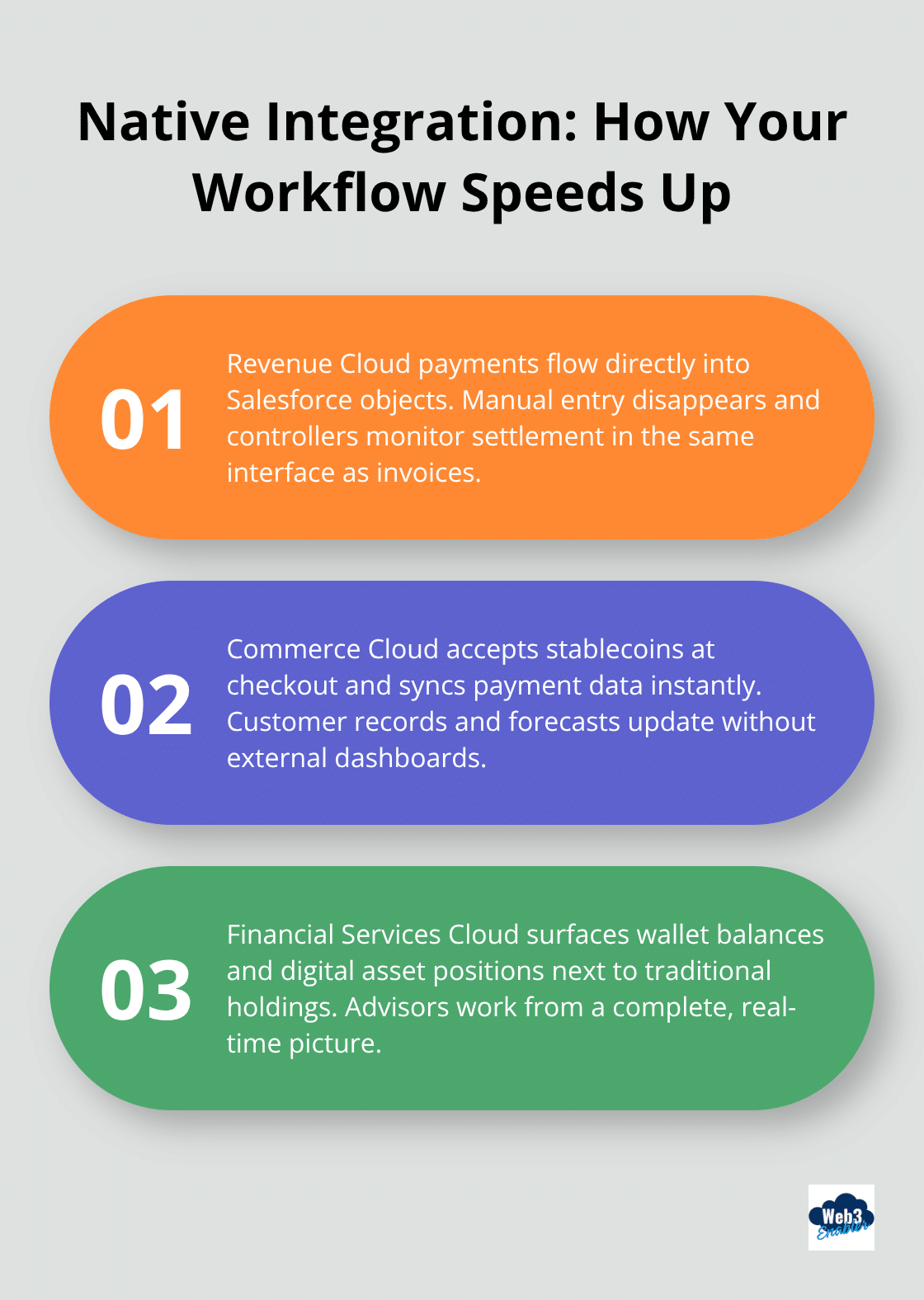
Financial Services Cloud advisors view client wallet balances and digital asset positions alongside traditional holdings, which gives them complete visibility for advisory conversations.
On-Chain Visibility Replaces Manual Reconciliation Work
Real-time on-chain visibility transforms how your treasury operations function. Instead of waiting for bank statements or manually tracking transaction confirmations, your team sees every stablecoin payment settled on the blockchain and reflected in Salesforce simultaneously. This matters for liquidity management because you know exactly when funds are available rather than estimating based on historical processing times. A financial services firm processing client settlements across multiple geographies reconciles accounts in hours instead of days because blockchain transactions are immutable and instantly visible. Your compliance team gains the auditability they need because every transaction creates a permanent record tied to the customer, amount, and settlement timestamp. When you combine this on-chain visibility with Salesforce automation, your team stops spending hours on manual reconciliation and focuses on strategy instead.
Unified Data Flow Across Your Organization
Stablecoin transactions create Salesforce objects that your entire organization can access and act on. Finance teams use this data for revenue recognition and cash flow forecasting. Operations teams track settlement status without external tools. Compliance teams maintain complete audit trails within the CRM itself. This unified approach (unlike traditional payment systems that scatter data across multiple platforms) means your teams work from a single source of truth. When a transaction settles on-chain, Salesforce automatically updates customer records, invoice status, and financial reports in real time. Your treasury operations team no longer reconciles data across disconnected systems or waits for manual confirmations from payment processors.
The speed and transparency of blockchain payments inside Salesforce create new possibilities for how your organization manages global operations. Your teams now have the real-time visibility and automation that traditional finance systems promised but never delivered. This foundation sets the stage for how different industries are already applying these capabilities to solve specific business challenges.
Where Blockchain Payments Solve Real Business Problems
Financial Advisors Access Complete Client Asset Pictures
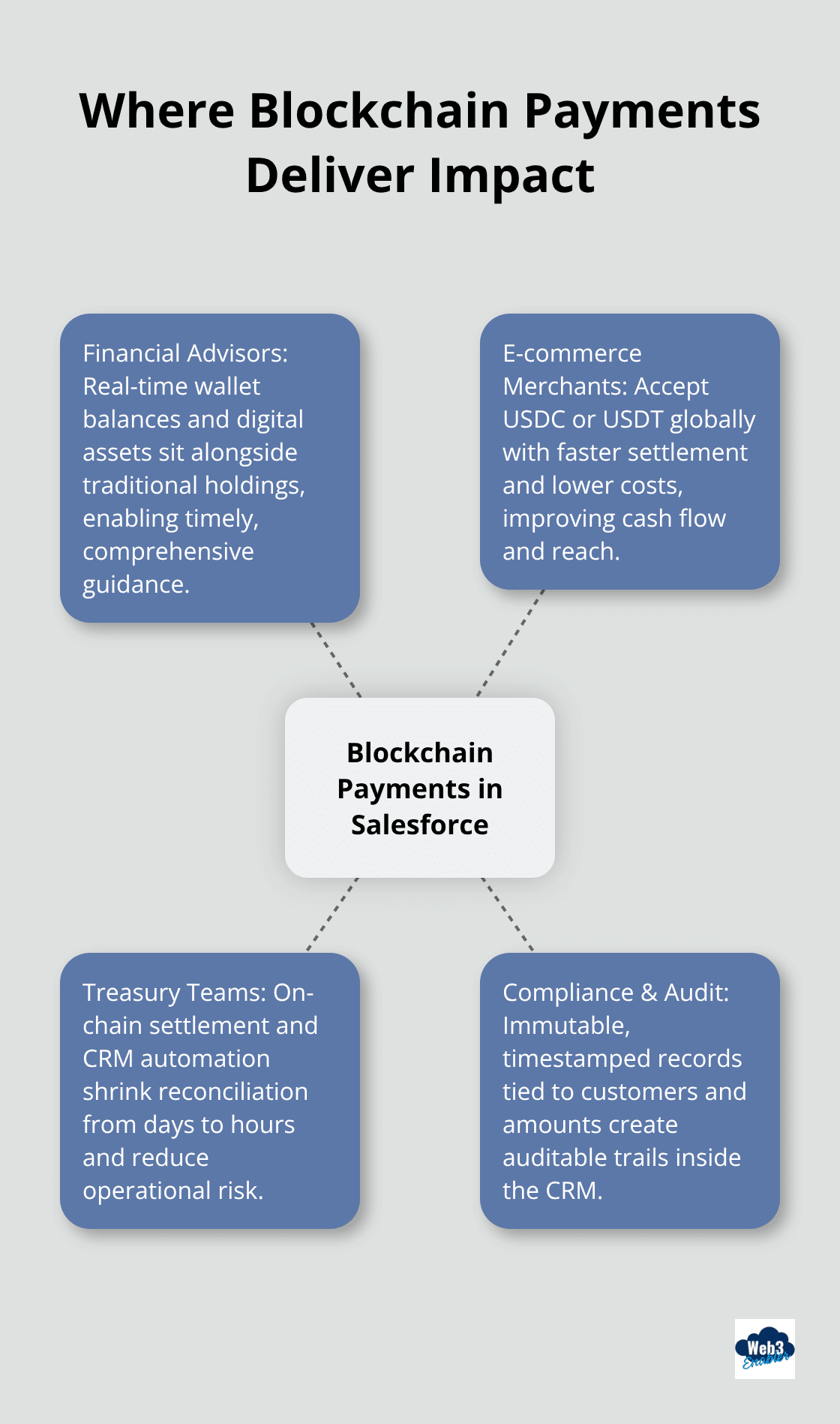
Financial services advisors managing client portfolios now access real-time wallet balances and digital asset positions directly within Financial Services Cloud. When a client holds USDC or USDT alongside traditional securities, advisors see the complete picture without switching platforms or requesting manual updates. Portfolio decisions require current data, and blockchain transactions settle instantly on-chain while Salesforce automatically records each transaction. An advisor reviewing a client’s net worth can now include digital assets in wealth calculations immediately after purchase, rather than waiting for manual confirmation from external systems. The ability to view stablecoin positions alongside traditional holdings transforms advisory conversations because advisors can offer more comprehensive guidance on diversification and risk.
E-Commerce Merchants Expand Global Reach at Lower Cost
E-commerce merchants expanding globally face a brutal reality: payment processing fees for international transactions can be significant when combining payment gateway fees, currency conversion charges, and bank settlement costs. Stablecoin payments eliminate most of these layers. A merchant selling products to customers across Southeast Asia, Europe, and the Middle East can accept USDC or USDT at checkout within Commerce Cloud, and funds settle directly to the merchant’s wallet in minutes rather than days. This speed matters for cash flow because inventory costs money upfront, and traditional payment processors lock funds for three to five business days. Merchants also gain access to customer markets previously too expensive to serve because payment friction disappears.
Enterprise Treasury Teams Eliminate Reconciliation Bottlenecks
Enterprise treasury teams managing global operations face constant reconciliation headaches. A multinational corporation with subsidiaries across four continents processes vendor payments, intercompany settlements, and client invoices daily. Traditional wire transfers create gaps in visibility: finance teams know payment initiation and eventual settlement, but the middle days create uncertainty about liquidity. Blockchain payments eliminate this gap. When a Revenue Cloud user processes a vendor payment in USDC, the transaction settles on-chain within minutes while Salesforce automatically records the settlement, updates the vendor record, and triggers revenue recognition. A treasury operation processing 200 monthly transactions across six currencies previously spent 40 hours monthly on reconciliation. With stablecoin settlement integrated into Revenue Cloud, that work dropped to under 10 hours because on-chain transactions create permanent, auditable records that sync directly to Salesforce objects. Operational risk decreases because the finance team knows exact settlement status rather than estimating based on historical processing times. Automated revenue recognition becomes possible because settlement no longer depends on bank processing windows.
Final Thoughts
Stablecoin adoption across enterprises and financial institutions accelerates rapidly. Major corporations now recognize that blockchain payments in Salesforce solve real operational problems: faster settlements, lower costs, and better visibility. Organizations processing global transactions daily move away from traditional payment infrastructure because the speed and transparency advantages are measurable and immediate.
Compliance and auditability built directly into CRM workflows represent the next evolution in how finance teams operate. Every transaction creates an immutable on-chain record that syncs automatically to Salesforce objects, giving your compliance team the audit trail they need without manual documentation. Your operations team stops chasing confirmations across disconnected systems, and your finance team recognizes revenue faster because settlement no longer depends on bank processing windows.
We at Web3 Enabler built the only native blockchain platform on the Salesforce AppExchange specifically to make this transition seamless. Your finance team gains instant settlement, real-time visibility, and automated reconciliation without leaving the CRM platform you already use daily. Transform your operations with blockchain payments in Salesforce.