



Your treasury team is probably still waiting three to five days for wire transfers to clear. Meanwhile, USDC payments integration lets you move money across borders in minutes, not business days.
At Web3 Enabler, we’ve watched treasury teams realize that blockchain isn’t some distant future-it’s the faster, cheaper way to handle payments right now. No ripping out your existing systems. No learning curve that’ll make your CFO’s head spin.
Why Stablecoins Beat Wire Transfers on Speed and Cost
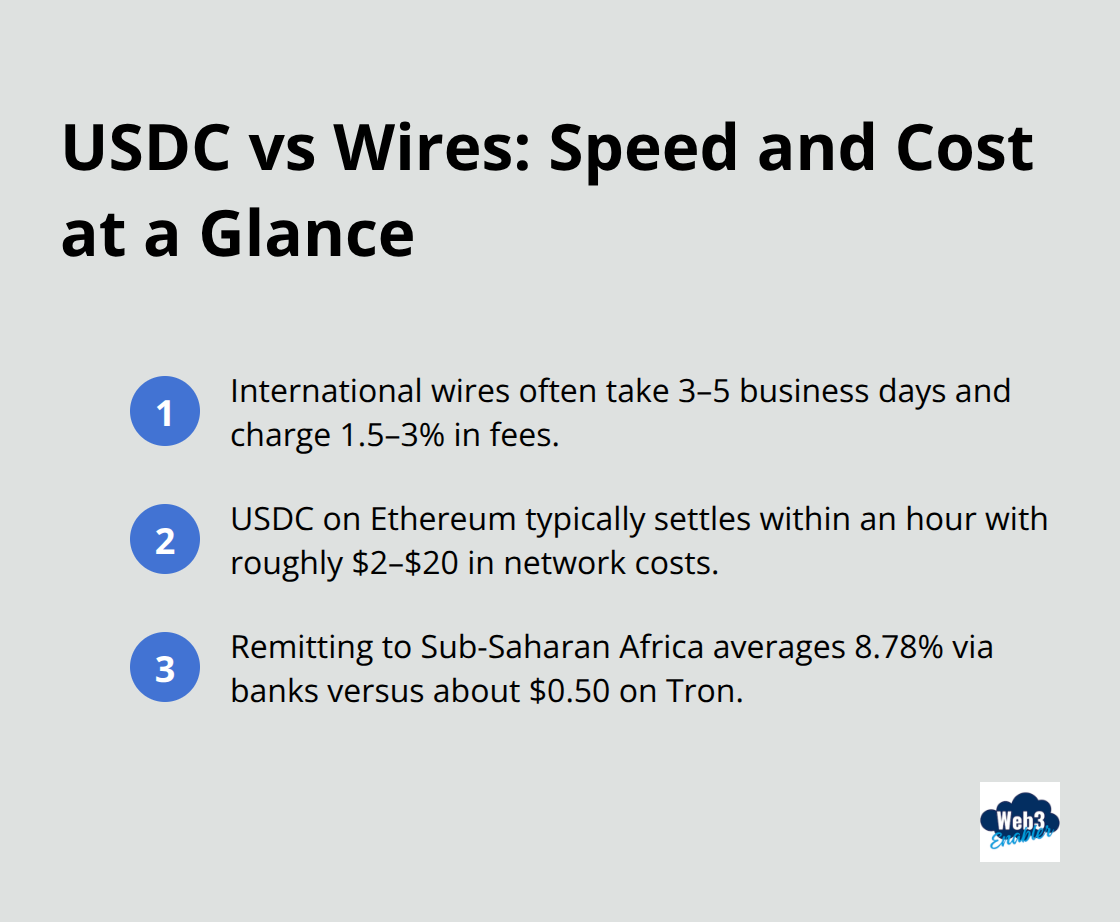
USDC payments settle in minutes, not days. A wire transfer to Singapore takes three to five business days and costs you 1.5 to 3 percent in fees. USDC on Ethereum costs roughly $2 to $20 depending on network congestion and settles within an hour. For vendors in emerging markets, the difference is even starker. Sub-Saharan Africa remittance fees average 8.78 percent per transaction, while USDC on Tron costs about $0.50. This matters because every day your money sits in transit is a day it’s not working for your business. Settlement finality on blockchain is absolute-no chargebacks, no reversals, no surprise holds from intermediary banks. Your counterparty receives funds, and the transaction locks in forever on the ledger.
That eliminates the settlement risk that keeps treasury teams up at night.
The Real Math on Global Payments
A $100,000 vendor payment to Mexico via traditional wire costs roughly $150 in fees and takes three to five days. The same payment in USDC costs under $5 and arrives in under an hour. Scale that across fifty vendors in thirty countries, and you’re looking at genuine savings-not theoretical ones. Bitso processed $6.5 billion in US-Mexico remittances in 2024, with stablecoins capturing a significant share of that volume because the economics are simply better. For treasury teams managing cash flow across subsidiaries, faster settlement means less working capital tied up in transit. Real-time visibility into payments also accelerates reconciliation. Traditional wire transfers leave you guessing when funds actually hit the destination account. USDC transactions are timestamped on-chain, so your finance team sees the exact moment settlement occurs and updates cash position immediately.
Why Banks Profit From Slowness
Banks profit from the float-the gap between when they debit your account and when they credit the recipient’s. They have zero incentive to speed this up. Regulatory guardrails like the GENIUS Act and the EU’s MiCA now mandate 100 percent reserve backing and monthly audits for stablecoins, which actually gives you more transparency than your bank provides. USDC is backed 1:1 by cash and short-term US Treasuries with regular third-party audits from the Centre Consortium, so you know exactly what’s behind every dollar.
Integrating USDC Without Ripping Out Your Stack
Your treasury team can move payments directly onto blockchain rails without replacing Salesforce or your existing accounting systems. Web3 Enabler, as a Salesforce ISV partner, connects USDC payments natively into Salesforce, so your team tracks payments, compliance, and reconciliation in the same interface they already use. This means your finance ops stay in one place while your settlement infrastructure gets faster and cheaper. The next step is understanding how this integration actually works with your existing workflows-and why native Salesforce connectivity matters more than you’d think.
How USDC Integrates Into Your Existing Workflow
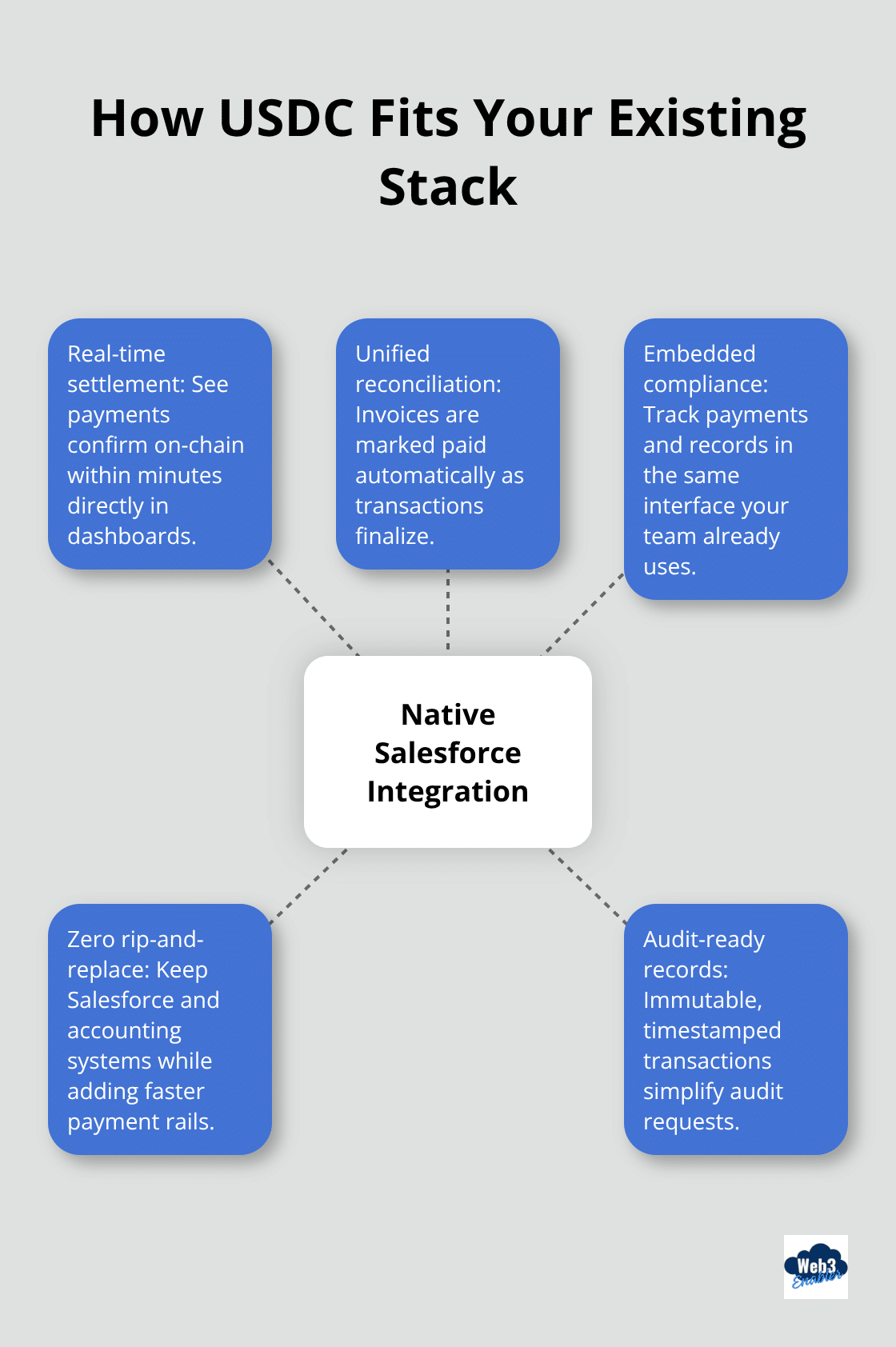
Your finance team abandons nothing when moving payments onto blockchain rails. USDC integration works inside the systems your treasury already uses every day. Web3 Enabler, as a Salesforce ISV partner, connects USDC payments natively into Salesforce, letting your team track payments, compliance records, and reconciliation in one place. When a vendor payment goes out in USDC, it appears in your Salesforce dashboard with the same clarity as a traditional wire transfer, except you see settlement happen in real time instead of waiting three to five days. Your accounting team marks invoices as paid the moment the transaction hits the blockchain, not when some bank decides to notify you. This eliminates the reconciliation nightmare where you hunt for confirmations across email, bank portals, and spreadsheets.
Audit Trails That Actually Work
USDC transactions are timestamped and immutable on-chain, so every payment creates an audit trail that satisfies compliance teams without requiring manual documentation. The compliance layer sits inside your workflow, not outside it, which means your finance ops don’t slow down when regulators ask questions. Regulatory frameworks like the GENIUS Act mandate reserve backing and real-time attestations for stablecoins, and USDC meets these requirements with attestations from the Centre Consortium, giving your audit team the transparency they need without extra busywork.
Real-Time Cash Position Without Manual Updates
Traditional payments hide cash flow visibility behind bank processing delays. A wire transfer debits your account immediately, but the recipient doesn’t see funds for days, leaving your treasury team blind to actual cash position across subsidiaries. USDC payments settle in minutes, so your cash position updates automatically across all your systems. Your controller sees that a $500,000 payment to your Singapore office arrived and is available for operations within the hour, not guessing whether it’s stuck in some intermediary bank. This matters for working capital management because faster settlement frees up cash sitting idle in transit. Companies managing fifty vendors across thirty countries save thousands monthly just from the working capital freed up through accelerated settlement.
Your team also gains the ability to automate conditional payments. Stablecoin rails support programmable settlement, meaning you encode rules like releasing payment only when an invoice is verified or splitting payments across multiple wallets automatically. Your finance ops shift from manual workflows to systems that execute without human intervention, reducing errors and freeing your team to focus on strategy instead of processing.
Compliance Checks That Happen in Real Time
Audit trails on blockchain are permanent and transparent. Every USDC transaction includes the sender, receiver, amount, timestamp, and cryptographic proof of settlement, all recorded on-chain forever. Your compliance officer gains visibility into payment flows without asking vendors or banks for documentation. When regulators ask about cross-border payments or sanctions screening, you pull the on-chain record and prove exactly when money moved and where it went. This beats traditional wires where you depend on banks to provide statements and confirmations weeks after the fact.
KYC and AML compliance integrates into the payment initiation process, not as an afterthought. Web3 Enabler’s Salesforce integration includes compliance checks built into your payment workflow, so your team flags high-risk transactions before they execute rather than discovering issues during audits. Your treasury team moves faster because compliance happens in real time, not in quarterly reviews. The combination of immutable on-chain records and automated compliance checks transforms your audit from a defensive exercise into a competitive advantage, proving to auditors and regulators that your payment controls are actually tighter than banks using legacy systems. With this foundation in place, your team is ready to see how these capabilities translate into real-world applications across vendor payments, payroll, and customer settlements.
Real-World Applications for Global Treasuries
Vendor Payments That Actually Move the Needle
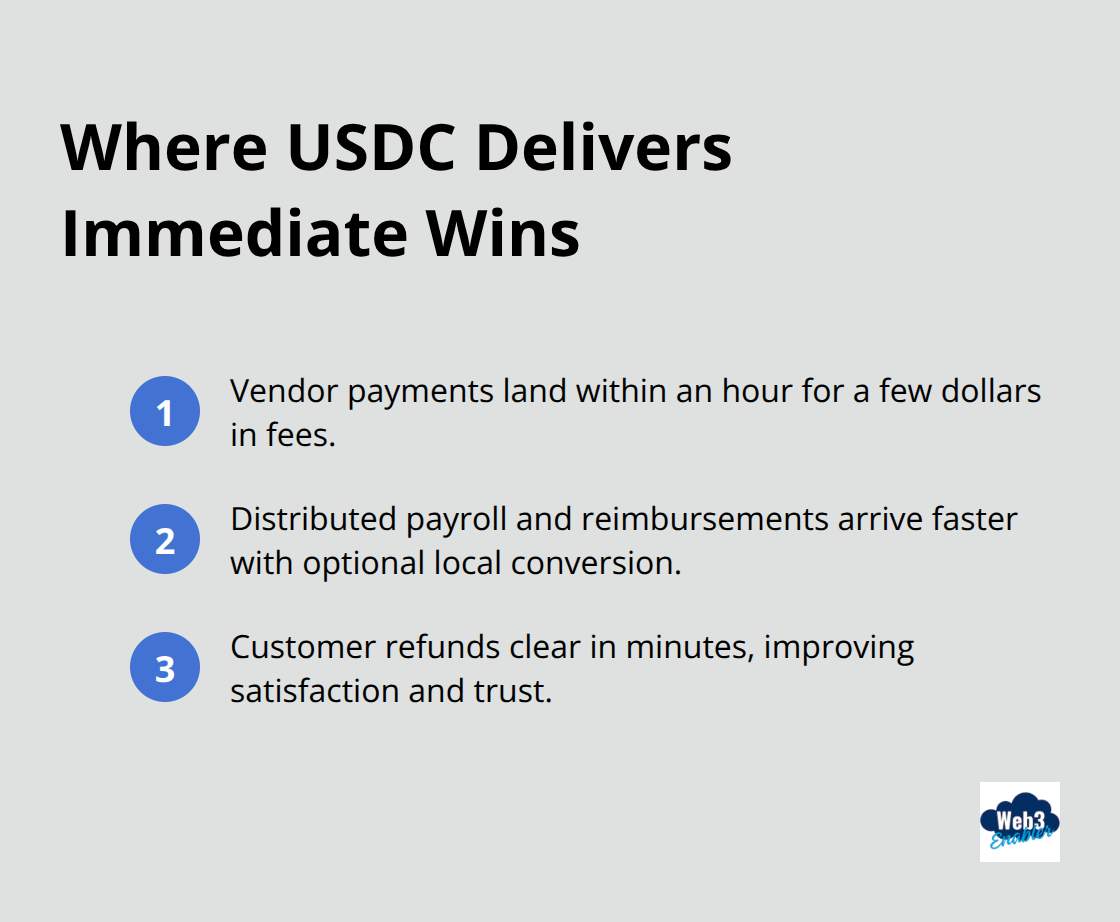
Vendor payments across borders represent the clearest win for USDC integration, and the numbers justify moving immediately. A $100,000 payment to a vendor in Mexico costs roughly $150 in wire fees and takes three to five days using traditional banking. The same payment in USDC costs under $5 and settles within an hour. Bitso processed $6.5 billion in US-Mexico remittances during 2024, with stablecoins capturing significant volume because the math is undeniable. Scale this across thirty vendors in ten countries and your treasury team saves tens of thousands annually while freeing working capital stuck in transit. More importantly, your accounting team marks invoices paid the moment settlement hits the blockchain instead of waiting for bank confirmations. Sub-Saharan Africa remittance fees average 8.78 percent per transaction, but USDC on Tron costs about $0.50, which means vendors in emerging markets actually receive more of what you send them. This creates genuine competitive advantage when recruiting suppliers in cost-sensitive regions.
Payroll and Reimbursement Without Geographic Friction
Employee reimbursement workflows shift dramatically with USDC integration because your team members receive reimbursements in stablecoins and convert to local currency on their own schedule. A contractor in Argentina can accept USDC payment and hold it as a USD hedge against local inflation, or convert immediately to pesos depending on economic conditions that day. Argentina’s stablecoin usage sits around 46.6 percent USDC according to recent data, which tells you the market is already moving this direction in high-inflation environments. Rise supports ninety-plus local currencies and enables daily payroll capability with funds arriving at midnight GMT on workdays, meaning your distributed team members receive payment faster than traditional banking allows. Employees choose whether they want fiat, USDC, USDT, or a combination each cycle, which eliminates the friction of rigid payroll systems that treat everyone the same regardless of their location or preference.
Customer Refunds That Build Trust
Customer refunds become genuinely faster with USDC because you eliminate the back-and-forth of bank routing numbers and wire instructions. A customer in Singapore receiving a refund gets USDC in their wallet within minutes rather than waiting five business days for a bank transfer to clear. This matters for customer satisfaction metrics because speed translates to trust, especially in B2B relationships where cash flow timing affects operations. The compliance layer handles everything automatically, so your finance team does not need to manually verify refund requests or worry about sanctions screening on every transaction. Stablecoin rails support conditional payments, which means you can encode rules like releasing refund payments only after a dispute resolves or an invoice receives verification, removing manual approval bottlenecks. Grey now supports receiving USDC payments and converting them to USD, enabling smoother integration into USD-based treasury workflows, which means your team can accept USDC from customers and settle back to fiat whenever the timing makes sense for your cash position. The combination of speed, transparency, and programmable settlement transforms customer refunds from a pain point into a competitive differentiator. Your treasury team that implements USDC payments today gains months of operational advantage before competitors catch up.
Final Thoughts
USDC payments integration transforms treasury operations from a waiting game into a competitive advantage. Your team moves money in minutes instead of days, cuts costs by ninety-five percent on cross-border transactions, and gains audit trails that satisfy regulators without extra busywork. A $100,000 vendor payment costs under $5 in USDC versus $150 through traditional wires, and that gap compounds across dozens of vendors in dozens of countries. Settlement finality eliminates counterparty risk, real-time cash visibility frees working capital stuck in transit, and employees in high-inflation regions like Argentina hold USDC as a currency hedge or convert to local fiat on their schedule.
The infrastructure already exists, so you do not need to rip out Salesforce or your accounting systems. Web3 Enabler connects USDC payments natively into the systems your team already uses every day, which means compliance, reconciliation, and payment tracking happen in one place without learning new tools. Regulatory frameworks like the GENIUS Act and MiCA now mandate reserve backing and audits for stablecoins, which actually gives you more transparency than traditional banking provides. USDC backed one-to-one by cash and short-term US Treasuries with regular third-party audits removes the guesswork about what stands behind your payments.
Your competitors are already moving, and the treasury teams that implement USDC payments integration today gain months of operational advantage before the rest of the market catches up. Start by mapping your highest-friction payment corridors and calculating the working capital freed up through faster settlement. Then connect with Web3 Enabler to see how native Salesforce integration brings blockchain payments into your existing workflow without disruption.