



Treasury teams managing global stablecoin operations face a critical problem: they can’t see liquidity movements in real time, making it impossible to forecast cash positions accurately.
Traditional forecasting tools weren’t built for blockchain-based assets, leaving finance leaders flying blind when it comes to settlement timing and wallet balances. At Web3 Enabler, we’ve seen firsthand how stablecoin treasury forecasting transforms this challenge into a competitive advantage by connecting on-chain data directly to your financial planning systems.
Why Treasury Teams Can’t Forecast Stablecoin Liquidity
Manual Processes Clash with 24/7 Settlement
Most treasury teams still operate within batch settlement windows and manual reconciliation processes designed for banking hours, not 24/7 blockchain operations. When you move stablecoin payments across borders, your liquidity sits in wallets and on-chain accounts that traditional ERP systems cannot see. Banks face mounting pressure to move liquidity on demand as markets never close, making real-time settlement capabilities increasingly critical for treasury operations. Yet most finance leaders lack visibility into when those stablecoins actually arrive, how much sits in each wallet, or when to trigger the next payment batch. This gap between on-chain reality and your accounting records creates operational friction that slows cash forecasting by days. Traditional cross-border payments already take 3 to 5 days to settle, but even stablecoins-which settle in minutes-cannot help if your team still waits for manual confirmations or checks multiple wallet interfaces outside your CRM. The result is trapped liquidity, missed payment opportunities, and forecasts that become outdated before completion.
Speed Demands Real-Time Data Integration
Stablecoins like USDC and USDT settle within minutes because they move on blockchain rails, not correspondent banking networks. However, speed only matters if your treasury team can actually see and act on that liquidity in real time. Tokenized deposits-digital representations of bank deposits issued on blockchain-allow direct, real-time transfers between institutions with instant ownership updates. Yet most finance teams still check wallet balances manually through separate interfaces. Web3 Enabler connects your on-chain transactions directly into Salesforce, so your revenue and treasury teams see settlement status and wallet positions without switching tools. This means your forecasting models can ingest actual on-chain data instead of waiting for bank statements, and your treasury staff can trigger automated fund movements when predefined thresholds are hit. Reconciliation becomes instant because posting and settlement occur simultaneously, eliminating exception handling and manual matching. If your reserve account falls below a defined level, you can automatically move stablecoins to cover the shortfall rather than manually orchestrating the transfer the next business day.
Blockchain Payments Expose Hidden Forecasting Gaps
Stablecoins do not eliminate forecasting risk-they expose it. Unlike traditional bank transfers where you know the settlement date in advance, blockchain payments arrive whenever the network confirms them, sometimes within seconds. Your accounting system must recognize revenue the moment settlement occurs, not three days later when the bank confirms it. This requires forecasting models that ingest real-time on-chain data and automatically update your financial position. Most treasury teams lack the infrastructure to connect blockchain data to their forecasting tools, leaving them unable to predict cash positions accurately even with stablecoins in place. Implementing predictive liquidity planning means integrating on-chain visibility into your existing financial workflows-not building separate blockchain dashboards that sit outside your core systems. The next section shows how to connect wallet positions and settlement data directly to your Revenue Cloud forecasting models.
Building Your Stablecoin Forecasting Foundation
Connect Historical Data to Your Forecast Models
Treasury teams that rely on manual wallet checks or separate blockchain dashboards fall behind competitors who automate the connection between on-chain settlement and financial planning. The real advantage comes from feeding actual settlement movements directly into your forecasting models so that cash position calculations update instantly. Start with historical transaction data from your stablecoin corridors-track which payment routes settle fastest, how often delays occur, and which counterparties deliver on-time settlement. Bitget, Coinbase, and Kraken provide institutional-grade transaction history that you can backtest against your forecast models to calibrate accuracy. Token Metrics analyzes developer activity and on-chain money movements to flag when liquidity conditions might tighten, while Glassnode’s Net Unrealized Profit/Loss indicator shows whether markets are overheated or stabilizing-both signals that affect your stablecoin reserves’ purchasing power. Pull three months of actual settlement data from your payment routes, measure the stablecoin settlement variance between expected and actual arrival times, then build that variance into your forecast models as a confidence band rather than a point estimate. This approach outperforms traditional treasury forecasting because stablecoins settle in minutes, not days, meaning your variance window shrinks dramatically and your forecasts become actionable within hours instead of weeks.
Automate Threshold Alerts for Real-Time Fund Movements
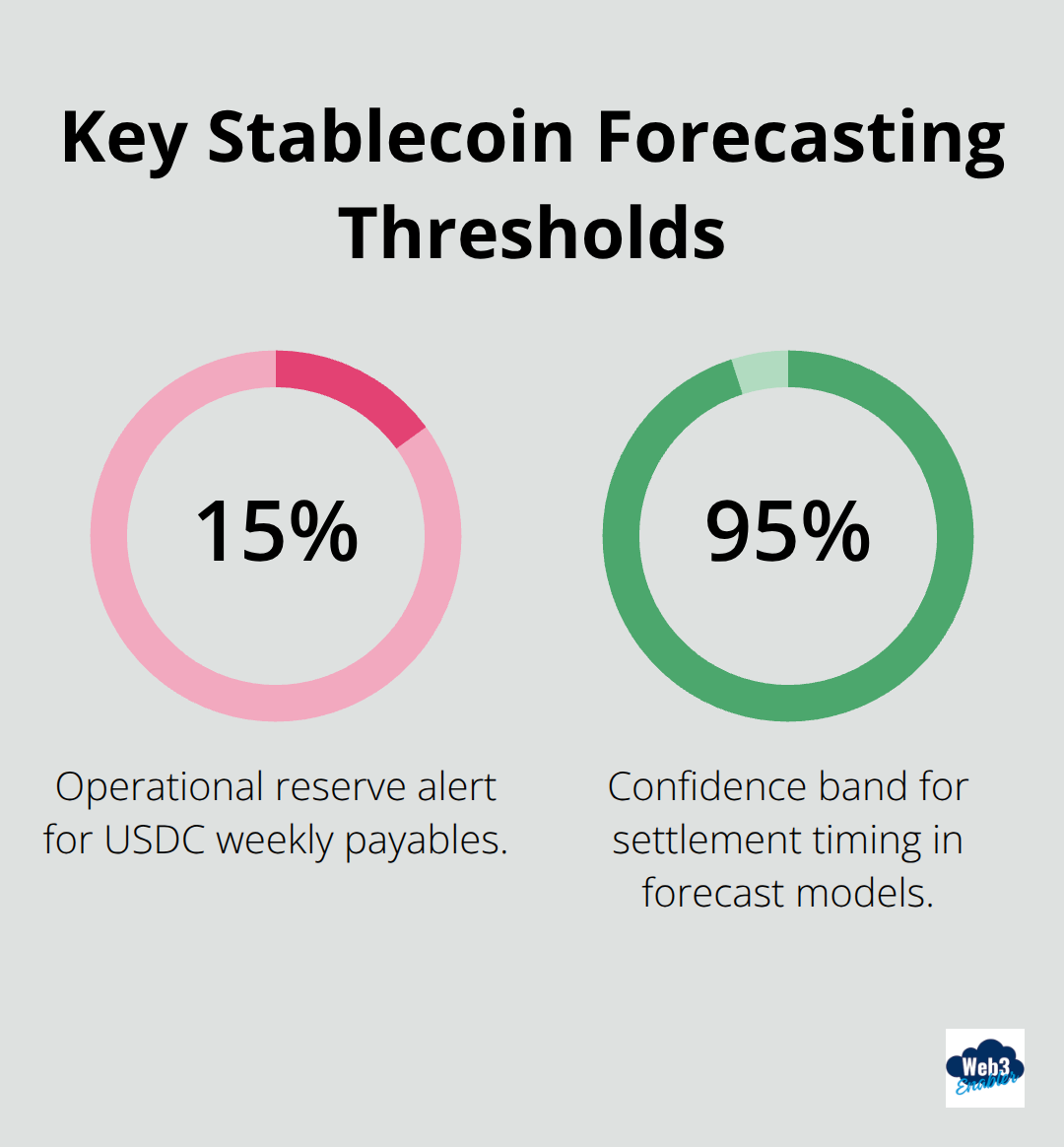
Once you establish baseline forecasting accuracy, layer in automated threshold alerts that trigger fund movements without manual intervention. If your operational reserve in USDC drops below 15 percent of weekly payables, an automated workflow should move stablecoins from your settlement wallet into that reserve without waiting for the treasury team to notice. Web3 Enabler connects your on-chain wallet positions directly into Revenue Cloud, so these thresholds live inside your forecasting dashboard and trigger actions based on real-time balances, not spreadsheet snapshots. Set alerts for three scenarios: liquidity falling below minimum operational reserves, settlement delays exceeding your forecast confidence band by two standard deviations, and counterparty stablecoin positions concentrated in a single issuer above your risk tolerance. Polymarket’s decentralized prediction markets signal regulatory or market stress up to a day before official announcements, giving you lead time to adjust your threshold triggers before conditions deteriorate.

Test Automation Before Tightening Thresholds
Automated alerts only work if they connect to actual execution capability-setting an alert that requires manual approval defeats the entire purpose of real-time forecasting. Build your alert thresholds conservatively at first and test them against three months of historical data to verify they would have prevented past liquidity shortfalls. Gradually tighten the bands as your team gains confidence in the automation. This staged approach reduces the risk of over-triggering alerts while you validate that your on-chain data feeds remain reliable and your Revenue Cloud workflows execute without delays. Once your team trusts the automation, you can shift from reactive threshold management to predictive liquidity positioning-moving funds before shortfalls occur rather than responding after they happen. The next section shows how to integrate these forecasting models with your broader settlement operations and counterparty risk management.
Automating Settlement Forecasting in Revenue Cloud
Map Payment Corridors and Configure Automated Recognition
Revenue Cloud transforms stablecoin treasury forecasting from a manual, error-prone process into an automated workflow that executes decisions in real time. The platform connects your on-chain wallet positions directly to your financial forecasting models, so your treasury team stops checking blockchain explorers and spreadsheets and instead monitors settlement activity through Revenue Cloud dashboards that update as transactions confirm. Start by mapping your stablecoin payment corridors into Revenue Cloud as distinct settlement routes, then configure automated revenue recognition rules that trigger the moment on-chain settlement occurs rather than waiting for bank confirmations days later. Web3 Enabler integrates your wallet balances and transaction history directly into Revenue Cloud, so your forecasting engine ingests actual on-chain data without manual imports or API delays.
Your accounting close accelerates because posting and settlement now occur simultaneously-no exception handling, no manual matching, no reconciliation delays. Configure Revenue Cloud to recognize revenue the instant on-chain settlement confirms, eliminating the three-to-five-day lag that traditional banking introduces.
Build Baseline Forecasts from Settlement Variance
Set your baseline forecast by analyzing settlement variance across your active corridors over the past 90 days. Measure the gap between expected arrival time and actual confirmation, then build that variance into your confidence bands. If USDC transfers from your operational wallet to your settlement account typically arrive within 45 seconds with a standard deviation of 12 seconds, your forecast model should assume a 95-percent confidence band of 21 to 69 seconds, not a single point estimate. This precision lets your treasury team position liquidity proactively rather than react to surprises.
Surface Real-Time Metrics Through Custom Dashboards
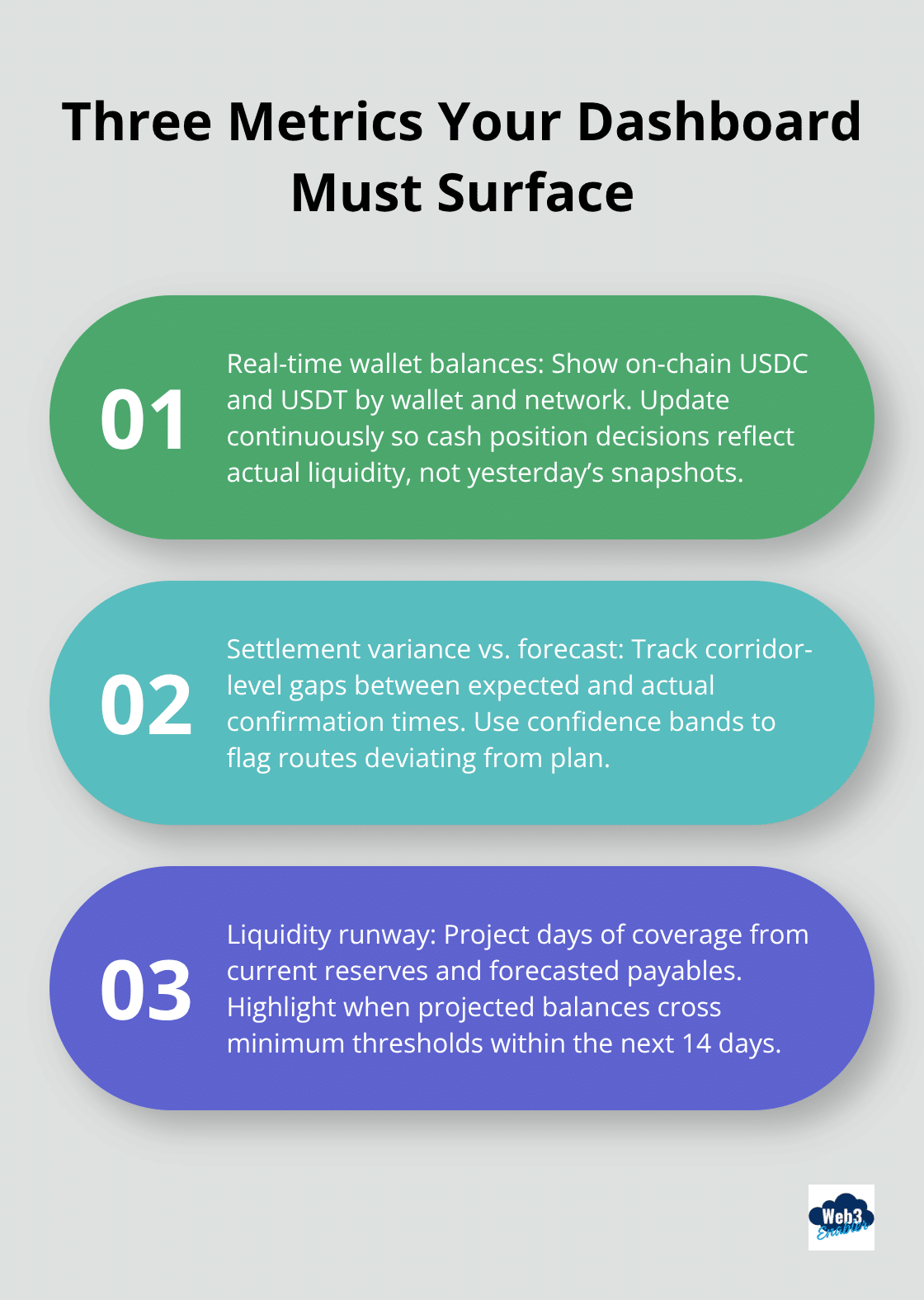
Custom dashboards in Revenue Cloud should surface three critical metrics that traditional treasury systems cannot display: current on-chain wallet balances updated in real time, settlement variance against forecast for each payment corridor, and liquidity runway calculations based on actual cash flow patterns rather than historical averages. Build a dashboard that shows your operational reserve balance in USDC alongside your forecasted weekly payables, then add a visual indicator that flags when projected balances fall below your minimum operational threshold within the next 14 days. This gives your treasury team lead time to move funds from settlement wallets or adjust payment schedules before shortfalls occur.
Add a second dashboard layer that displays settlement performance by counterparty-which payment providers deliver on time consistently, which ones introduce delays, and which corridors tighten during market stress. Polymarket’s decentralized prediction markets often signal regulatory announcements or market volatility up to 24 hours before official news breaks, so integrate those signals as a risk indicator on your dashboard to alert your team when external conditions might disrupt your stablecoin operations.
Connect Wallet Positions to Forecasting Models
Connect your wallet positions to your financial forecasting models by configuring Revenue Cloud to pull on-chain balances every 15 minutes rather than waiting for manual daily updates. This means your cash position calculations stay current throughout the business day, and your treasury team can make funding decisions based on actual liquidity rather than yesterday’s snapshots. Test this automation against your historical settlement data first-run a simulation using the past three months of actual on-chain transactions and verify that your automated thresholds would have prevented past liquidity shortfalls without generating false alerts.
Once your team gains confidence in the data feeds and execution logic, shift from daily manual reviews to exception-based monitoring, freeing your treasury staff to focus on strategic decisions instead of operational busy work.
Final Thoughts
Stablecoin treasury forecasting transforms how your finance team manages liquidity across global operations. When you connect on-chain settlement data directly to Revenue Cloud, your treasury staff stops checking blockchain explorers and spreadsheets and instead monitors real-time wallet positions through dashboards that update as transactions confirm. This shift from manual reconciliation to automated decision-making prevents liquidity shortfalls before they occur and accelerates your accounting close from days to minutes.
The modernization path starts simple: map your stablecoin payment corridors, analyze settlement variance over 90 days to establish baseline accuracy, and layer in automated threshold alerts that trigger fund movements without manual intervention. Test those alerts against historical data before tightening the bands, then shift from reactive threshold management to predictive liquidity positioning once your team gains confidence in the automation. Your forecasts become actionable within hours instead of weeks, and your operational reserves stay positioned to cover unexpected demand.
Web3 Enabler connects your on-chain wallet positions directly into Revenue Cloud so your forecasting engine ingests actual on-chain data without manual imports or API delays. Web3 Enabler empowers your finance team to implement stablecoin treasury forecasting directly within Salesforce, transforming settlement complexity into a strategic advantage that reduces operational risk and frees your team to focus on decisions that matter.