



Your payment infrastructure is stuck in the past. Traditional methods drain your margins with high fees, slow settlements, and friction that kills international sales.
Stablecoin payments in Salesforce change that equation. We at Web3 Enabler built Blockchain Payments to let you accept digital currencies directly within Commerce Cloud, Revenue Cloud, and Sales Cloud-no middleware, no complexity.
Why Stablecoin Payments Make Economic Sense
The Cost and Speed Advantage
Traditional payment networks charge 2-3% per transaction plus fixed fees that compound across high-volume operations. Stablecoin payments on blockchain settle at a fraction of that cost. Blockchain payments are 90% cheaper and settle 95% faster than traditional methods, which means your Salesforce teams spend less time reconciling and more time selling. For a mid-market company processing $10 million annually in cross-border transactions, that difference translates to $200,000 to $300,000 in recovered margin.
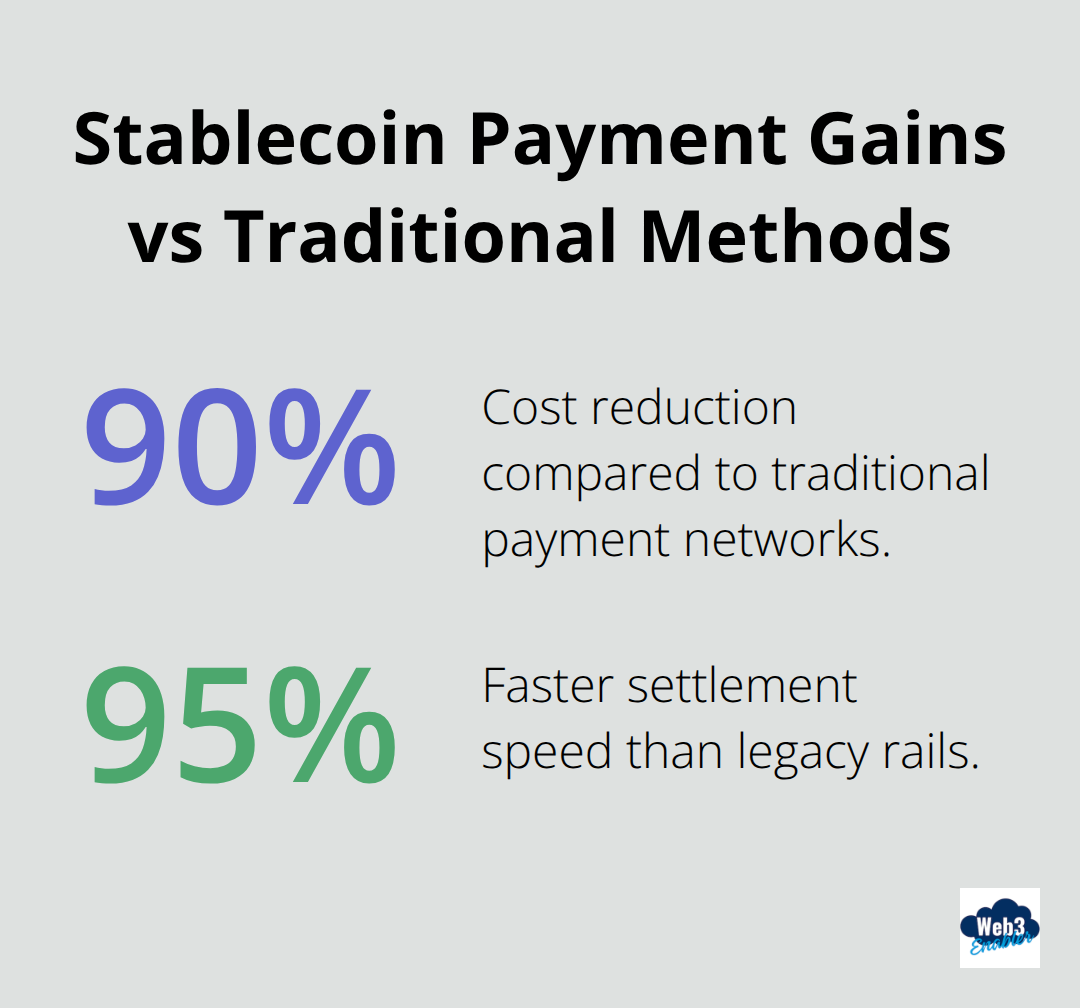
Settlement happens in minutes instead of 3-5 business days. This matters when you manage cash flow across multiple currencies and regions. International transfers that normally require correspondent banking networks and multiple intermediaries now move directly from wallet to wallet within your Salesforce environment. Your sales teams see faster customer confirmations. Your finance team gains real-time visibility into transaction status without manual bank calls or waiting for clearing house notifications.
Real Transaction Volume Confirms the Shift
The adoption data confirms this isn’t theoretical. Cross-border payment volumes are forecast to exceed $180 trillion by 2027. That’s real transaction volume flowing through blockchain rails right now. Your competitors in financial services, e-commerce, and enterprise billing are already testing these capabilities.
The barrier to entry has collapsed because you no longer need separate systems, wallet infrastructure, or blockchain expertise. Web3 Enabler integrates directly into Salesforce as a native app on the AppExchange, meaning your existing Salesforce workflows handle stablecoin payments the same way they handle everything else.
Operational Simplicity Within Salesforce
Your compliance team gets audit trails baked into Salesforce objects. Your revenue recognition follows standard Salesforce automation. Your customer data stays unified. You don’t bolt on external services or manage separate reconciliation processes. That operational simplicity is why enterprises with global operations and high transaction volumes move first. They measure success in days to deployment, not months, because the friction that typically slows blockchain adoption simply doesn’t exist when payments live inside Salesforce.
The next step is understanding how to integrate these capabilities into your specific Salesforce environment-whether you operate Commerce Cloud, Revenue Cloud, or Financial Services Cloud.
How Stablecoin Payments Connect to Your Salesforce Data
Native Integration Without Middleware
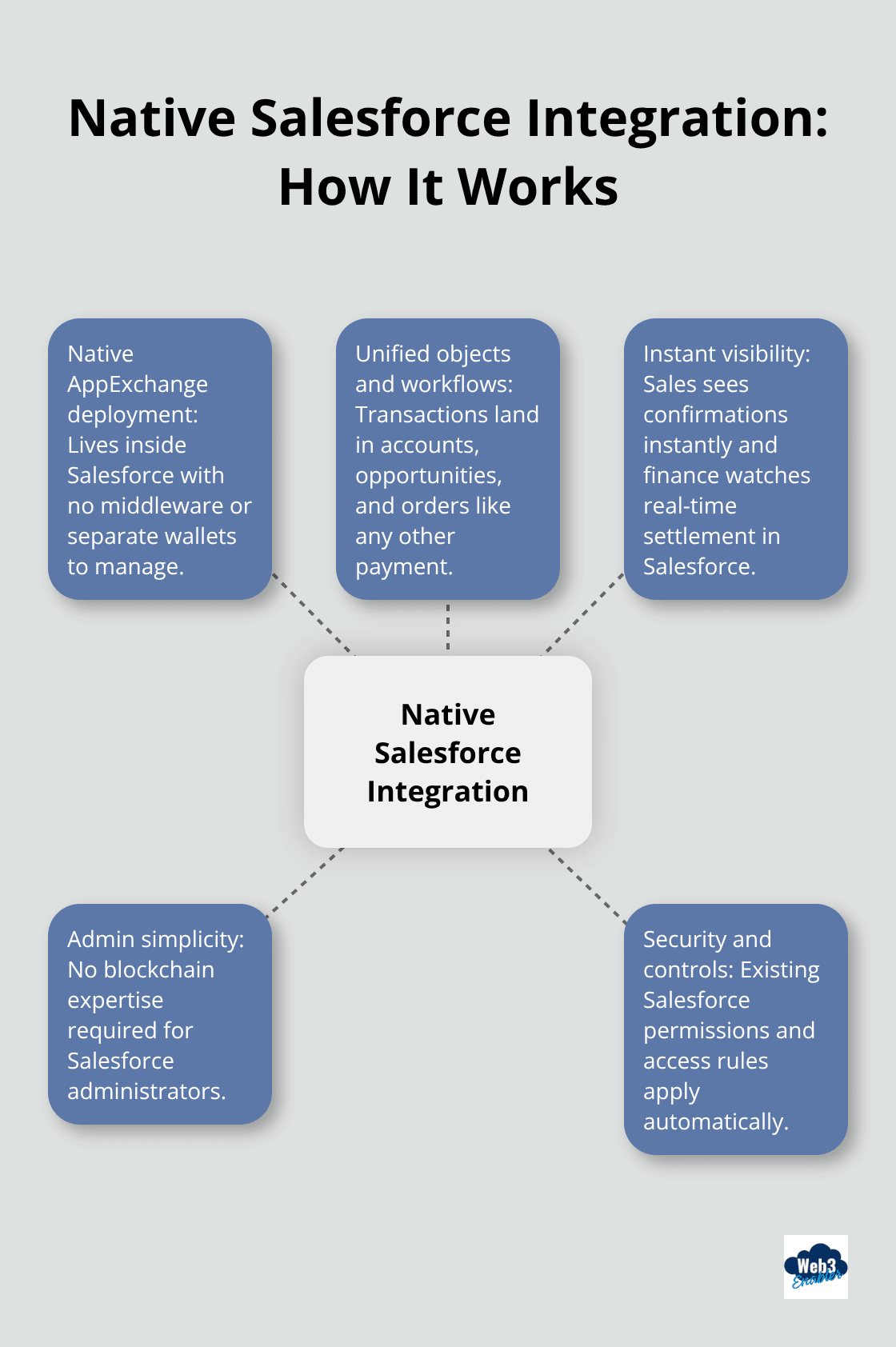
Stablecoin transactions inside Salesforce look and behave like every other transaction your teams already manage. Web3 Enabler sits natively on the AppExchange, which means stablecoin payments flow directly into Commerce Cloud, Revenue Cloud, or Sales Cloud without requiring separate wallets, middleware platforms, or blockchain expertise from your Salesforce administrators. We offer Salesforce Native Wallets, “Liquidation Wallets” that go directly to your bank account, or support for your non-custodial wallet. When a customer pays in USDC or another stablecoin, the transaction lands in your Salesforce objects-account records, opportunity stages, order management-exactly as it would with a traditional payment method. Your sales teams see payment confirmation instantly. Your finance team watches settlement happen in real time instead of waiting for bank clearing windows.
Speed That Transforms Cash Flow
This native integration eliminates the reconciliation delays that plague traditional cross-border payments. For mid-market companies handling high transaction volumes, that speed difference means cash flow visibility improves dramatically. A distributor processing 500 international invoices monthly gains immediate confirmation of payment completion rather than manual bank verification. Settlement happens in minutes instead of days, which transforms how you manage liquidity across multiple currencies and regions.
Audit Trails Built Into Your CRM
Compliance teams gain a structural advantage: every stablecoin transaction creates an immutable audit trail within Salesforce itself, tied directly to customer records, contracts, and revenue entries. Your existing Salesforce security controls, field-level permissions, and record access rules apply automatically to blockchain transactions-no separate access control systems to manage. Real-time reconciliation becomes automatic when stablecoin payments settle on-chain and post to your Salesforce ledger simultaneously. Unlike traditional payments where transaction status requires manual updates or third-party API polling, blockchain transactions confirm within minutes and trigger Salesforce workflows immediately.
Revenue Recognition and Financial Reporting
Your revenue recognition in Revenue Cloud can run on actual settlement confirmation rather than estimated clearing dates, which means financial reporting reflects true cash position sooner. For Financial Services Cloud users managing client digital asset positions, this real-time visibility extends to wallet balances and stablecoin holdings tied directly to account records-advisors see client on-chain positions without logging into external blockchain explorers or waiting for end-of-day settlement reports. Compliance and reporting workflows integrate into your existing Salesforce processes rather than requiring parallel systems. Transaction monitoring, customer due diligence, and audit trail generation happen within your CRM using the same tools and processes your teams already know.
Unified Operations Across Departments
This consolidation reduces operational friction and eliminates data silos where compliance information lives separately from customer and transaction records. Teams that previously managed stablecoin compliance in external spreadsheets or third-party compliance platforms now handle everything within Salesforce, which means faster decision-making and fewer manual handoffs between departments. Your finance, sales, and compliance teams collaborate within a single environment where stablecoin transactions carry the same visibility and control as traditional payments. The next step involves understanding how these capabilities apply across your specific Salesforce clouds-whether you operate Commerce Cloud for e-commerce, Revenue Cloud for enterprise billing, or Financial Services Cloud for wealth management and digital asset advisory.
Where Stablecoins Fit Into Your Salesforce Operations
Commerce Cloud: Accepting Stablecoins at Checkout
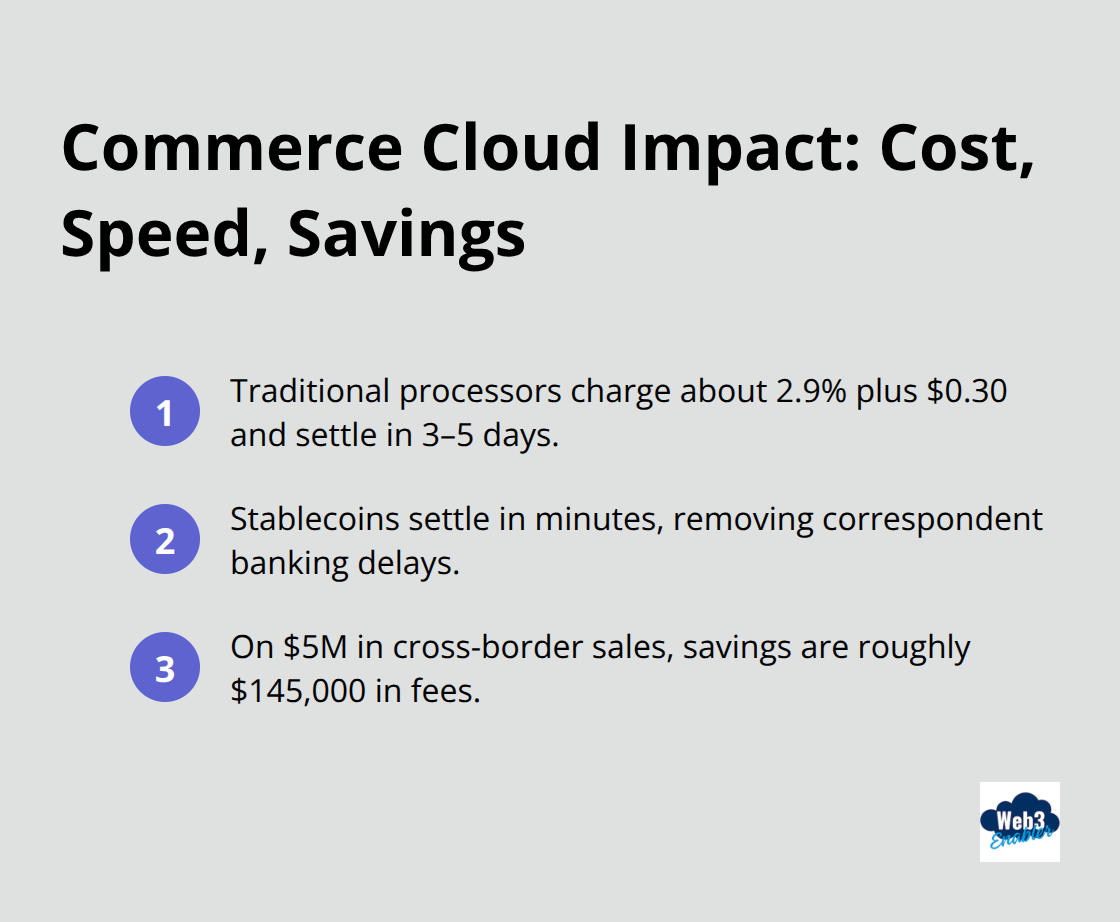
E-commerce teams in Commerce Cloud face a straightforward problem: international customers want faster checkout and lower fees, but traditional payment processors charge 2.9% plus $0.30 per transaction and require 3-5 days to settle. Stablecoin payments eliminate both friction points. A merchant processing $5 million annually in cross-border sales saves roughly $145,000 in processing fees alone when accepting USDC or other stablecoins. Settlement happens in minutes, which means inventory gets replenished faster and cash flow improves immediately.
B2B Customers see crypto payment options alongside traditional methods during checkout, transaction records post automatically to order objects, and your finance team watches settlement confirmations arrive in real-time instead of waiting for clearing house notifications. Your finance team sees a Purchase Order and an Inbound Payment to reconcile into their GL. This matters most for merchants selling to crypto-native audiences or operating in regions where traditional payment rails are expensive or unreliable – like Africa, LATAM, and South Asia. Your sales team tracks customer purchase history in the same account records regardless of payment method, which simplifies customer segmentation and loyalty program management.
Revenue Cloud: Accelerating Enterprise Billing
Revenue Cloud users managing enterprise billing across multiple currencies gain concrete advantages. When you invoice a customer in Singapore and accept USDT or accept USDC settlement instead of waiting for wire transfers through correspondent banking, cash hits your wallet in minutes rather than days. For companies processing hundreds of invoices monthly across different regions, this speed difference compounds into meaningful working capital improvements.
Your revenue recognition automation triggers on actual blockchain settlement confirmation rather than estimated clearing dates, which means your financial statements reflect true cash position sooner and your auditors see immutable transaction records tied directly to revenue entries. This real-time visibility transforms how your finance team manages liquidity across multiple currencies and regions without manual bank verification or third-party API polling.
Financial Services Cloud: Real-Time Digital Asset Visibility
Financial Services Cloud teams managing client digital assets operate with fundamentally different visibility than traditional wealth management platforms. Advisors see client wallet balances, stablecoin holdings, and on-chain transaction history without logging into external blockchain explorers or requesting manual reports from custodians. This unified view surfaces on-chain data directly within Financial Services Cloud account records, so advisors deliver real-time guidance on digital asset positions and execute settlement instructions without switching between systems.
This consolidated approach transforms how compliance and operations teams handle customer due diligence and transaction monitoring, since all relevant data lives in Salesforce alongside traditional account information rather than scattered across spreadsheets and third-party platforms. Your teams collaborate within a single environment where stablecoin transactions carry the same visibility and control as traditional assets.
Final Thoughts
Stablecoin payments in Salesforce eliminate the operational complexity that has historically blocked blockchain adoption in enterprise environments. Your teams gain faster settlements, lower costs, and real-time visibility without learning new systems or managing separate platforms. Whether you operate Commerce Cloud, Revenue Cloud, or Financial Services Cloud, the advantages compound across every department that touches payments or customer data.
When settlement happens in minutes instead of days, your cash flow improves immediately and your finance team stops waiting for clearing house notifications. Your compliance team gains immutable audit trails built directly into Salesforce objects rather than scattered across spreadsheets and third-party tools. Your sales teams see customer payment confirmations instantly, which accelerates order fulfillment and improves customer experience.
We at Web3 Enabler built Blockchain Payments specifically to eliminate this friction. As the only native blockchain payments app on the Salesforce AppExchange, we integrate directly into your existing Salesforce workflows without middleware, separate wallets, or blockchain expertise requirements. Connect Web3 Enabler to your Salesforce environment and enable stablecoin payment options within your chosen cloud to start your first transactions within minutes.
Frequently Asked Questions: Stablecoin Payments in Salesforce
What are stablecoin payments in Salesforce?
Stablecoin payments in Salesforce let businesses accept and send USD-pegged digital currencies (such as USDC or USDT) directly inside Salesforce products like Commerce Cloud, Revenue Cloud, and Sales Cloud. Instead of running payments through separate crypto tools, transactions can be captured in Salesforce records for faster settlement, easier reconciliation, and cleaner reporting.
Why should businesses accept stablecoin payments instead of traditional payment methods?
Stablecoins can reduce cross-border payment friction by improving settlement speed and potentially lowering fees compared to card processing and international wires. For businesses selling internationally, stablecoin rails can improve cash flow, reduce payment delays, and create clearer transaction visibility, especially when payments are tied directly to orders, invoices, and customer records in Salesforce.
How do stablecoin payments improve settlement speed and cash flow?
Traditional cross-border payments often settle in days due to banking hours, intermediaries, and clearing windows. Stablecoin payments can settle much faster on-chain, which gives finance teams earlier confirmation of payment completion. Faster settlement can improve working capital visibility and speed up fulfillment, billing cycles, and revenue recognition workflows.
Do we need middleware or a separate crypto payment platform to accept stablecoins in Salesforce?
With a native approach, stablecoin payments can be integrated into Salesforce without adding separate middleware layers. The advantage of a Salesforce-native workflow is that transaction data can live in the same system as accounts, orders, opportunities, and compliance records, which reduces tool sprawl and manual reconciliation.
How do stablecoin payments connect to Salesforce data like Orders, Opportunities, and Invoices?
When stablecoin payments are captured inside Salesforce, the transaction can be linked directly to the customer record and related objects (like Orders, Opportunities, or Invoices). This creates a unified trail from the customer interaction to the payment event and makes it easier for teams to confirm status, reconcile payments, and report results without jumping between systems.
How does Commerce Cloud use stablecoin payments at checkout?
In Commerce Cloud, stablecoins can appear as a payment option during checkout alongside traditional methods. When a customer pays in a stablecoin, payment confirmation can be tied to the order record, helping e-commerce teams reduce cross-border fees, improve authorization success, and get faster settlement visibility for fulfillment and inventory decisions.
How does Revenue Cloud benefit from stablecoin settlement?
Revenue Cloud teams managing subscriptions and enterprise billing can benefit from faster settlement and clearer confirmation when invoices are paid in stablecoins. When payment confirmation is tied directly to invoice records, finance teams can reduce manual follow-up, accelerate collections, and align revenue recognition more closely with actual settlement.
How does Financial Services Cloud support stablecoins and digital asset visibility?
In Financial Services Cloud, stablecoin payments and on-chain balances can be surfaced alongside traditional holdings to support advisory, compliance, and reporting workflows. This can reduce reliance on external dashboards and help teams maintain consistent audit trails and monitoring inside the CRM environment.
How do stablecoin payments support audit trails and compliance inside Salesforce?
On-chain payments provide transaction identifiers, timestamps, and verifiable settlement status. When this information is stored in Salesforce objects and linked to customer and revenue records, compliance teams can access audit-ready documentation in a structured format and reduce the time spent reconstructing payment trails from multiple platforms.
How does Web3 Enabler enable stablecoin payments in Salesforce?
Web3 Enabler’s Blockchain Payments enables stablecoin payment workflows inside Salesforce so teams can accept and track stablecoin transactions within the platforms they already use. The goal is to reduce operational complexity by keeping payment data connected to Salesforce records and workflows across Commerce Cloud, Revenue Cloud, and Sales Cloud.