


Your treasury team is probably drowning in spreadsheets while stablecoin payments settle in minutes. Traditional banking infrastructure wasn’t designed for the speed and transparency that modern finance demands.
At Web3 Enabler, we’ve seen firsthand how stablecoin treasury tools cut through the noise. Real-time visibility into your cash positions and faster cross-border settlements aren’t luxuries anymore-they’re competitive advantages.
Why Your Treasury Can’t Keep Up
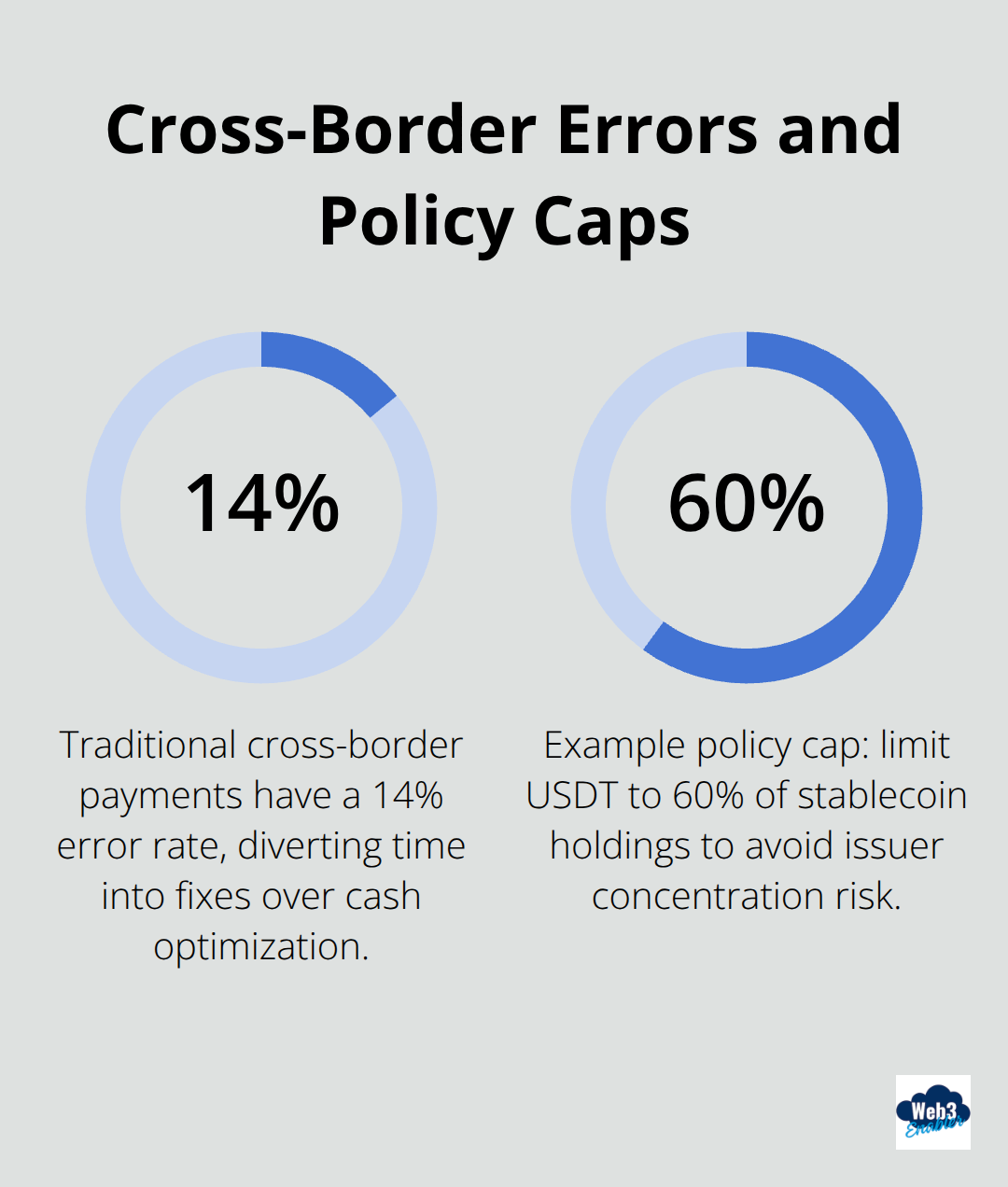
Traditional treasury systems operate on banking infrastructure designed in the 1980s, and it shows. Settlement takes three to five business days because money moves through correspondent banks, each adding their own delays and fees. A cross-border payment to Southeast Asia or Latin America sits in limbo over weekends and holidays, tying up working capital that could be deployed elsewhere. Standard Chartered reports that traditional cross-border payments carry a 14% error rate, meaning your team spends time fixing mistakes instead of optimizing cash flow.
Most treasury platforms were built to manage fiat currencies and bank accounts. They treat blockchain assets as exotic add-ons rather than core infrastructure, forcing your team to maintain separate systems, spreadsheets, and manual reconciliation processes that create friction and audit risk.
The Speed Problem Nobody Talks About
Stablecoins settle in minutes, not days. Visa reported over 3.5 billion dollars in annualized stablecoin settlement volume by November 2025, proving this isn’t theoretical anymore. A vendor payment using USDC or USDT clears in three to five seconds, eliminating the need to pre-fund overseas accounts and freeing trapped working capital immediately. Your finance team no longer waits for funds to arrive before deploying them into yield opportunities or covering operational needs. Traditional banking’s 24/5 operating window means Monday morning payments don’t clear until Wednesday afternoon. Stablecoins operate around the clock, letting you move money at 2 AM on Sunday if market conditions demand it. The cost difference is staggering too-a single cross-border wire costs 15 to 50 dollars and takes days, while a stablecoin transfer costs pennies and settles in minutes.
Why Legacy Tools Miss the Mark
Your current treasury platform probably can’t see stablecoin balances in real time, track on-chain transactions, or automate compliance reporting for digital assets. Integration requires custom APIs, external consultants, and months of implementation. Web3 Enabler built a Salesforce-native solution specifically to close this gap-connecting blockchain payments directly to your existing financial infrastructure without ripping out systems you’ve already invested in. Real-time cash visibility across traditional bank accounts and stablecoin wallets lives in Salesforce, the platform your team already uses daily. Automated compliance tracking flags suspicious activity instantly instead of waiting for monthly reports. Your accounts payable team can send global payments through the same interface they use for domestic transfers, eliminating training friction and reducing errors that plague manual processes.
What Happens When You Connect the Dots
When stablecoin treasury tools integrate with your existing stack, something shifts. Your team stops juggling multiple platforms and starts making faster decisions. Cash positions update in real time across all channels (traditional and blockchain), giving your CFO actual visibility instead of yesterday’s numbers. Compliance reporting happens automatically rather than through quarterly spreadsheet marathons. Vendor payments that once required three days of pre-funding now settle in seconds, freeing capital for strategic investments or emergency reserves. The friction disappears, and your treasury function transforms from a cost center managing legacy processes into a competitive advantage that moves money faster than your competitors can.
How Stablecoin Treasury Tools Actually Work
Stablecoin treasury tools sit between your existing financial systems and blockchain networks, translating on-chain activity into the real-time data your finance team needs. Unlike traditional treasury platforms that treat crypto as a side project, these tools integrate directly into your operational stack. Kyriba’s instant stablecoin payments powered by Fipto settle near-instantly, while GTreasury combined with Ripple’s enterprise infrastructure delivers real-time cash positions across traditional and digital assets simultaneously. The core mechanic is straightforward: your system connects to blockchain wallets via APIs, pulls balance and transaction data continuously, and feeds everything into your existing workflows. When you send a USDC payment to a vendor in Mexico, the tool tracks it from initiation through settlement in seconds, records it in your accounting system automatically, and updates your cash position in real time. No manual entry, no waiting for bank confirmations that arrive days later.
Real-Time Cash Visibility Across Everything
Your treasury dashboard now shows traditional bank balances and stablecoin holdings side by side without spreadsheets or manual reconciliation. Ripple Treasury, built on 40 years of GTreasury expertise, displays positions in USDC, USDT, and other assets within the same interface where you manage fiat accounts.

This matters because working capital decisions happen on incomplete information in legacy systems. When you know exactly how much USDC you hold in Singapore, how much USDT sits in your US wallet, and what your bank balance is in London all at once, you stop making decisions based on yesterday’s numbers. Every transaction creates an immutable audit trail on the blockchain, which means your compliance team gets permanent records instead of relying on bank statements that arrive monthly.
Compliance and Risk Happen Automatically
Tools like Kyriba’s Liquidity Performance product embed compliance directly into payment workflows rather than treating it as an afterthought. As stablecoins move through your treasury, the system flags counterparty risk, monitors exposure to specific issuers like Tether or Circle, and prevents concentration risk automatically. You set policy rules once-perhaps limiting USDT to 60% of your stablecoin holdings to diversify away from a single issuer-and the system enforces them continuously. Sanctions screening, KYB verification, and AML checks happen instantly rather than requiring manual reviews. This matters because the GENIUS Act signed in July 2025 requires monthly attestations and annual audits for stablecoin reserves. Systems that automate these disclosures give you compliance-ready documentation instead of scrambling to gather records. Your finance and legal teams no longer debate whether a transaction is reportable; the system handles it according to your configured rules.
Integration Without Ripping Out Your Stack
Salesforce-native solutions mean your accounts payable team sends stablecoin payments through the same interface they use for wire transfers. No new training, no parallel systems, no consultant overhead. The tool connects to your ERP, your bank APIs, and blockchain networks simultaneously, treating stablecoins as just another payment rail. When your procurement system flags a vendor invoice for payment, the workflow can automatically route it to stablecoin settlement if conditions match your policy-perhaps using USDC for international vendors and traditional wire transfers for domestic ones. This hybrid approach matters because you’re not betting your entire treasury on blockchain adoption overnight. You’re adding speed and transparency to specific corridors where the benefits are undeniable, then expanding gradually as your team gains confidence and comfort with the technology.
Practical Implementation for Your Business
Pick one payment corridor where stablecoins solve a real problem, not where they sound exciting. If you’re hemorrhaging money on monthly wire transfers to a vendor in the Philippines, that’s your pilot. If you’re paying contractors across Latin America and watching 14% of transactions get flagged for errors, that’s another solid candidate. The goal is measurable pain-specific lanes where traditional banking’s three to five day settlement window costs you money or operational friction.
Start With One Corridor That Hurts
Start small because your team needs to build muscle memory with the technology before you expand globally. A single vendor relationship or one geographic market teaches you what compliance workflows look like, how to manage counterparty risk with stablecoin issuers, and whether your current finance team can handle the operational shift. Most importantly, it gives you concrete numbers to show your CFO: this corridor saved us 47 dollars per transaction, settled in 90 seconds instead of 72 hours, and eliminated our pre-funding requirement for that vendor relationship.
Choose Platforms That Fit Your Existing Stack
Your treasury software stack didn’t cost six figures to implement so you could abandon it for blockchain. Solutions built natively on Salesforce let your accounts payable team initiate stablecoin payments from the same interface they use for domestic transfers, which means zero training overhead and zero parallel systems. Stablecoin treasury management software powered by modern platforms integrate directly into existing workflows rather than requiring custom APIs and consulting projects. The integration matters more than the flashy dashboard because your team’s adoption depends on friction-if paying a vendor in USDC requires three extra steps compared to a wire transfer, adoption dies.
Choose platforms that treat stablecoins as a native payment rail, not a bolted-on feature. When your ERP flags an invoice for payment, the system should automatically route it to stablecoin settlement if your policy rules permit it, with zero manual intervention. This automation is where the real efficiency gains hide. One treasury manager told us they eliminated two hours of daily reconciliation work because stablecoin transactions create immutable audit trails instead of relying on bank statements that arrive days late.
Track Three Metrics That Matter
Track settlement speed, cost per transaction, and working capital freed up during your pilot. Stablecoin transfers settle in three to five seconds versus three to five business days for traditional wires, so document exactly how many hours of pre-funding your vendor relationships required before and after. Calculate the wire fees you eliminated-most international transfers run fifteen to fifty dollars each, and if you process fifty vendor payments monthly to your pilot corridor, that’s seven hundred fifty to twenty five hundred dollars annually just in wire fees.
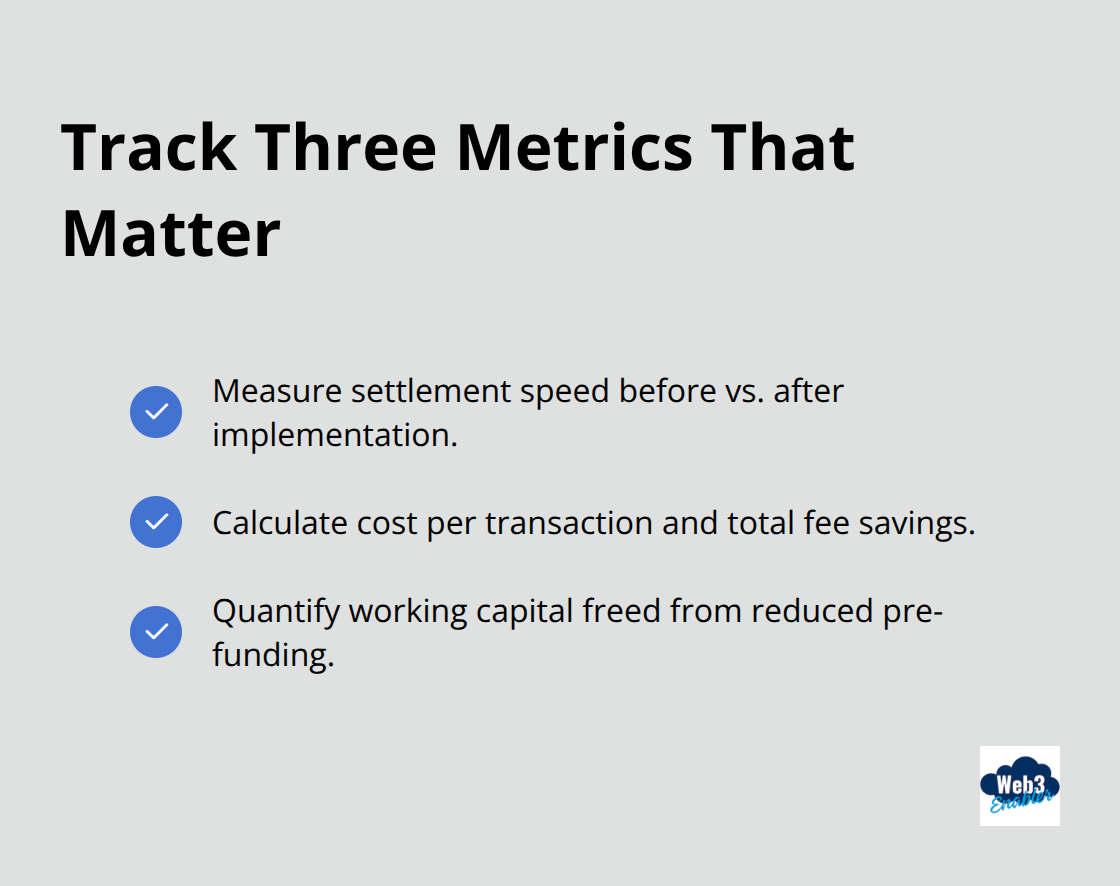
The real money sits in working capital acceleration. When a vendor payment settles in seconds instead of days, you stop maintaining cash buffers specifically to cover in-flight transfers. If your pilot corridor required maintaining one hundred thousand dollars in overseas pre-funding before stablecoins, and now it requires nothing, that’s one hundred thousand dollars you deploy into yield opportunities or emergency reserves. Capture these numbers in a simple spreadsheet alongside your transaction count and average settlement time. After 30 to 60 days, you’ll have concrete evidence whether stablecoins deliver value in your specific business context rather than relying on industry benchmarks that may not apply to your operations.
Final Thoughts
Stablecoin treasury tools transform how companies move money across borders and manage cash positions in real time. Your existing infrastructure stays intact while speed, transparency, and working capital acceleration become immediate competitive advantages. The shift happens gradually, one payment corridor at a time, which means you avoid the consultant overhead and system replacement projects that plague traditional treasury upgrades.
We at Web3 Enabler built Salesforce-native solutions specifically for this transition. Your accounts payable team initiates stablecoin payments through the same interface they use for domestic transfers, your compliance team receives automated reporting instead of manual reviews, and your CFO gains real-time visibility without expensive implementations. We connect blockchain technology directly to your existing corporate infrastructure because modern treasury management doesn’t require abandoning systems you’ve already invested in.
Start your pilot now with one corridor where traditional banking costs you money or operational friction. Measure settlement speed, transaction costs, and working capital freed up over 30 to 60 days. The clarity you gain will make expansion obvious.