



Your payment options are stuck in 2005 while your customers live in 2026. Crypto isn’t some fringe experiment anymore-it’s how forward-thinking businesses are getting paid faster, cheaper, and without the banking middleman.
We at Web3 Enabler know that integrating blockchain payments sounds like a nightmare. But Salesforce Revenue Cloud payments changes that equation entirely, letting you accept crypto without ripping apart your existing systems.
Why Crypto Payments Are Already Winning With Your Customers
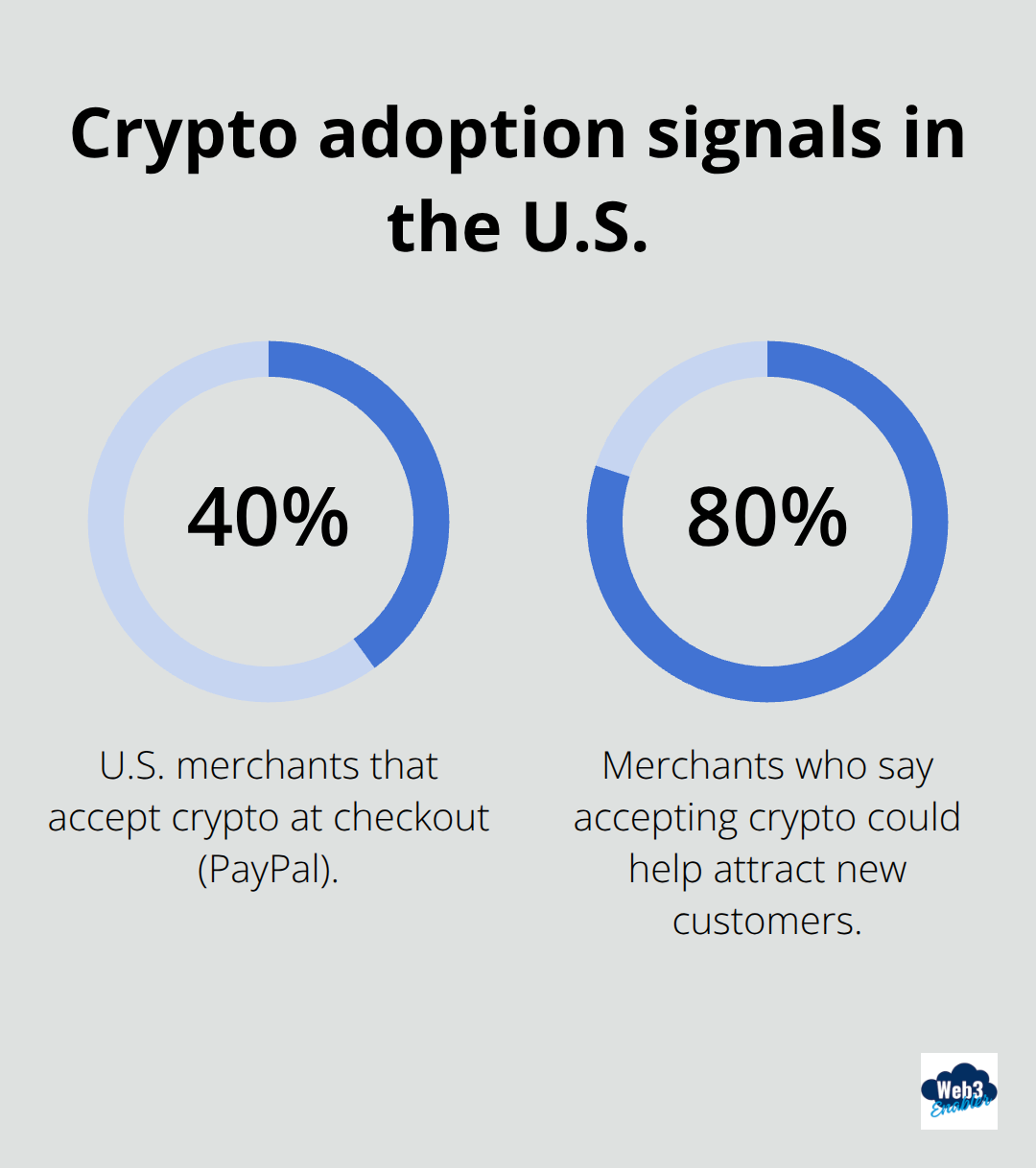
Your customers are already using crypto. According to PayPal, 4 in 10 U.S. merchants accept crypto at checkout. This isn’t a future trend-it’s happening right now. Large enterprises move fastest because they understand the math: crypto payments settle in minutes instead of days, and transaction costs drop dramatically without traditional banking intermediaries sitting in the middle taking their cut.
If you’re not offering this option, you’re actively telling a growing segment of customers to shop elsewhere.
The speed advantage is real and measurable. Traditional cross-border payments take 3-5 business days through banking networks. Stablecoins like USDC and USDT settle on blockchain in under a minute, which means your business receives payment faster and can reinvest that capital immediately instead of waiting for settlement windows. For global companies, this acceleration compounds. A mid-market business that processes 100 international transactions monthly could recapture weeks of float annually just by switching to crypto rails alongside traditional payments.
The Enterprise Segment Already Moved
Adoption splits sharply by company size, and the pattern is unmistakable. Meanwhile, four in five merchants agree that accepting crypto could help them attract new customers, highlighting its value as both a payment method and a customer acquisition tool. These aren’t retail crypto enthusiasts-they’re CFOs and controllers who’ve done the math on settlement costs and decided crypto makes financial sense. Mid-market adoption lags not because the value proposition is weak, but because implementation barriers still exist.
Square moved 4 million vendors toward crypto acceptance, proving that when payment infrastructure simplifies crypto integration, adoption accelerates rapidly. The winning move now is removing friction before your competitors do, because once enterprise clients standardize on crypto payments, they’ll expect every vendor to support it.
Global Expansion Gets Cheaper and Faster
Crypto payments unlock markets that traditional banking makes unprofitable. A company that sells software subscriptions to customers across Southeast Asia, Africa, or Latin America faces brutal wire fees, currency conversion spreads, and multi-day settlement delays. Stablecoin payments eliminate most of that friction. You receive payment instantly in a currency you can immediately convert or hold, without waiting for correspondent banks or paying percentage-based intermediary fees.
This matters for customer acquisition in emerging markets where traditional payment infrastructure is expensive or unreliable. Customers in those regions often prefer crypto because it’s faster and cheaper than what their local banking system offers them. The next section shows how Salesforce Revenue Cloud Payments removes the technical complexity that once made this integration feel impossible.
How Salesforce Revenue Cloud Payments Works
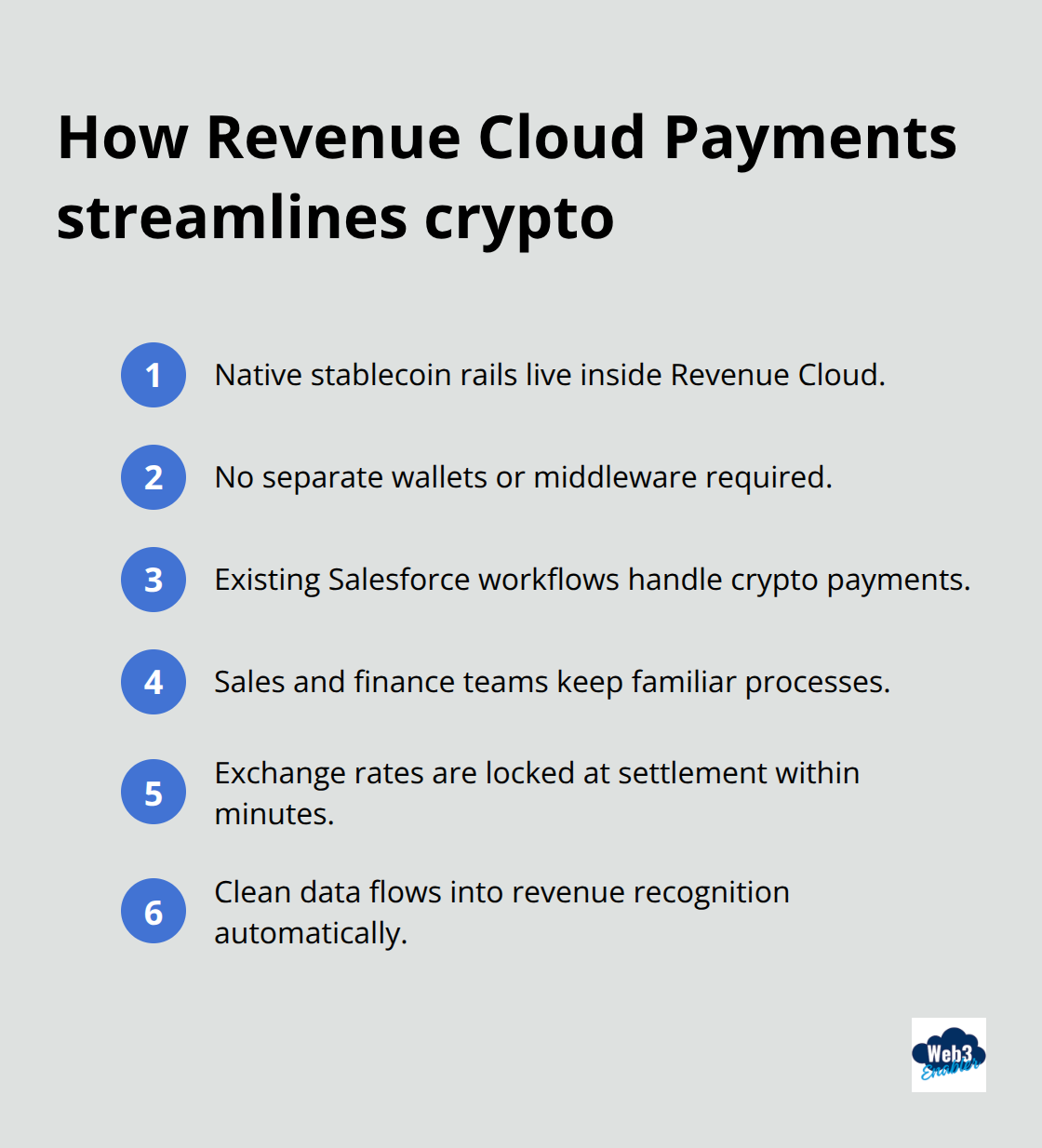
The real advantage of Salesforce Revenue Cloud Payments isn’t that it adds blockchain somewhere in your tech stack. It’s that crypto payment rails sit natively inside the platform where your revenue actually happens. You don’t need separate wallets, middleware layers, or custom integrations that cost six figures and take months to deploy. Stablecoins like USDC and USDT flow directly through Revenue Cloud, which means your finance team sees crypto transactions in the same dashboard where they track every other payment method. Settlement happens on blockchain in minutes, but from your Salesforce perspective, it feels like any other payment landing in your system.
Skip the Custom Development Nightmare
Most companies assume crypto integration requires hiring blockchain developers, building custom APIs, and spending months on testing. Revenue Cloud Payments inverts that equation. Native stablecoin acceptance means your existing Salesforce workflows handle crypto payments without modification. Your sales team doesn’t learn new processes. Your finance team doesn’t reconcile crypto transactions in a separate system. Payment data flows into your revenue recognition module automatically, which matters because crypto transactions settle instantly while your accounting still needs accurate revenue records tied to customer records.
A mid-market SaaS company processing 500 monthly transactions activates crypto payments in weeks instead of quarters, and that speed advantage compounds when you consider the revenue impact of accepting customer payment preferences immediately instead of waiting for development sprints.
Real-Time Visibility Across Global Revenue
Crypto payments introduce one genuine complexity that traditional banking doesn’t force you to confront: real-time currency conversion decisions. A customer in Singapore sends USDC, your company operates in USD, and that conversion needs to happen at a known rate the moment payment lands. Revenue Cloud Payments handles this automatically, locking in exchange rates at settlement and feeding clean, reconciled data directly into your revenue operations. Your dashboards show actual cash received, not pending amounts waiting for three-day settlement windows. This matters operationally because finance teams can forecast cash flow with precision instead of guessing when international wire transfers will actually arrive. Companies processing global revenue reduce their cash conversion cycle significantly, which directly improves working capital and cash available for reinvestment.
Native Integration Eliminates the Friction Layer
Your existing Salesforce workflows handle crypto payments without modification because the platform processes stablecoins the same way it processes traditional payments. Revenue Cloud Payments removes the technical complexity that once made this integration feel impossible. Settlement happens on blockchain in minutes, but your finance team sees transactions in the same dashboard where they track every other payment method. This native approach (rather than bolted-on middleware) means your team focuses on revenue, not infrastructure. The platform handles the blockchain complexity so your sales and finance teams work with familiar tools and familiar processes.
What Happens When Payment Lands
When a customer sends USDC or USDT through Revenue Cloud Payments, the transaction settles on blockchain instantly. Your system locks in the exchange rate at that moment, converts the stablecoin to your operating currency if needed, and feeds the transaction directly into your revenue recognition module. No waiting for correspondent banks. No multi-day settlement windows. No separate reconciliation process. Your finance team sees the payment in real time, which means cash flow forecasting becomes accurate instead of speculative. This speed advantage matters most for companies with high transaction volume or global customer bases, where traditional banking delays compound into significant working capital drag.
Where Crypto Payments Actually Create Business Value
Enterprise teams adopt crypto payments because the financial mechanics work, not because it’s trendy. When a Fortune 500 company processes invoices across 40 countries, traditional banking creates a nightmare of correspondent fees, currency conversion spreads, and settlement delays that compound into real working capital drag. Stablecoin payments through Revenue Cloud eliminate that friction entirely. A payment in USDC settles in under a minute on blockchain, arrives in your operating currency at a locked exchange rate, and flows directly into revenue recognition without manual reconciliation.
This isn’t theoretical efficiency. A company processing $50 million in annual cross-border revenue saves roughly $250,000 to $500,000 annually just from eliminating correspondent banking fees alone, which typically run 1-2% of transaction value. That capital redeploys immediately instead of waiting for a three to five day settlement window. Enterprise adoption accelerates fastest at companies with $500 million-plus annual revenue because their transaction volumes make the per-transaction savings add up to material numbers.
How Compliance Actually Gets Easier
Your legal and compliance teams worry that blockchain introduces regulatory risk. Revenue Cloud Payments inverts that concern. Every stablecoin transaction creates an immutable audit trail that actually makes compliance easier than traditional banking. When a regulator asks for proof that you processed payments correctly, you provide blockchain transaction records that show exactly what happened, when it happened, and at what rate.
Traditional banking requires reconstructing payment history from multiple bank statements and reconciliation spreadsheets that introduce human error. The blockchain record is final and unchallengeable. Your compliance team implements KYC/AML screening at the point of payment, which means high-risk transactions get flagged and rejected before they settle rather than discovered months later during review. Revenue Cloud Payments integrates compliance checks into the payment workflow itself, which is how modern financial infrastructure actually works. Companies that implement crypto payments correctly report that their compliance review process becomes more efficient because the blockchain provides better audit trails than traditional banking systems.
Multiple Payment Rails Win More Deals
The strongest case for crypto payments isn’t replacing traditional banking entirely. It’s offering crypto alongside existing payment methods so customers choose what works for them. A SaaS company selling to customers in Southeast Asia, Africa, and Eastern Europe discovers that wire transfers and credit card payments create friction because local banking infrastructure makes those options expensive or unreliable for the customer. The same customer sending USDC faces no intermediary fees, no currency conversion spreads beyond the market rate, and settlement in minutes instead of days.
You’re not forcing crypto adoption. You’re removing the barrier that prevents customers from paying you their preferred way. Revenue Cloud Payments supports USDC, USDT, and other stablecoins natively, which means your sales team qualifies deals based on customer preference rather than payment infrastructure limitations. The financial impact compounds when you consider deal velocity. A sales cycle that stalls because your payment options don’t match customer capabilities moves forward immediately once crypto becomes available. Companies piloting crypto checkout report that roughly 8-12% of their customer base chooses crypto when given the option, which translates to meaningful revenue acceleration without changing your product, pricing, or sales process.
Reconciliation Time Drops Dramatically
Your finance team sees exactly which customer sent what payment, when it settled, at what rate, and whether it passed compliance screening. This immutable record matters enormously during audits because you’re not reconstructing payment history from email threads and bank statements.
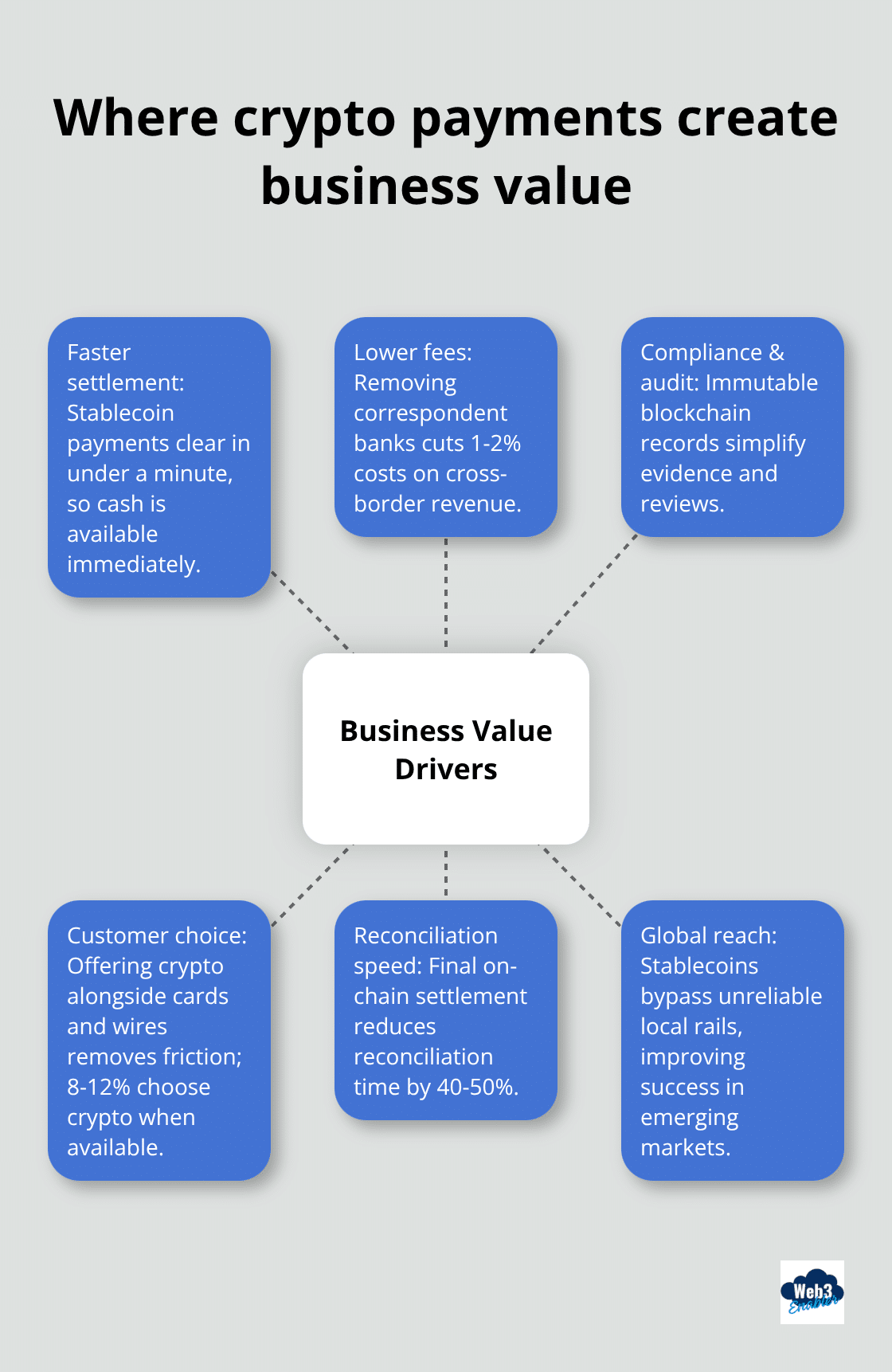
The blockchain transaction is the source of truth. Mid-market companies that pilot crypto payments typically report 40-50% reduction in payment reconciliation time because the blockchain settlement is final and doesn’t require follow-up verification calls or manual bank rec adjustments.
When a customer sends stablecoin payment, the system locks in the exchange rate at settlement, records the blockchain transaction hash for permanent audit trails, and feeds clean data into your revenue recognition module with full compliance metadata attached. Your finance team no longer spends hours matching payments to invoices or chasing down wire confirmations. The blockchain handles that work automatically, which frees your team to focus on analysis instead of data entry.
Final Thoughts
Your competitors are already moving. Forty percent of U.S. merchants accept crypto, and enterprise adoption keeps accelerating because the financial case is undeniable. Faster settlement, lower costs, and access to customers who prefer stablecoins aren’t nice-to-have features anymore-they’re competitive requirements that separate winners from everyone else.
Salesforce Revenue Cloud payments removes the implementation barrier that once made crypto integration feel impossible. Native stablecoin support means your existing workflows handle crypto transactions automatically, your finance team sees everything in one dashboard, and settlement happens on blockchain while your revenue recognition stays clean and compliant. We at Web3 Enabler specialize in connecting blockchain technology with your existing Salesforce infrastructure through 100% Salesforce native blockchain solutions available on the Salesforce AppExchange, built for businesses that need payments, compliance, and automation without the crypto speculation noise.
The businesses winning right now aren’t waiting for perfect conditions. They accept crypto payments today, capture customers their competitors can’t reach, and improve their cash conversion cycle immediately. Your next customer might already be waiting to pay you in stablecoin-stop making them choose a different vendor because your payment options are stuck in the past.