



Finance teams are drowning in spreadsheets, manual payment tracking, and systems that refuse to talk to each other. It’s exhausting, error-prone, and expensive.
Salesforce Revenue Cloud changes that. We at Web3 Enabler have seen firsthand how unified payment solutions transform finance operations-cutting processing time, eliminating reconciliation headaches, and giving teams the visibility they actually need.
Why Your Finance Team Is Stuck in Payment Purgatory
Finance teams save an average of 40-60 minutes per day thanks to AI assistance with manual payment tasks that should be automated. That’s not a minor inconvenience-it’s a productivity killer. When payments live across disconnected systems, spreadsheets become the default source of truth, and someone inevitably spends Thursday afternoon reconciling three different payment platforms that should have talked to each other months ago. The real cost isn’t just time; it’s accuracy. Data errors drop by as much as 80 percent with automation and integrated data flows, meaning your current setup probably leaks mistakes everywhere. Manual processes invite human error at every handoff: invoice entry, payment matching, reconciliation, reporting. Each step becomes a failure point waiting to happen. Your finance team knows this. They feel it every single day when they chase down a missing payment or explain why the books don’t match reality.
The Visibility Problem Nobody Talks About
Fragmented payment systems create blind spots that kill decision-making speed. A finance leader at a mid-market company might have invoices in one system, payments in another, and customer data scattered across a third. Real-time visibility disappears. When you can’t see cash flow in real time, you can’t make smart decisions about liquidity, customer creditworthiness, or payment timing. According to Salesforce research, organizations with well-integrated systems report about 78 percent average CSAT scores, and that integration directly fuels revenue growth. Without unified visibility, you’re essentially flying blind on customer payment behavior, which means you miss opportunities to optimize collection timing or spot payment problems before they become customer churn.
Compliance and Reconciliation Become Nightmares
Audit trails scatter across multiple systems, creating compliance risks that keep finance leaders up at night. When regulators ask for proof of payment compliance or transaction history, you hunt through multiple systems, export data, reformat it, and pray nothing got lost in translation. That’s not just frustrating-it’s a compliance liability. Finance teams need one source of truth for payments, reconciliation, and reporting, not a treasure hunt across legacy platforms. Unified payment solutions eliminate these scattered audit trails and give you the documentation regulators actually want to see.
How Revenue Cloud Transforms Your Payment Operations
One Platform Replaces Your Payment Chaos
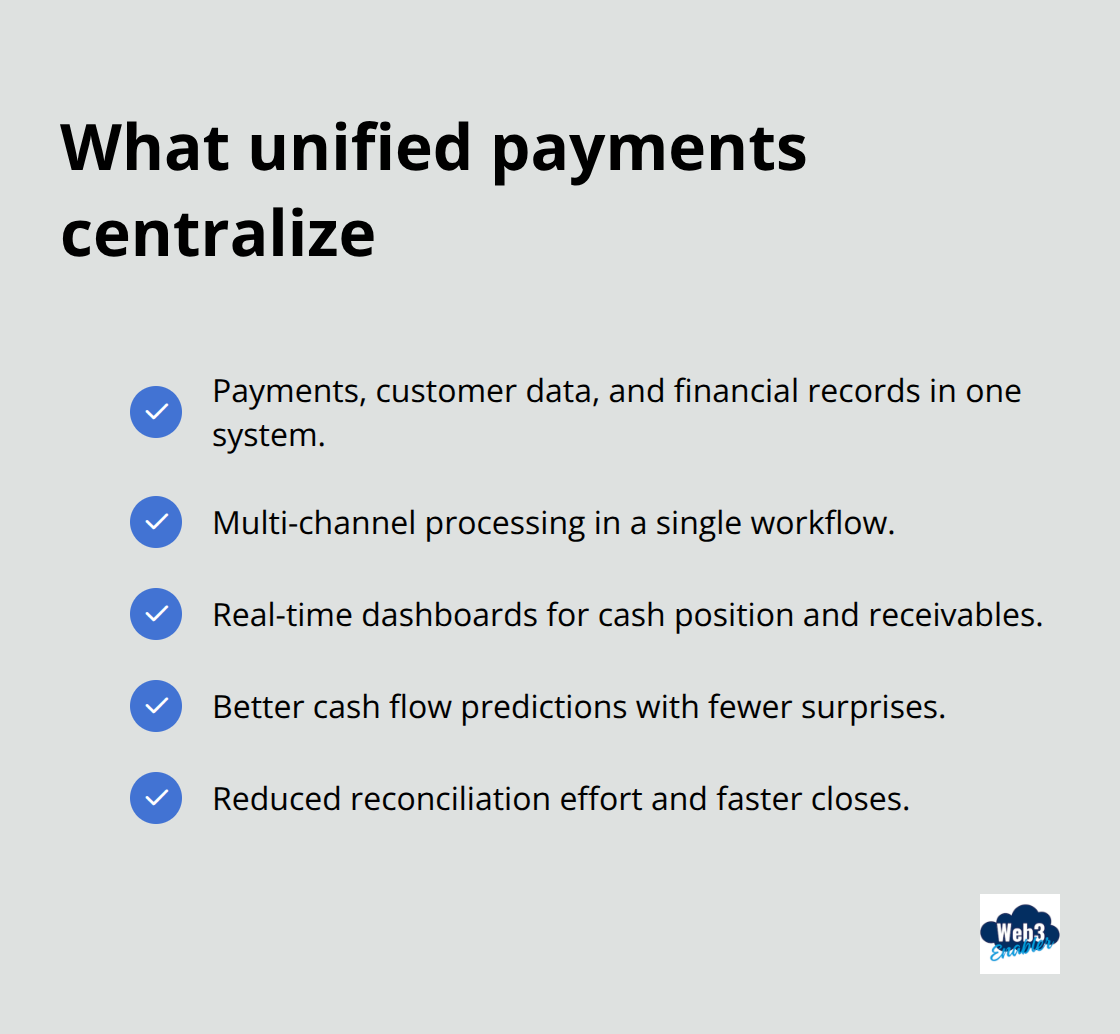
Unified payments in Revenue Cloud consolidate your data into a single system where payments, customer data, and financial records coexist. This integration matters because over 41% of marketers measure the success of their content marketing strategy through sales, according to HubSpot’s 2024 State of Marketing Report. Finance teams gain better cash flow predictions and fewer surprises when invoices arrive. Processing payments across multiple channels-credit cards, ACH, wire transfers, international methods-happens in one workflow instead of scattered manual steps. A textile manufacturer called Matouk achieved about 223 percent annual ROI after integrating Salesforce CRM with their ERP system, and unified payment processing drove that success. When payment channels consolidate, reconciliation transforms from a Friday afternoon nightmare into an automated background task. Real-time reporting dashboards show exactly where cash stands, what remains outstanding, and which customers pay on time, giving finance leaders the visibility they need to make decisions without waiting for batch reports that arrive days later.
Automation Delivers the Real Financial Payoff
The automation capabilities in Revenue Cloud earn their keep through measurable returns. Enterprises see an average ROI of 299 percent over three years from integrated CRM and data platforms, per Forrester’s Total Economic Impact studies. That return comes from eliminating manual payment matching, reducing data entry errors by up to 80 percent through automated workflows, and freeing your team from tedious reconciliation tasks. Your finance staff stops chasing spreadsheets and starts analyzing payment patterns, optimizing collection timing, and spotting customer credit issues before they become problems. MuleSoft integration connects Salesforce to payment gateways and financial systems, driving up to 78 percent faster project delivery. This means you go live with unified payments sooner rather than later. Compliance becomes straightforward too: every transaction creates an audit trail automatically, so when regulators ask questions, you pull reports instead of hunting through email chains and exported files.
Customer Satisfaction and Revenue Growth Follow Integration
Organizations report about 78 percent average CSAT scores when systems integrate properly, and that satisfaction fuels repeat business and reduces churn. Unified payments eliminate the friction that frustrates customers-delayed processing, payment failures across channels, and unclear billing status. When customers experience seamless payment experiences, they stay longer and spend more. This connection between operational efficiency and customer loyalty makes unified payments a revenue driver, not just a cost-reduction tool. The next section explores how real companies translate these capabilities into concrete business results.
How Companies Turn Unified Payments Into Real Revenue Growth
Faster Cash Flow Transforms Working Capital
Finance teams at mid-market and enterprise companies report concrete wins after moving to unified payment systems within Revenue Cloud. A textile manufacturer called Matouk achieved approximately 223 percent annual ROI after integrating Salesforce CRM with their ERP system, and that integration directly improved payment processing speed and accuracy. When payments consolidate into one platform, cash doesn’t sit in limbo waiting for manual reconciliation. Faster payment processing means invoices clear within days instead of weeks, which directly improves working capital.
Companies processing high-volume international transactions see even sharper gains because unified payment systems enhance payment acceptance globally. One financial services firm reduced their payment processing cycle from eight days to three days after implementing Revenue Cloud, freeing up millions in operating cash that previously sat trapped in the payment pipeline. That’s not theoretical improvement-that’s cash that funds operations, pays down debt, or fuels growth initiatives today instead of next month.
Visibility Unlocks Supplier Negotiations
The visibility that comes with unified payments surfaces opportunities for early payment discounts from suppliers, which many finance teams miss entirely when payment data scatters across systems. When you can see all outstanding payments in real time, you spot these opportunities and negotiate better terms. Real-time dashboards show exactly which invoices remain outstanding and when payment windows close, enabling finance leaders to make strategic decisions about cash deployment rather than reacting to payment crises.
Automation Cuts Operational Costs Dramatically
Operational cost reduction compounds when automation handles tasks that previously demanded manual attention. Enterprises see an average ROI of 299 percent over three years from integrated CRM and data platforms, according to Forrester’s Total Economic Impact studies, and much of that return flows directly from eliminating manual payment tasks. Finance staff stops spending hours matching invoices to payments and reconciling discrepancies across platforms. Instead, automated workflows flag mismatches, apply payments to correct invoices, and generate reconciliation reports without human intervention.
One insurance company reduced their reconciliation time from five days per month to two hours per month after moving to unified payments-that’s the difference between one full-time employee dedicated to reconciliation versus a single afternoon per month. MuleSoft integration connects Salesforce to payment gateways and core financial systems, driving up to 78 percent faster project delivery according to MuleSoft documentation, which means you realize these cost savings sooner.
Customer Satisfaction Drives Revenue Expansion
Customer satisfaction improves measurably because unified payments eliminate the friction that damages relationships. Organizations with well-integrated systems report approximately 78 percent average CSAT scores, and much of that satisfaction stems from payment reliability and clarity. When customers experience consistent, fast payment processing and clear billing visibility, they renew contracts at higher rates and expand their spending with your company. Payment reliability becomes a competitive advantage that strengthens customer loyalty and reduces churn across your entire customer base.
Final Thoughts
Unified payments aren’t a nice-to-have feature anymore-they’re the foundation that separates finance teams operating at full speed from those stuck managing chaos across disconnected systems. Salesforce Revenue Cloud Finance teams gain real-time visibility, eliminate manual reconciliation work, and build compliance into every transaction automatically. Enterprises see 299 percent ROI over three years from integrated platforms, operational costs drop significantly, and customer satisfaction climbs when payment experiences work seamlessly.
Your finance team stops hunting for missing payments and starts making strategic decisions about cash flow, supplier negotiations, and customer retention. Automation handles the tedious work that currently consumes hours each week, while reconciliation transforms from a Friday afternoon nightmare into a background process that flags issues before they become problems. Real-time dashboards replace batch reports that arrive too late to influence decisions, giving you the visibility you need to act fast.
Implementation doesn’t require ripping out your entire infrastructure-Revenue Cloud integrates with your existing payment gateways, ERP systems, and financial platforms through MuleSoft connectivity, which accelerates deployment by up to 78 percent. Start with your highest-volume payment channels or most problematic reconciliation processes, measure the impact on processing time and error rates, and build from there. If you’re exploring how to modernize your payment infrastructure while maintaining security and compliance, Web3 Enabler specializes in connecting Salesforce with advanced payment solutions that scale with your business needs.