

 Digital asset management metadata is often overlooked, yet it’s the backbone of any efficient content system. Without proper metadata, your team wastes hours searching for files, duplicating work, and losing track of important assets.
At Web3 Enabler, we’ve seen firsthand how organizations transform their operations by implementing solid metadata strategies. This guide walks you through the practical steps to get it right.
What Metadata Actually Is
Metadata is structured information about your digital assets. It includes technical details like file format, resolution, and creation date, alongside business context such as usage rights, creator information, and asset status. The distinction matters because technical metadata alone won’t help your team find assets quickly, while business metadata without technical details creates gaps in governance. Most organizations fail here by treating metadata as optional information instead of a foundational system. Metadata forms the connection between what your assets are and how your team uses them. Without it, assets become orphaned files that nobody can locate or properly manage. The reality is simple: metadata transforms a chaotic file repository into a searchable, governed system where teams spend minutes finding assets instead of hours digging through folders.
Why Search Speed Changes Everything
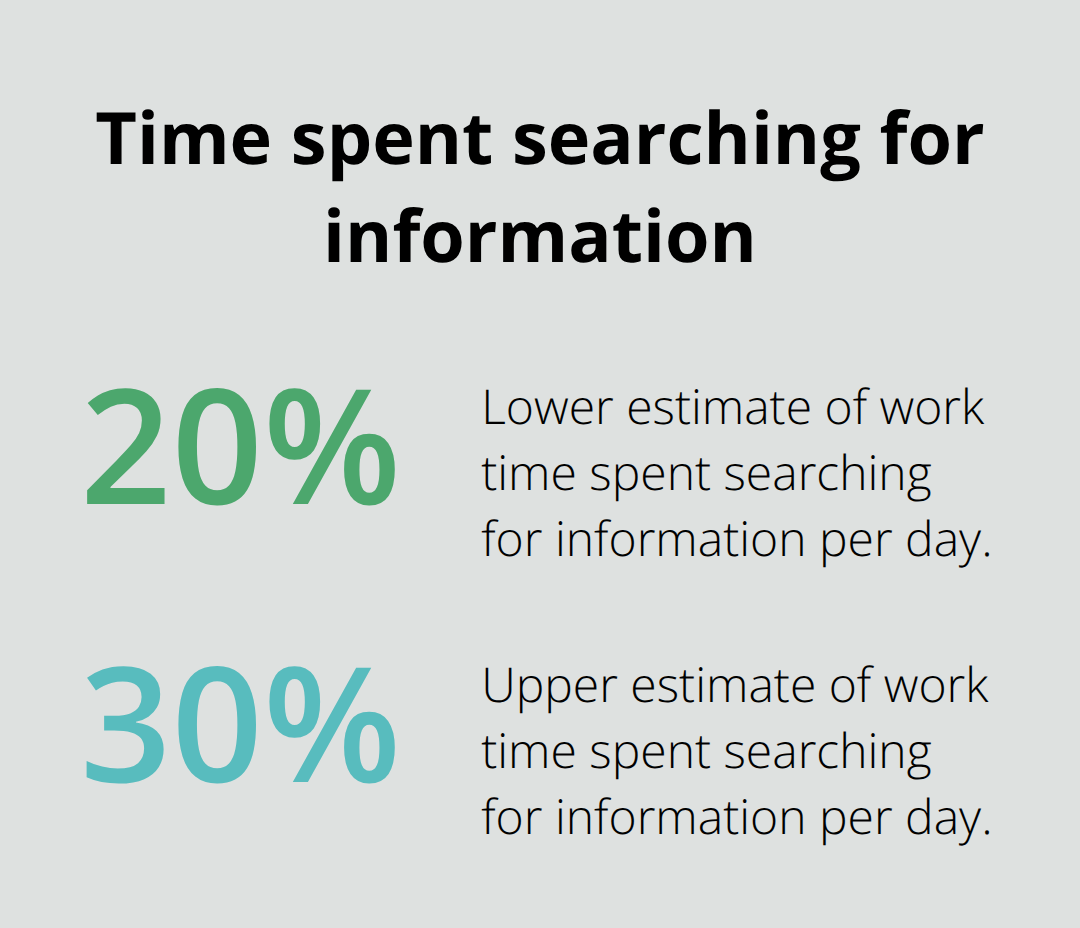
Asset discovery speed directly impacts productivity and costs. Knowledge workers spend an estimated 1.8 to 2.5 hours per day searching for information, accounting for roughly 20 to 30 percent of their time.
When metadata is structured correctly, search times drop dramatically because assets become findable through multiple pathways-by creator, usage rights, campaign, format, or custom business fields. Poor metadata means your search function returns irrelevant results or nothing at all, forcing employees to browse manually or ask colleagues for files. Controlled vocabularies and standardized tagging eliminate the chaos where one person labels an asset marketing-campaign-2024 while another uses campaign-2024-marketing. Consistency across your asset library makes automated search features actually work.
Rights Management and Compliance
The second impact is rights management and compliance. Metadata captures licensing information, usage restrictions, and expiration dates. Without this, teams accidentally use assets they don’t have permission to use, creating legal and financial exposure. Organizations in regulated industries like healthcare or finance face serious consequences when metadata governance fails.
Define Your Metadata Fields
Start with defining what metadata fields your organization actually needs. This sounds obvious but most teams skip this step and suffer for it. You need technical metadata for asset management and business metadata for decision-making. Assign clear ownership for metadata quality because unmaintained metadata becomes useless metadata. Establish a metadata governance body responsible for updating standards and enforcing consistency.
Automate and Maintain Quality
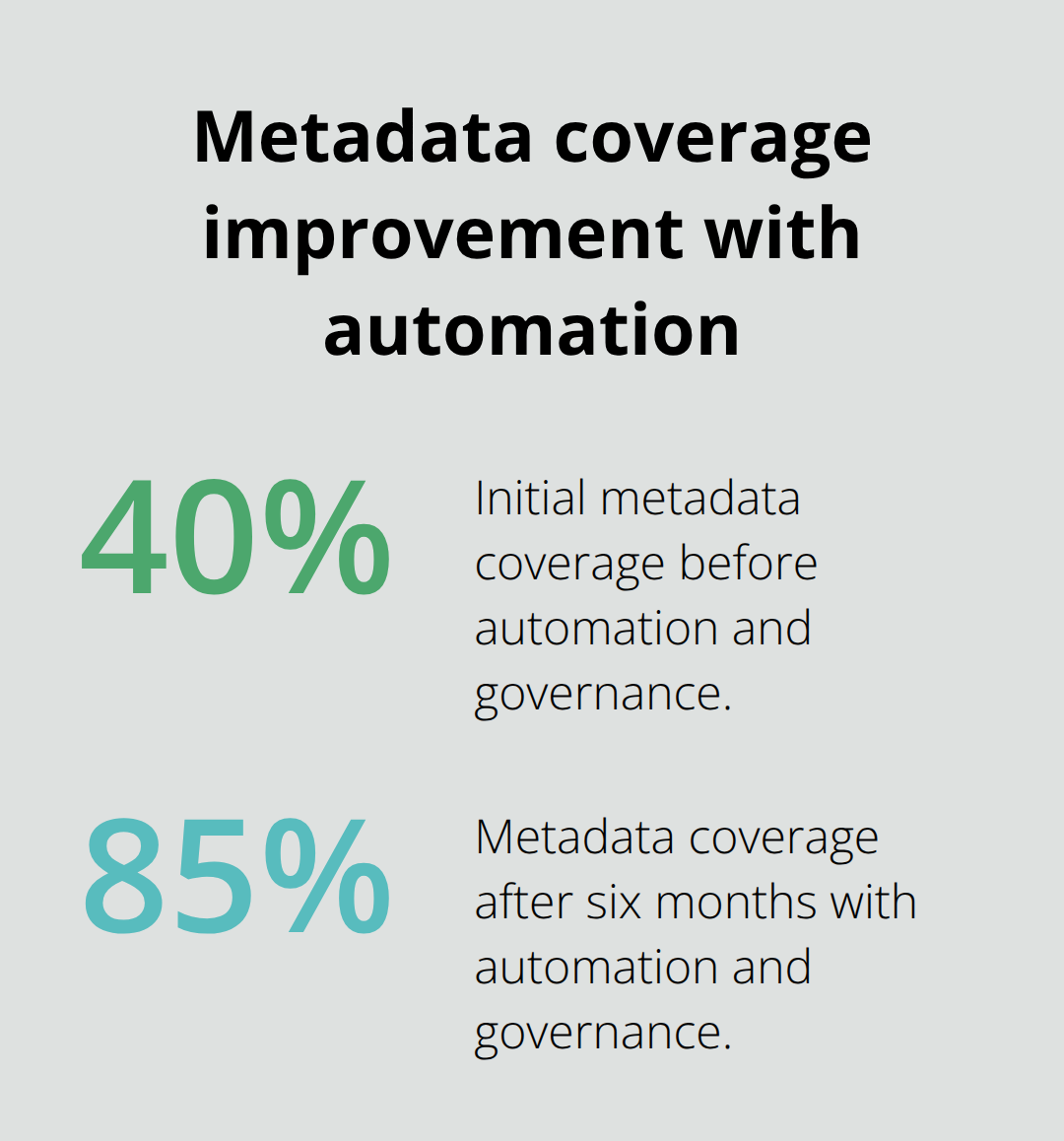
Automate what you can-auto-tagging powered by AI reduces manual workload while expanding coverage. Tools that extract metadata automatically during asset upload save significant time compared to manual tagging. However, automation has limits. AI-powered tagging systems include confidence scores, and you should establish review workflows for low-confidence tags to maintain accuracy. Real organizations see metadata coverage improve from 40 percent to 85 percent within six months when they combine automation with clear governance and assigned ownership. This foundation of clean, consistent metadata sets the stage for implementing the right tools and technologies that amplify these benefits across your entire organization.
Building Metadata Systems That Actually Stay Clean
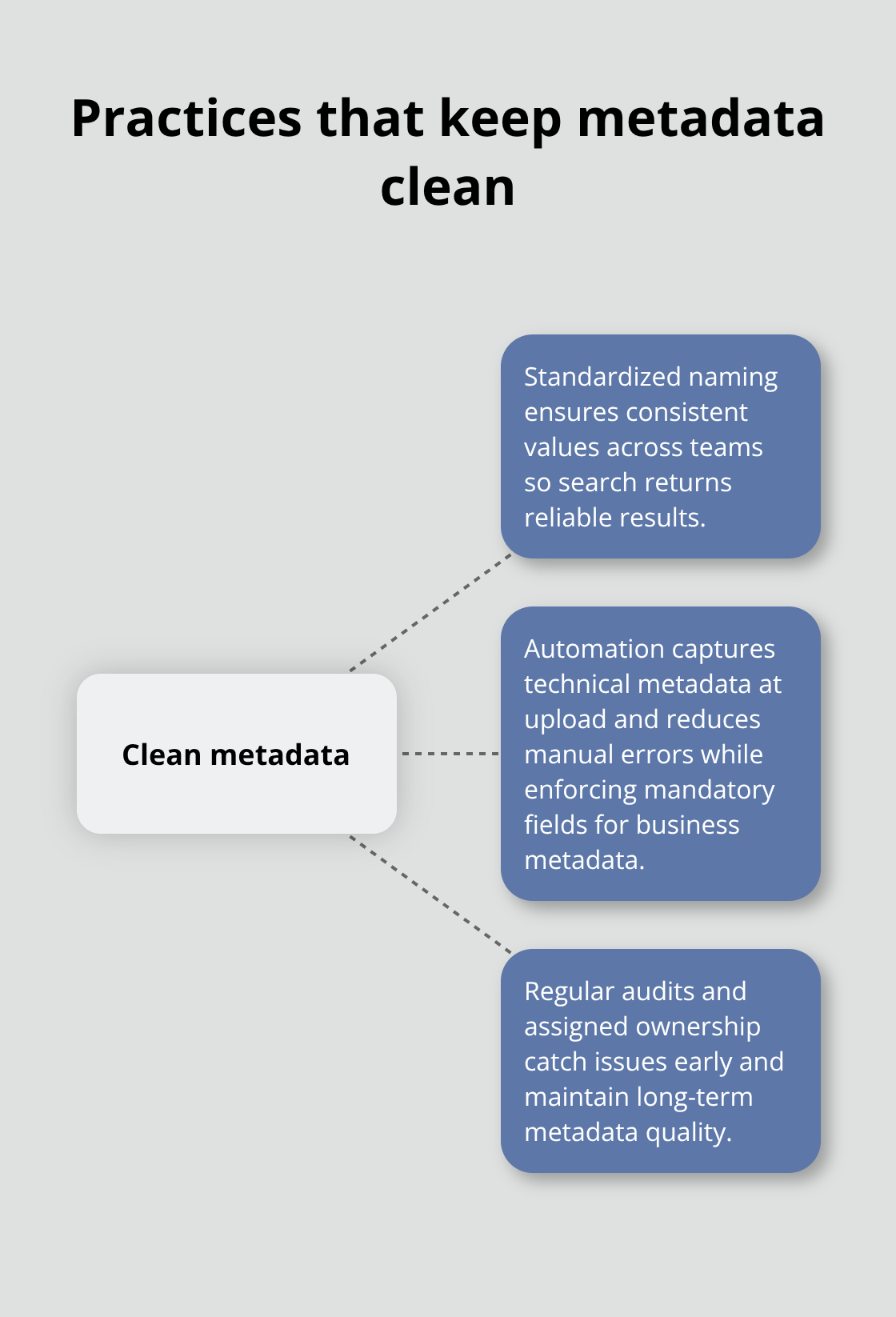
Metadata governance fails when organizations treat it as a one-time project rather than an ongoing operation. The hard truth is that metadata becomes stale or inaccurate without active maintenance. Three interconnected practices work simultaneously to prevent this: standardized naming that your entire team follows without exception, automation that captures metadata at the point of asset creation, and regular audits that catch quality problems before they cascade through your system.
Enforce Naming Conventions Across Your Team
Start with naming conventions that are specific enough to matter but simple enough that humans follow them consistently. If your team uses marketing-campaign-2024-v1 in one folder and 2024-Marketing-Campaign-V1 in another, your search function becomes useless because the system treats these as different values. Define your naming rules in writing and enforce them through your digital asset management platform’s settings, not through emails or wiki pages that people ignore. Your platform should prevent non-compliant filenames from being uploaded in the first place.
Automate Metadata Extraction at Upload
Automate metadata extraction during upload so technical metadata like resolution, color space, and file format populate automatically without human intervention. This eliminates the most error-prone part of metadata entry. For business metadata like usage rights and campaign assignment, create mandatory metadata forms that assets cannot be published without completing. Adobe Experience Manager and similar platforms enforce this through workflow gates, preventing incomplete metadata from entering your system. Organizations combining mandatory fields with automation achieve strong metadata coverage within six months, compared to teams relying on voluntary tagging.
Validate AI-Generated Tags Through Review Workflows
AI-powered auto-tagging systems generate keywords and tags in near real-time with confidence scores attached. However, treating this output as final is a mistake. Establish a review workflow for tags below a certain confidence threshold, where a human validates whether the AI suggestion is accurate before it becomes permanent. This hybrid approach captures the speed benefit of automation while maintaining quality standards. Real organizations report that this review step catches a significant portion of incorrect tags that would otherwise pollute search results.
Conduct Quarterly Audits and Assign Ownership
Set up quarterly metadata audits where you sample assets across folders and check whether metadata matches actual content, whether tags follow your controlled vocabulary, and whether required fields are populated. Document audit findings and assign specific owners to remediate gaps. Assign one person per department or team as the metadata steward responsible for maintaining standards in their area. This person doesn’t need to tag everything manually, but they own the quality and escalate problems to your metadata governance body. Without this clear ownership, metadata quality degrades because nobody feels accountable.
Manage Schema Changes With Intentional Planning
Establish a change management process for when your metadata schema evolves. When you add new fields or retire old ones, communicate the change explicitly, update your documentation, and give teams time to transition. Retroactively applying new metadata to old assets requires planning because manual updates don’t scale. Instead, apply new fields prospectively and use automation to backfill what you can on existing assets. Organizations that skip this step end up with inconsistent metadata across asset cohorts, making it impossible to search or report across your entire library. Once your metadata foundation stabilizes, the right technology platform amplifies these practices and makes governance scalable across teams and departments.
Tools and Technologies for Metadata Management
The metadata foundation you build means nothing without a platform that enforces your standards and makes them scale. Your choice of technology determines whether metadata stays clean or devolves into chaos as your asset library grows. Most organizations fail here because they either select a platform without matching it to their actual workflow, or they implement a platform that technically works but nobody uses because it creates friction instead of solving problems.
Select Platforms That Enforce Your Standards
Digital asset management platforms like Adobe Experience Manager, Bynder, and Acquia DAM provide the infrastructure to enforce metadata governance at scale. Adobe Experience Manager includes mandatory metadata forms that prevent assets from publication without completing required fields, which is non-negotiable for maintaining consistency. Bynder delivers AI-driven asset organization with customizable workflows, making metadata capture feel like part of the natural upload process rather than an additional burden. Acquia DAM offers cloud-native scalability with centralized asset repositories and customizable workflows designed for large teams managing thousands of assets monthly.
The critical difference between these platforms isn’t the features they advertise, but whether they integrate seamlessly with your existing tech stack. If your team uses Slack, Salesforce, Google Drive, or Adobe Creative Cloud, the platform must connect directly to these tools or metadata entry becomes a separate, disconnected task that people avoid. Pics.io integrates directly into Google Drive, eliminating the need to switch applications when managing assets. 4ALLPORTAL combines digital asset management with product data management, supporting multilingual content and natural-language search, making it valuable if your organization distributes products across multiple regions.
Prioritize Integration Over Feature Count
Integration matters more than feature count because a platform with fewer features that fits your workflow will achieve higher adoption and cleaner metadata than a feature-rich platform that requires context switching. Your team spends less time fighting the system and more time actually managing assets when the platform sits where they already work. This adoption difference translates directly into metadata quality because people complete metadata fields when the process feels natural rather than forced.
Implement AI-Powered Metadata Generation Correctly
AI-powered metadata generation has matured significantly and now delivers real productivity gains when implemented correctly. Adobe Sensei’s Smart Tags auto-annotate assets in near real-time with confidence scores attached, allowing your team to review low-confidence suggestions before they permanently pollute your taxonomy. Air uses facial recognition to automatically label people in photos, accelerating metadata generation for asset libraries with significant image content. These systems reduce manual tagging workload substantially, but the key is establishing review workflows for suggestions below your confidence threshold rather than accepting all AI output as final.
The platform you select should support review capability natively rather than forcing you to build custom workflows. This built-in review function separates platforms that actually work from those that create extra work.
Evaluate Pricing and Conduct Proof of Concept Testing
Pricing varies significantly across the market. Air starts around $250 per month, Brandkit runs approximately $30 per user per month, and Pics.io costs around $100 monthly, with 4ALLPORTAL offering a 14-day free trial. Enterprise pricing scales differently based on asset volume and user count, so conducting a proof of concept with your actual asset workload before committing is essential.
Test whether the platform handles your file types efficiently, whether search performance remains acceptable as your library grows, and whether the interface matches how your team actually works. A platform that handles enterprise-scale asset libraries with high-resolution media without performance degradation will save you infrastructure headaches as you scale. Your proof of concept should run for at least two weeks with real team members and real assets to surface adoption friction before you commit to a full implementation.
Final Thoughts
Metadata optimization transforms how organizations manage digital assets, but only when you treat it as a continuous operation rather than a one-time implementation. Your team spends less time searching for assets and more time creating value when you define clear metadata standards with assigned ownership, automate capture at the point of asset creation, and conduct regular audits to catch quality problems before they spread. This foundation prevents the common failure where digital asset management metadata becomes stale or inconsistent within months of launch.
Implementation starts with defining your metadata fields based on what your organization actually needs, not what sounds comprehensive. Select a platform that enforces your standards through mandatory fields and integrates directly with your existing tools rather than creating disconnected workflows. Conduct a proof of concept with real assets and real team members before full deployment, establish a metadata governance body with clear ownership, and run quarterly audits to maintain quality as your library evolves.
Organizations that get this right gain competitive advantage through faster decision-making, reduced operational friction, and better asset reuse across campaigns and channels. If your organization manages digital assets across teams or departments, metadata governance directly impacts your bottom line through productivity gains and risk reduction. Web3 Enabler provides seamless integration between Salesforce and blockchain systems, enabling you to manage digital assets and track investment returns within your existing corporate environment while handling global payments and international contractor compensation efficiently.