



Enterprise blockchain adoption isn’t a distant future scenario anymore. Global companies are moving stablecoins and blockchain infrastructure into production today, cutting cross-border payment costs by 40-60% and settling transactions in hours instead of days.
At Web3 Enabler, we’ve seen firsthand that success depends on starting with the right use cases and removing implementation barriers systematically. This guide walks through the practical strategies that actually work.
Why Blockchain Moves Money Faster and Cheaper
Settlement Speed Transforms Global Payroll Operations
Enterprise leaders often hear that blockchain settles transactions faster, but the real question is how much faster and what that speed actually saves. Global companies transferring money across borders today wait 3-5 business days for correspondent banking to clear. Stablecoins settle in seconds. That gap matters enormously when you run payroll for teams spread across Africa, the Middle East, and Europe. A company paying 500 contractors across Nigeria, Kenya, and the UAE loses money every day funds sit in transit-currency fluctuations, cash flow delays, and the opportunity cost of capital locked in the pipeline. Stablecoin-based payroll eliminates that friction. Settlement happens in hours, not days. For supplier payments, the economics shift even more dramatically. A manufacturer in South Africa importing components from Vietnam traditionally waits a week for payment confirmation while the exporter holds inventory. Stablecoins compress that to minutes, freeing working capital on both sides.
Real Transaction Volumes Prove the Business Case
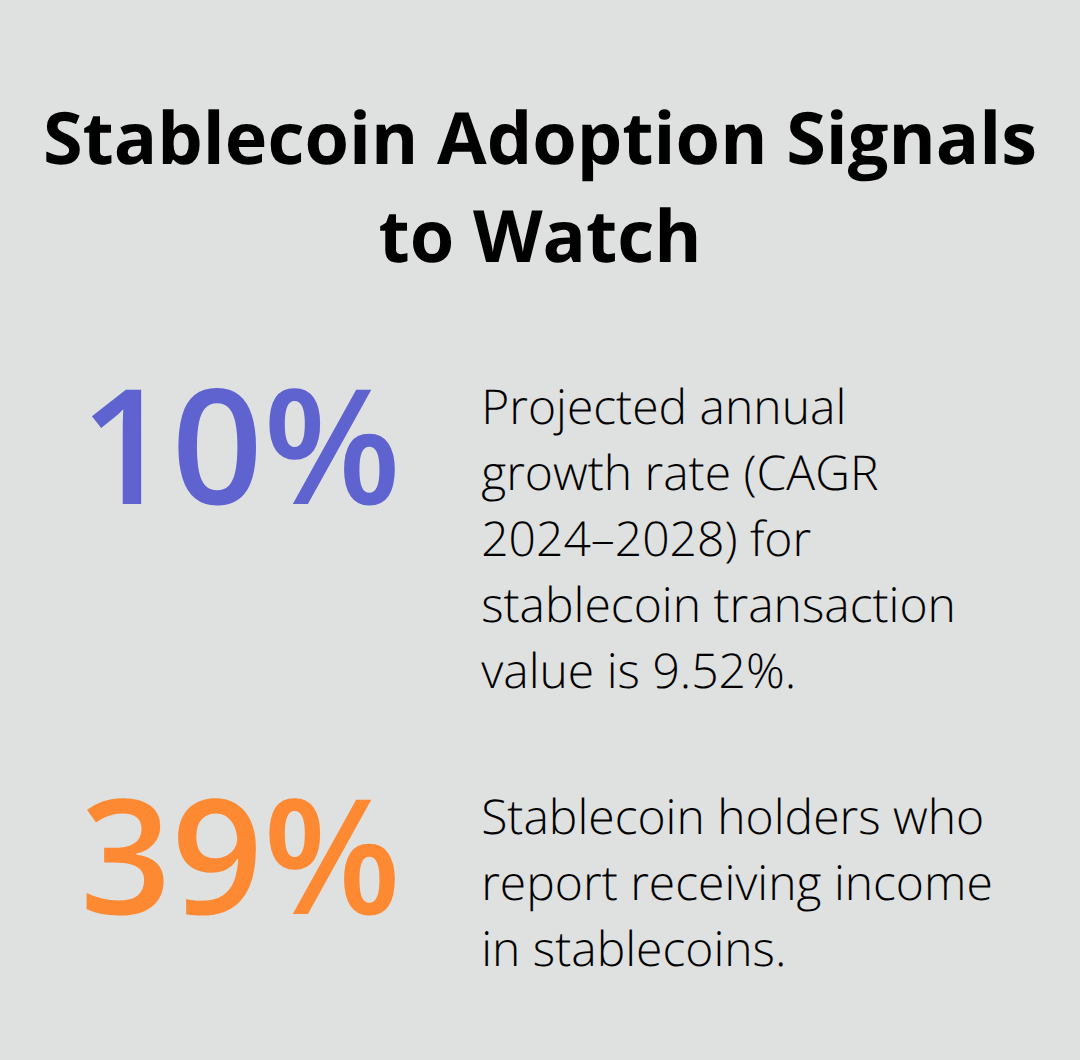
The IMF analysis of African stablecoin flows in 2024 showed that stablecoin transaction volumes are growing rapidly, with total transaction value expected to show an annual growth rate (CAGR 2024–2028) of 9.52% resulting in a projected total amount of US$16.59tn by 2028-a signal that the speed and cost advantage is real enough that enterprises already move material transaction volumes through these rails. Nigeria processed nearly $22 billion in stablecoin transactions between July 2023 and June 2024 according to available market analysis, demonstrating that when cost and speed align, enterprises move real volume through these channels. A study of stablecoin adoption showed that 39% of stablecoin holders report receiving income in stablecoins, and those using stablecoins for payments cited lower fees and speed as primary drivers.
Transparency Eliminates Reconciliation Work
Traditional cross-border payments obscure what actually happens to your money. A wire to a supplier in Ghana moves through 4-6 intermediary banks, each adding opaque fees and processing delays. Blockchain transactions are immutable and instantly auditable. Every payment creates a permanent, timestamped record that your finance team can verify in real time without waiting for bank statements. This matters for compliance and treasury operations. If you operate across multiple jurisdictions with different tax and reporting requirements, blockchain records eliminate reconciliation work. A global company managing payroll in 15 countries can audit all transactions from a single dashboard instead of coordinating with 15 different banks. For supplier payments, transparency reduces dispute risk. The exporter sees funds moving on-chain and confirms settlement immediately rather than disputing whether a wire actually left your bank.
Regulatory Frameworks Accelerate Enterprise Adoption
Tokenized assets and stablecoin rails create audit trails that regulators increasingly expect, particularly in Africa and the Middle East where governments strengthen financial controls. The UAE’s regulatory framework explicitly treats tokenized assets as an extension of traditional finance, requiring the same compliance rigor but enabling faster settlement and lower operational overhead. This regulatory clarity removes a major barrier that previously slowed enterprise pilots. When your compliance team knows exactly what rules apply, implementation timelines compress significantly.
Fee Compression Drives Margin Improvement
Cross-border payment fees typically run 1-3% of transaction value through traditional banking. For a company paying $2 million monthly in global payroll, that’s $20,000-$60,000 lost to fees annually. Stablecoins reduce that to near zero for the blockchain layer itself. The real savings compound when you eliminate correspondent banking fees, currency conversion spreads, and the time cost of delayed settlement. Instant settlement reduces the capital tied up in transit. Faster supplier payments improve vendor relationships and sometimes unlock early-payment discounts. Lower fees directly improve margins on high-volume, low-margin business like cross-border e-commerce or remittances.
These operational and financial advantages explain why enterprises across Africa and the Middle East are moving from pilots to production deployments. The next challenge is identifying which use cases deliver the fastest payback and how to navigate the implementation barriers that typically slow blockchain rollouts.
What Actually Stops Enterprise Blockchain Rollouts
Legacy Systems Block Integration Without Native Connectors
Legacy systems create the first real friction point. Most large enterprises run on SAP, Oracle, or proprietary banking infrastructure built over decades. These systems weren’t designed to talk to blockchain rails. A financial services company in South Africa managing supplier payments across 12 countries doesn’t want to rip out its ERP system to integrate stablecoins. Without native integration, implementation costs explode. A manufacturer in Kenya attempting to bolt stablecoin settlement onto legacy accounting software faces months of custom development, testing, and validation. The integration burden often kills projects before they start.
Web3 Enabler solves this problem by providing a seamless interface between Salesforce and blockchain infrastructure. This native integration allows enterprises to manage digital assets and international payments directly within their existing corporate platform without system replacement. Teams work within familiar tools instead of learning new systems.
Regulatory Complexity Multiplies Across Borders
Regulatory complexity compounds the problem across borders. Nigeria’s Central Bank restricts crypto activities for licensed institutions, while Kenya allows testing within regulatory sandboxes and the UAE treats tokenized assets as extensions of traditional finance. A company running payroll across these three markets faces three different compliance frameworks, three different licensing requirements, and three different timelines for approval ranging from 2 months in Rwanda to 4-8 months in South Africa.
Compliance teams spend resources mapping regulatory requirements for each jurisdiction instead of building production systems. Many enterprises hire local regulatory experts at $20,000–$50,000 per market just to understand what’s actually permitted. This cost burden delays projects significantly before implementation even begins.
Organizational Resistance Slows Workflow Adoption
The third barrier is organizational friction that most discussions skip over. Technical teams understand blockchain benefits, but treasury departments often resist change because stablecoin workflows differ from traditional banking. Finance staff trained on wire transfers and correspondent banking need retraining on wallet management, private key controls, and blockchain settlement verification.
A company with 200 finance professionals cannot instantly upskill them on blockchain operations. Successful enterprises address this by starting with dedicated pilot teams of 5–10 people who understand both traditional finance and blockchain. These teams run production payroll or supplier payment flows in parallel with legacy systems for 3–6 months. This approach proves the workflow actually works before rolling out enterprise-wide.
Leadership Skepticism Requires Proof, Not Promises
Leadership resistance emerges differently. CFOs worry about volatility even though stablecoins are pegged to fiat currency, and they demand guarantees that blockchain settlement won’t create accounting complications. The solution isn’t better marketing of blockchain benefits. It’s showing real numbers from comparable companies.
When a logistics company in Lagos demonstrates that stablecoin supplier payments cut working capital requirements by 15% and accelerated vendor relationships enough to unlock 2% early-payment discounts, other companies move from skepticism to action. Concrete evidence from peers carries far more weight than theoretical arguments about blockchain efficiency.
Implementation Timelines Demand Realistic Planning
Implementation timelines matter more than most realize. A well-planned pilot takes 4–6 months from regulatory approval to first production transaction. Many enterprises underestimate this timeline, allocating 8 weeks and then hitting regulatory delays or legacy system integration problems. The enterprises that succeed plan for 6–9 months, build in buffer time, and treat the pilot as a learning exercise rather than a race to production. They also isolate the pilot from existing critical systems, running stablecoin settlement on parallel infrastructure until confidence builds.
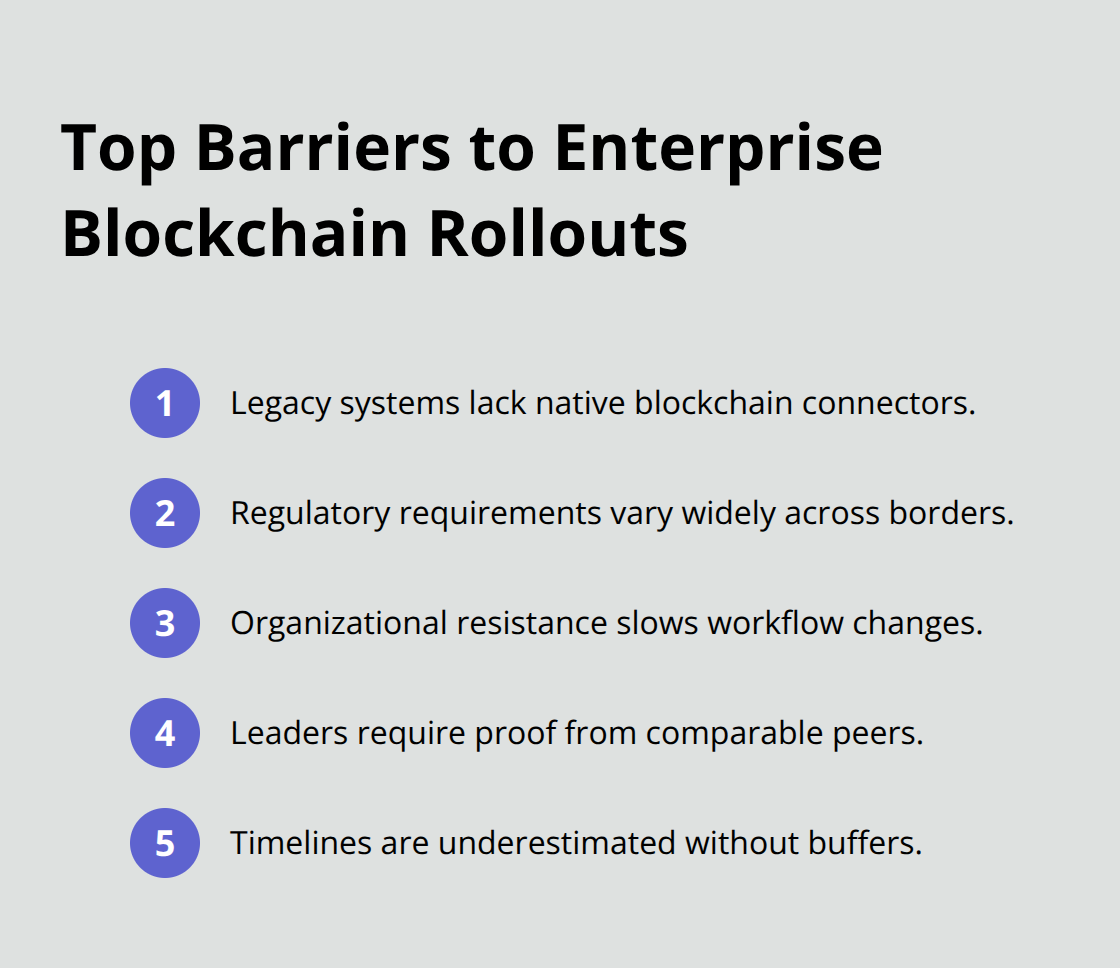
These barriers explain why many blockchain projects stall before reaching production. The enterprises that move forward systematically address each obstacle-starting with integration solutions that fit existing infrastructure, mapping regulatory requirements early, building dedicated pilot teams, and setting realistic timelines. Once you clear these barriers, the actual implementation becomes straightforward. The next step is identifying which specific use cases deliver the fastest payback and structuring your pilot to prove measurable value.
How to Structure Your Blockchain Pilot for Fast Payoff
Select Use Cases That Deliver Measurable Returns in 90 Days
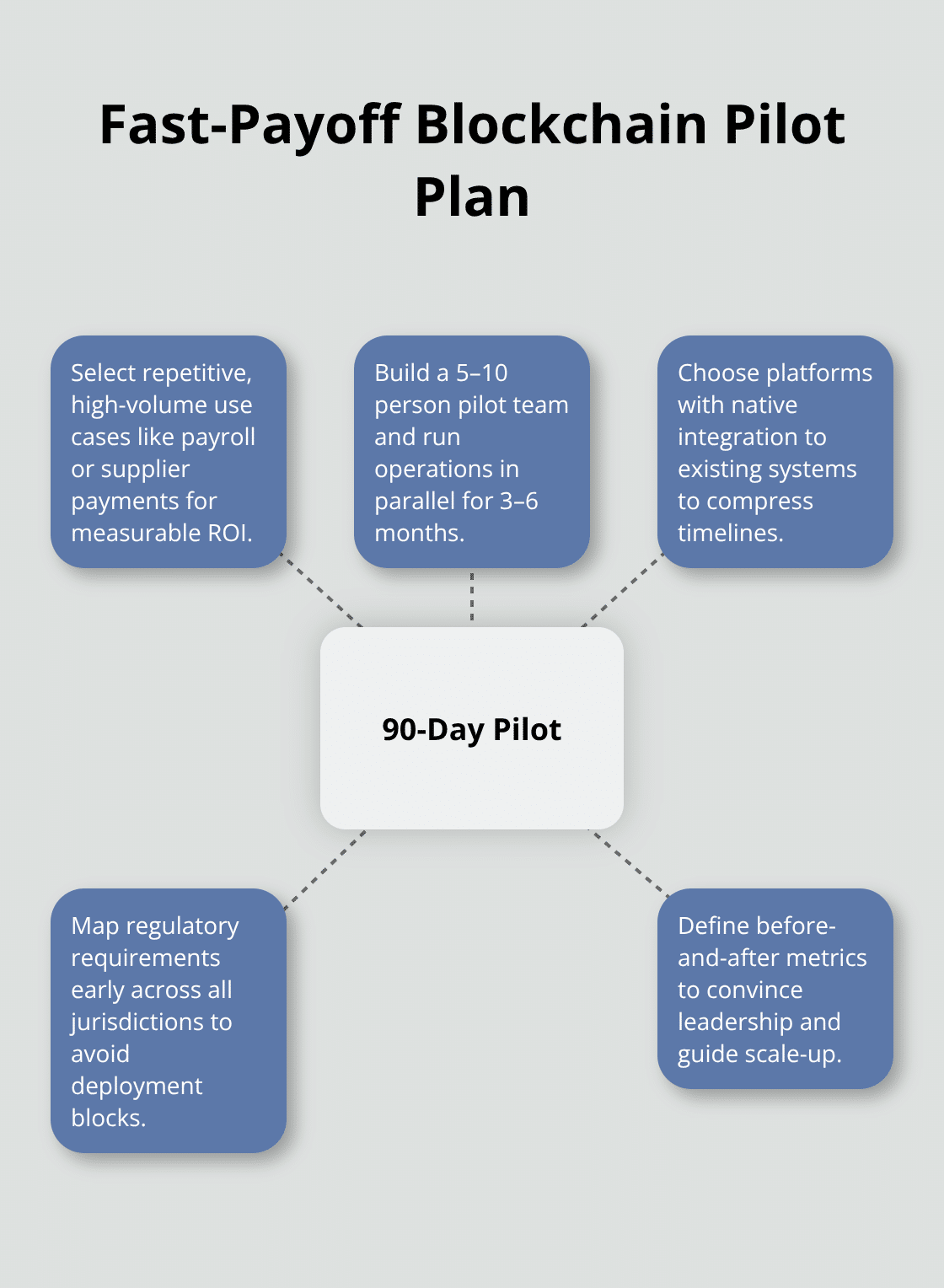
Payroll and supplier payments generate the fastest financial returns. A manufacturer in Kenya paying 200 suppliers across East Africa typically spends $8,000–$12,000 monthly on correspondent banking fees and loses 5–7 days of working capital to settlement delays. Switching to stablecoin-based supplier payments offers advantages in settlement and improved liquidity management, freeing $40,000–$60,000 in annual cash flow while accelerating vendor relationships. Payroll produces similar economics. A company with 500 contractors spread across Nigeria, Ghana, and South Africa loses approximately $15,000–$25,000 monthly to banking fees and currency conversion spreads on traditional wire transfers. Stablecoins reduce this to near-zero blockchain costs. More importantly, contractors receive funds in hours instead of 3–5 days, improving retention and reducing administrative burden.
These use cases work because they involve repetitive, high-volume transactions where cost per transaction matters significantly. They also generate clear before-and-after metrics that convince skeptical leadership and justify expanding blockchain adoption to other workflows later.
Build Your Pilot Team and Run Parallel Operations
A dedicated team of 5–10 people who understand both traditional finance and blockchain infrastructure should run your pilot. This team executes production payroll or supplier payments in parallel with legacy systems for 3–6 months. This approach proves the workflow actually works before rolling out enterprise-wide. Finance staff trained on wire transfers and correspondent banking need retraining on wallet management, private key controls, and blockchain settlement verification. Running parallel operations lets your team build confidence gradually without disrupting critical payment flows.
Leadership skepticism fades when you show real numbers from your own operations. A 15% reduction in working capital requirements or 2% early-payment discounts from accelerated vendor payments carry far more weight than theoretical arguments about blockchain efficiency.
Choose Platforms That Integrate With Existing Infrastructure
Platform selection determines whether your pilot succeeds or stalls in legacy system integration. Solutions that provide native support for your existing corporate infrastructure eliminate the integration friction that kills most blockchain projects. Your teams work within familiar tools instead of context-switching between legacy systems and new blockchain infrastructure. Implementation timelines compress from 6–9 months to 4–6 months because you avoid custom development and system replacement costs. Your internal expertise grows faster because staff learn blockchain workflows within a platform they already understand.
Map Regulatory Requirements Across All Operating Jurisdictions
Regulatory mapping must happen immediately, not mid-implementation. Nigeria requires different licensing than Kenya or the UAE, and approval timelines range from 2 months in Rwanda to 4–8 months in South Africa. Engaging local regulatory experts early costs $20,000–$50,000 per market but compresses timelines significantly by identifying blockers before you build infrastructure. This parallel approach to technical implementation and regulatory mapping prevents the scenario where your pilot works perfectly but you cannot legally deploy it. Compliance teams that understand the specific requirements for each jurisdiction move faster than those discovering regulatory gaps after infrastructure is built.
Final Thoughts
Enterprise blockchain adoption succeeds when you focus on measurable outcomes rather than technology for its own sake. The companies moving from pilots to production across Africa and the Middle East start with high-impact use cases like payroll and supplier payments, remove integration barriers by choosing platforms that fit existing infrastructure, and build dedicated teams that prove value within 90 days. The financial case is straightforward: cutting cross-border payment fees by 40-60%, freeing working capital through faster settlement, and reducing reconciliation overhead directly improve margins and cash flow.
Organizations ready to implement should start now, as regulatory approval timelines range from 2-8 months depending on jurisdiction. Map your regulatory requirements across operating markets, identify your highest-impact use case, and assemble a pilot team of 5-10 people who understand both traditional finance and blockchain infrastructure. Run production transactions in parallel with legacy systems for 3-6 months to build confidence before enterprise-wide rollout.
Web3 Enabler provides native Salesforce integration that eliminates the legacy system friction that kills most blockchain projects. Your teams work within familiar tools instead of context-switching between systems, and implementation timelines compress because you avoid custom development costs. This approach lets you move from pilot to production faster while building internal expertise that sustains long-term enterprise blockchain adoption.