


The digital assets landscape shifted dramatically in 2025, with enterprise adoption reaching unprecedented levels. Major financial institutions moved beyond pilot programs into full-scale implementations.
We at Web3 Enabler attended leading digital assets conferences throughout the year, gathering insights that reveal where the industry is heading. The conversations have fundamentally changed from “if” to “when” and “how fast.”
What Changed at Major Digital Assets Conferences in 2025
Traditional Finance Commits to Digital Asset Integration
The shift became undeniable at conferences across Luxembourg, New York, and Singapore. JPMorgan’s BMW Group partnership for automated foreign exchange transactions through Kinexys Digital Payments marked a watershed moment. BMW plugged its treasury infrastructure into JPMorgan’s Kinexys blockchain-based treasury platform to automate global cash transfers and foreign-exchange, which demonstrated that blockchain treasury operations moved from theory to practice.
Siemens and B2C2 followed with similar implementations, and these cases proved enterprise-grade blockchain payments work at scale. Major banks reported they reduced cross-border payment costs from the traditional 3-5% range to under 1% while they cut settlement times from days to seconds.
Regulatory Framework Builds Investment Confidence
Europe’s Markets in Crypto-Assets regulation and the upcoming Accessibility Act (effective June 2025) provided the clarity enterprises demanded. Conference panels featured Coinbase and Circle executives who emphasized how defined compliance frameworks accelerated institutional adoption.
Deloitte’s Digital Assets Awards highlighted organizations that built regulatory infrastructure, with winners who demonstrated practical compliance solutions rather than experimental projects. The regulatory certainty enabled traditional financial institutions to allocate serious capital to digital asset infrastructure. Corporate treasurers now view blockchain payments as compliant alternatives to legacy systems, not regulatory risks that require extensive legal review.
Enterprise Infrastructure Reaches Production Scale
Conference demonstrations showed blockchain integrations that operated within existing enterprise systems rather than standalone pilots. Organizations reported 24/7 liquidity management capabilities and real-time cross-border value movement became standard requirements.
The technology discussions focused on API connectivity that provided live FX rates and automated compliance reporting rather than blockchain fundamentals. Enterprise adoption accelerated because the infrastructure finally matched corporate operational standards for security, reliability, and integration depth.
These infrastructure advances set the stage for the specific trends that emerged across digital asset management operations.
How Are Enterprises Actually Using Digital Assets
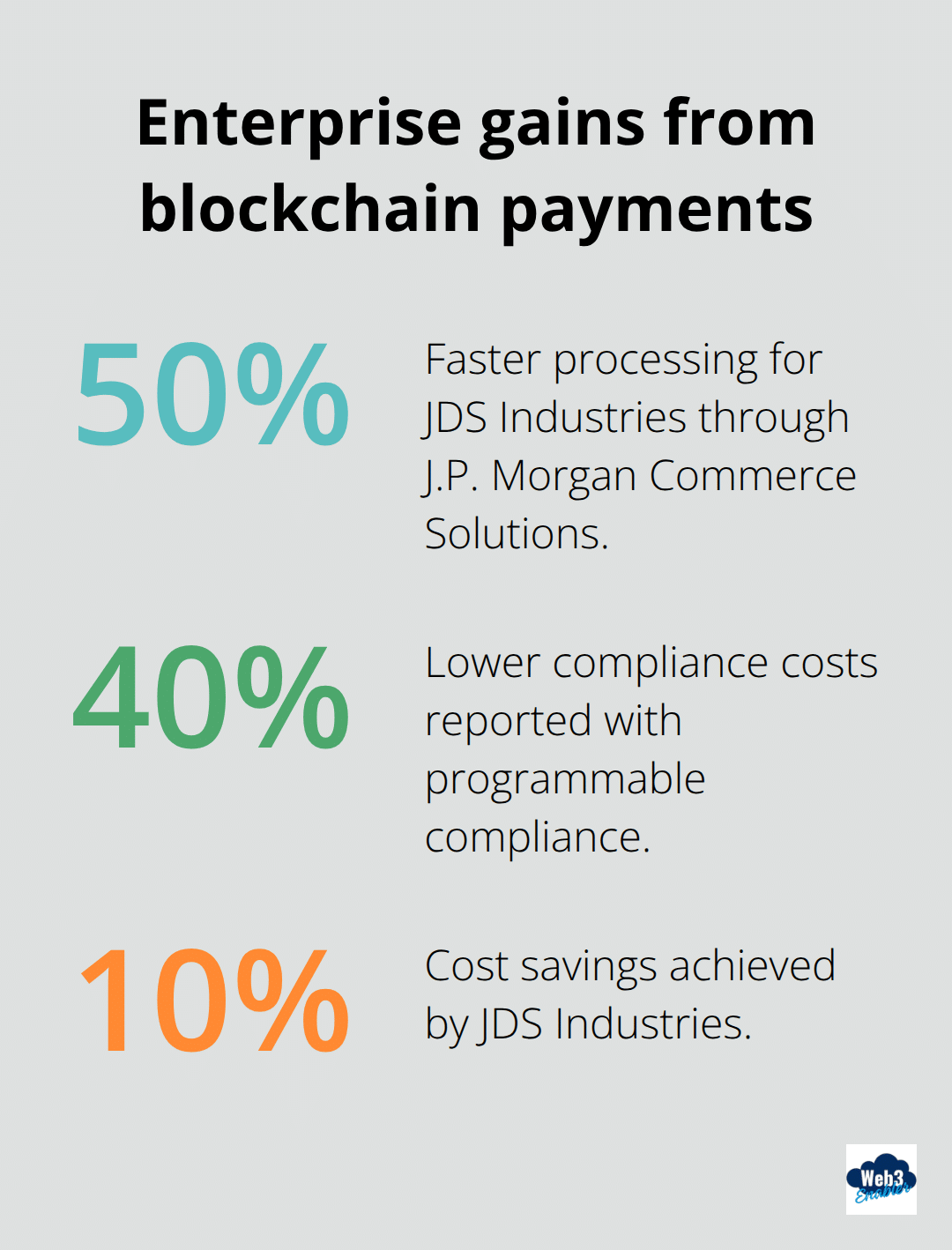
Enterprise digital asset adoption accelerated beyond expectations in 2025, with stablecoin payment volumes surging to $18.4 trillion according to industry data. Corporate treasurers discovered that USDC and Tether transactions cost between 0.1% and 1% compared to traditional wire transfers at 3-5%, while settlement times dropped from 3-5 business days to under 30 seconds. JDS Industries reported 10% cost savings and 50% faster processing through J.P. Morgan’s Commerce Solutions, which proves that enterprise blockchain payments deliver measurable ROI rather than experimental benefits.
Stablecoins Replace Wire Transfers for Vendor Payments
Manufacturing companies now pay suppliers in Asia with USDC rails instead of SWIFT networks. Automotive parts suppliers receive payments within minutes rather than wait days for international wire clearance, which improves their cash flow management significantly. Treasury departments report that stablecoin payments eliminate correspondent banking fees and foreign exchange spread costs that traditionally added 2-3% to cross-border transactions.
Real-Time Liquidity Management Changes Treasury Operations
Corporate treasurers gained 24/7 access to global liquidity through blockchain rails, which enables instant fund transfers across subsidiaries without banking hour restrictions. Companies that use Kinexys Digital Payments achieved near-continuous treasury optimization and moved funds between currencies and regions based on real-time market conditions rather than batch processing schedules. This operational flexibility reduced idle cash balances by an average of 15% across participating organizations (directly improving working capital efficiency and investment returns on corporate cash management).
Automated Compliance Streamlines Regulatory Reporting
Enterprise blockchain platforms now generate audit trails automatically, which eliminates manual transaction reconciliation that previously required days of accounting work. Companies report that programmable compliance features validate transactions against regulatory requirements in real-time, reducing compliance costs by up to 40% while improving accuracy. The automated reporting capabilities satisfy regulatory frameworks like MiCA without additional overhead, making digital asset adoption compliant by design rather than requiring separate compliance processes.
These operational improvements create the foundation for the technological innovations that reshape how enterprises integrate blockchain capabilities into existing systems.
What Technology Makes Enterprise Blockchain Integration Actually Work
Enterprise blockchain integration reached production scale in 2025 through API-first architectures that connect directly to existing ERP and treasury systems. Companies report that native integrations reduce implementation time from 12-18 months to 6-8 weeks while they eliminate the custom middleware that previously caused security vulnerabilities. Adobe reported that AI-powered asset management tools reduce search time by 40%, and similar automation appears in blockchain treasury operations where smart contract templates auto-execute payments based on predefined business rules.
The Digital Asset Management market grew from $6.59 billion in 2025 to a projected $12.80 billion by 2030 with a 14.18% CAGR. Enterprises demand seamless integration rather than standalone blockchain applications that create operational silos.
Native CRM Integration Transforms Digital Asset Operations
Salesforce emerged as the dominant platform for digital asset management because finance teams refuse to operate outside their existing CRM workflows. We at Web3 Enabler built the only native blockchain platform on the Salesforce AppExchange, which enables treasury operations within Financial Services Cloud without system switching requirements.
Circle, Ripple, and Cardano chose integrated CRM solutions because their finance teams gained real-time visibility into client wallet balances and stablecoin positions directly within advisor dashboards. This integration approach eliminates data silos that plague standalone blockchain platforms and provides audit trails through native Salesforce objects.
API-First Architecture Accelerates Implementation Speed
Modern blockchain platforms connect through REST APIs that integrate with existing enterprise systems in weeks rather than months. Treasury departments report that API connectivity provides live FX rates and automated transaction validation without custom development work (which previously required 6-12 months of engineering resources).
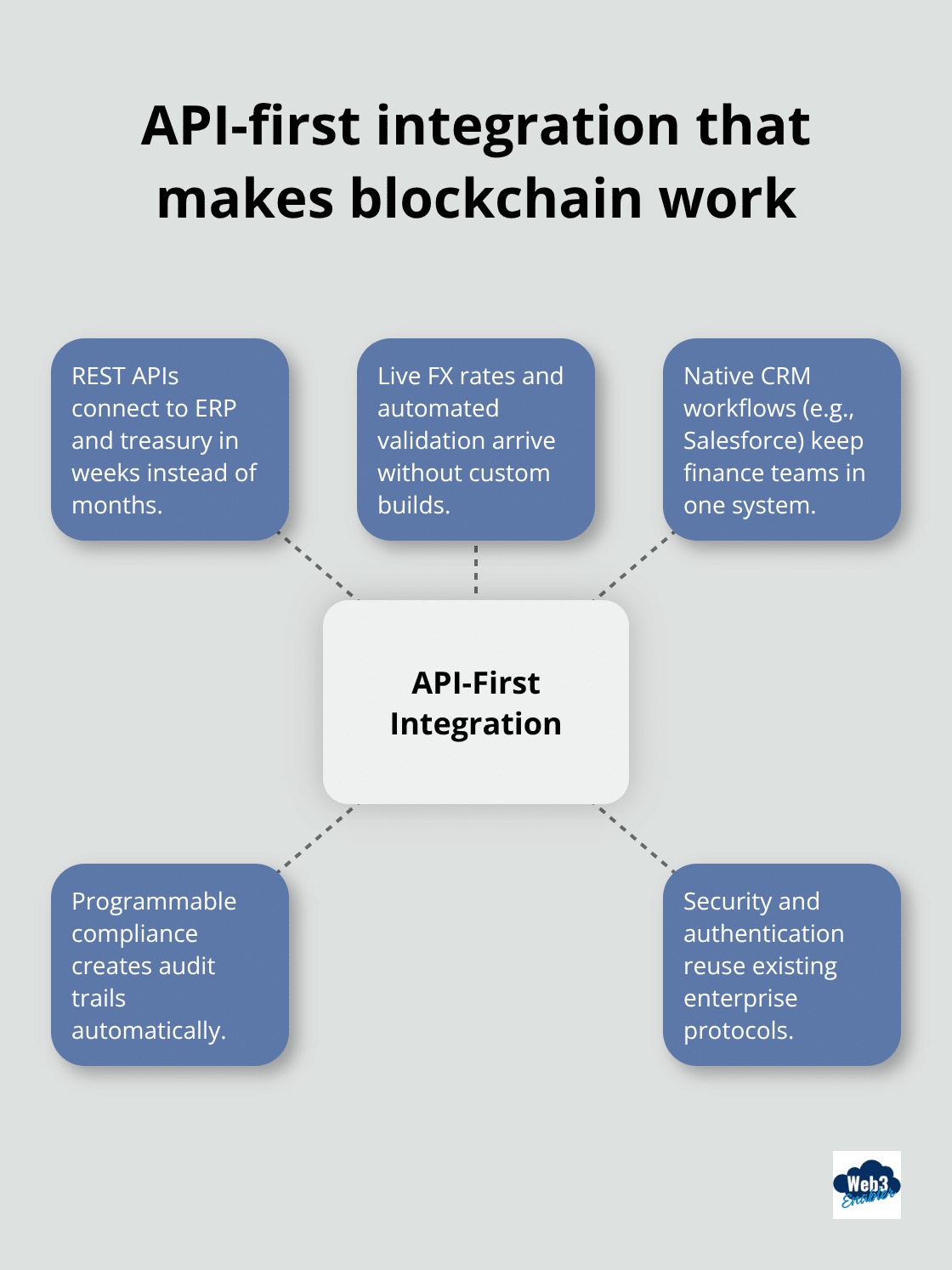
Companies achieve faster deployment because API-first platforms work with existing security protocols and authentication systems. The standardized integration approach reduces technical risk and enables IT departments to maintain their current infrastructure while they add blockchain capabilities.
Automated Compliance Eliminates Manual Reporting Overhead
Programmable compliance features now validate transactions against MiCA and other regulatory frameworks in real-time, which reduces compliance costs by 40% according to enterprise implementations. Organizations report that automated audit trail creation eliminates the manual reconciliation work that previously required 3-5 business days per month for international payments.
The technology automatically creates regulatory reports and maintains transaction histories that satisfy auditor requirements without additional overhead. Compliance becomes a byproduct of operations rather than a separate process that requires dedicated staff time and manual verification steps.
Final Thoughts
The digital assets conference circuit in 2025 revealed a fundamental shift from experimental pilots to production-scale implementations. BMW’s automated FX transactions through JPMorgan’s blockchain platform and Siemens’ treasury automation prove that enterprise blockchain adoption moved beyond proof-of-concept stages. Corporate treasurers now view stablecoin payments as operational necessities rather than experimental technologies.
The 40% reduction in compliance costs and 50% faster processing times create competitive advantages that early adopters capture while competitors struggle with legacy payment infrastructure. The infrastructure maturity we observed at conferences throughout the year positions blockchain payments as standard treasury tools. Organizations that implement these solutions today gain operational efficiency and cost advantages that compound over time.
We at Web3 Enabler built the only native blockchain platform on the Salesforce AppExchange specifically for this transition (enabling financial institutions to integrate stablecoin payments and treasury automation directly within Salesforce workflows). Our Web3 Enabler platform eliminates the system switching that slows adoption. The window for competitive advantage remains open, but it narrows as more enterprises recognize blockchain payments as essential infrastructure rather than optional innovation.