


Your Salesforce Revenue Cloud is built for speed, but your payment systems aren’t keeping up. Slow settlements, payment friction, and limited currency options are costing you deals and customer satisfaction.
A blockchain-enabled revenue cloud changes that game entirely. We at Web3 Enabler have seen firsthand how stablecoins and blockchain infrastructure can plug directly into your existing Salesforce workflows, cutting settlement times from days to minutes while keeping everything secure and compliant.
Why Your Payment Systems Are Holding Back Revenue Cloud
The Speed Problem Nobody Talks About
Your Salesforce Revenue Cloud processes deals at lightning speed, but the moment cash needs to move, everything grinds to a halt. Wire transfers take three to five business days. International payments? Add another week and stack on currency conversion fees that eat into margins. ACH transfers come with daily limits that cap how much you can settle. These aren’t minor inconveniences-they’re revenue killers that directly impact your cash flow and customer satisfaction.
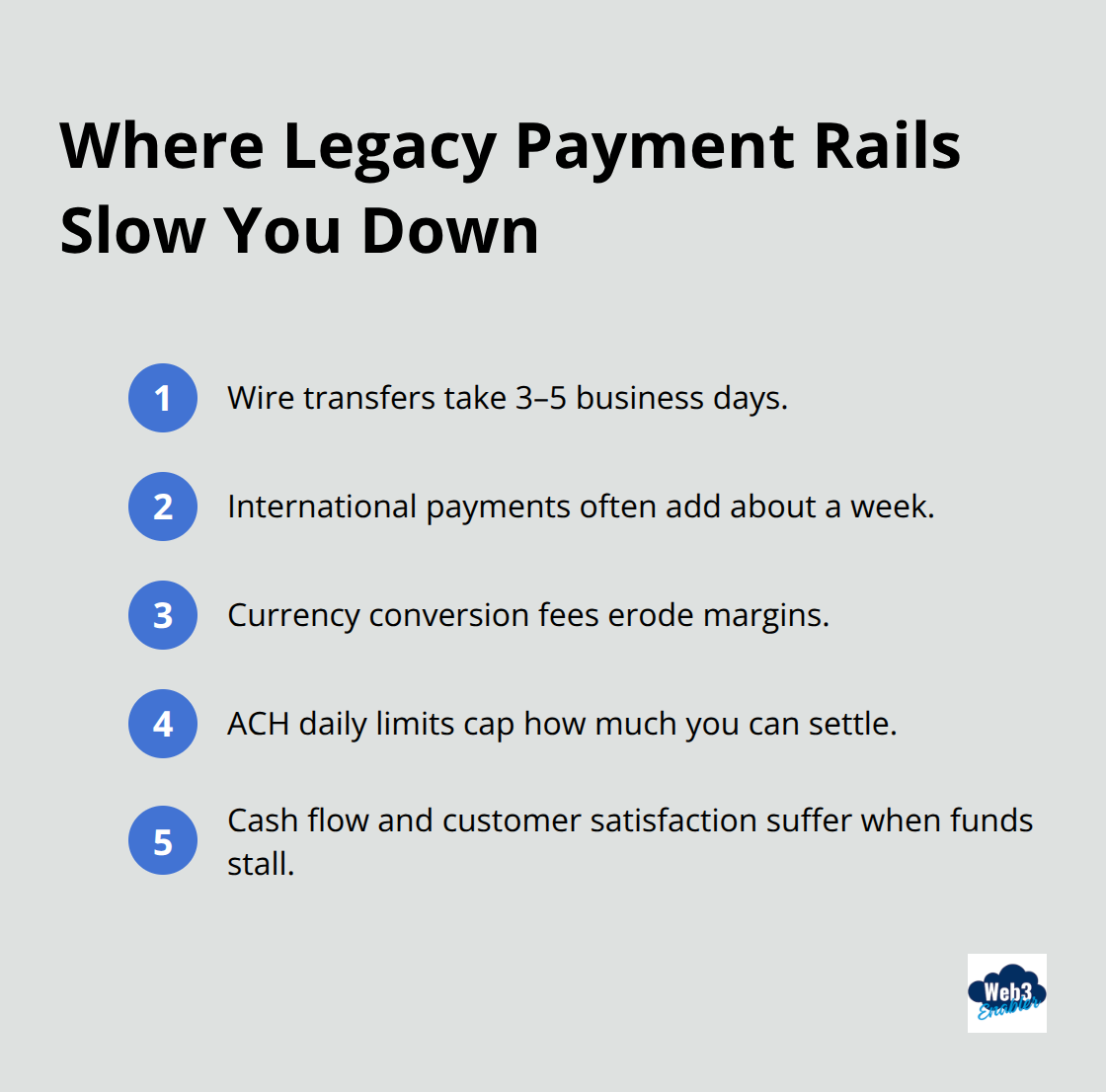
Traditional payment rails weren’t designed for speed or transparency. When a customer pays you via wire transfer, you’re stuck waiting for correspondent banks to shuffle money through multiple intermediaries, each taking a cut and adding friction. Cross-border payments still take significant time despite decades of financial technology advancement. You’re using 21st-century CRM software powered by 20th-century payment infrastructure. The disconnect is painful.
How Blockchain Fixes the Friction
Stablecoins and blockchain infrastructure eliminate the middlemen entirely. When a customer sends you USDC or USDT directly into Salesforce, settlement happens in minutes, not days. There’s no currency conversion risk, no intermediary fees bleeding your margins, and no guessing when money actually arrives. Your revenue operations team sees payment confirmation in real-time without switching between six different platforms.
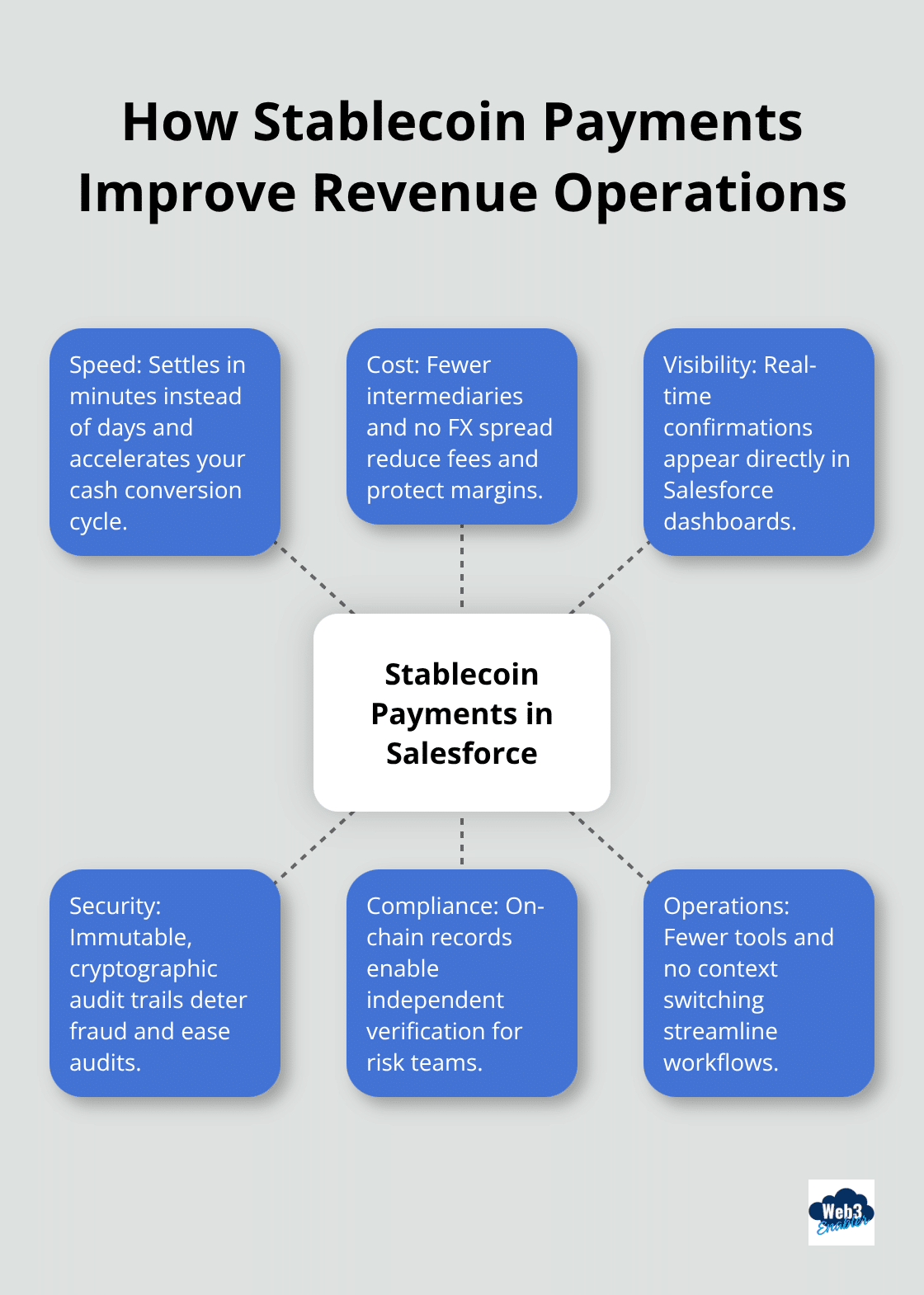
The security advantage is equally compelling. Blockchain transactions are immutable and cryptographically secured, meaning fraud attempts leave an audit trail that traditional payments simply can’t match. Every transaction gets recorded on an immutable ledger that your compliance team can verify independently.
Real Operational Gains
Enterprise adoption accelerates because the math works. Companies accepting crypto payments report faster revenue recognition, reduced reconciliation errors, and improved cash flow forecasting. Your sales team gets real-time visibility into whether payment actually cleared instead of chasing status updates. That’s not theoretical-that’s operational efficiency that directly impacts your bottom line.
The next step is understanding exactly how to plug these capabilities into your existing Salesforce workflows without disrupting what already works.
How to Actually Accept Crypto Payments in Salesforce
Stablecoin payments land directly inside Salesforce without separate payment processors or crypto wallet training. The payment arrives in Salesforce, your revenue recognition updates automatically, and your finance team sees it in real-time dashboards without switching between platforms. Your settlement clock starts immediately rather than waiting three to five business days for wire transfers to clear. For companies processing cross-border payments, this advantage compounds quickly. A customer in Singapore paying you in stablecoins settles in minutes at rates far lower than traditional international wire fees. Your margins improve instantly because there’s no currency conversion spread eating into revenue recognition.
Where Stablecoins Win Against Everything Else
Stablecoins function as payment rails pegged to the U.S. dollar or other fiat currencies, not volatile trading assets. USDC is issued by Circle, a regulated financial technology company, and USDT holds the position as the most liquid stablecoin in circulation. Your customers already understand these if they’ve handled cross-border business. The competitive advantage emerges when you automate global payouts to vendors, contractors, or international team members. PayPal’s PYUSD and the Bahamas Sand Dollar CBDC demonstrate that institutional money recognizes stablecoins as legitimate payment infrastructure. Companies using blockchain-enabled revenue systems report faster vendor payments, reduced reconciliation errors, and improved cash flow forecasting because payment settlement happens on-chain with cryptographic proof rather than relying on banking confirmations that arrive days later. Your accounting team stops chasing wire transfer status updates and focuses on actual revenue strategy. The audit trail remains immutable and independently verifiable, which compliance officers prefer over traditional banking statements requiring manual verification.
Building Real-Time Financial Visibility
Your sales team currently lives in Salesforce while your finance team lives in banking portals and accounting software. Blockchain integration collapses that gap. When a customer pays via stablecoin, the transaction lands in your Salesforce dashboard showing payment confirmation, amount received, and wallet address in a single view. Your revenue operations team recognizes revenue faster because the payment settles and verifies, not pending. Sales leaders see actual cash collected versus forecasted revenue, which eliminates the fiction that deals close when signed rather than when money arrives. This matters for accurate pipeline reporting and cash flow planning. Real-time wallet visibility lets financial professionals monitor crypto asset balances directly within Salesforce, eliminating the need for separate crypto platforms or manual balance tracking. Your treasury team gains complete visibility into reserves without logging into multiple systems. Settlement times compress dramatically-cross-border transactions that historically took ten business days now settle in under an hour, which accelerates your cash conversion cycle and improves working capital efficiency.
Moving From Manual Reconciliation to Automated Verification
Your current reconciliation process wastes time and introduces human error. Finance teams manually match bank statements against Salesforce records, a process that takes hours each week and creates reconciliation gaps. Blockchain transactions create an immutable audit trail that your team verifies independently without waiting for banking confirmations. Every transaction records on-chain with cryptographic proof, meaning your compliance team accesses the same verified data your accounting team uses. This alignment eliminates the back-and-forth between departments that currently slows down month-end close. Your team recovers two hours per day they currently waste reconciling payments across spreadsheets and banking portals. That time shifts toward revenue strategy and customer relationship management rather than administrative busywork. The operational efficiency compounds when you process multiple cross-border transactions daily-each one settles with cryptographic certainty rather than banking uncertainty.
Choosing Your Implementation Path
Web3 Enabler provides 100% Salesforce Native blockchain solutions available on the Salesforce AppExchange, built specifically for businesses accepting stablecoin payments and managing global transactions. Our tools support USDC, USDT, and XRP without requiring your team to learn crypto infrastructure or manage separate wallets outside Salesforce. The implementation integrates directly into your existing Revenue Cloud workflows, meaning your sales team and finance team continue working in the systems they already know. Your compliance team maintains control over payment verification and audit trails without adopting new compliance frameworks. The next step involves understanding how to measure the financial impact of these changes and build a sustainable blockchain revenue strategy that scales with your business.
Building Your Blockchain Revenue Strategy
Selecting a Partner That Actually Fits Your Business
Your partner selection determines whether blockchain integration becomes a competitive advantage or an expensive distraction. The vendor you choose shapes implementation speed, compliance rigor, and whether your team actually adopts the system. A Salesforce ISV partner specializing in blockchain technology offers native integration rather than forcing your team to switch between platforms. This matters because your sales team and finance team work inside Salesforce already-forcing them to adopt external systems kills adoption faster than any technical obstacle.
Native integration means stablecoin payments land directly in your Revenue Cloud without separate wallet management or crypto platform training. Your compliance team maintains audit trails and payment verification inside the same system they already monitor. Evaluate any potential partner on three concrete criteria: first, do they operate natively inside Salesforce or require external platforms, second, what stablecoins and assets do they actually support (USDC, USDT, and XRP cover most enterprise corridors), and third, what happens when settlement fails or a transaction reverses-does your team have clear remediation paths without engineering involvement.
Implementation Timelines That Respect Your Cash Flow
Implementation timelines matter more than feature lists. A vendor promising twelve months of configuration work wastes cash flow that could fund revenue operations. Salesforce Native solutions enable stablecoin payments over standard HTTP flows, which compresses your go-live window from quarters to weeks.
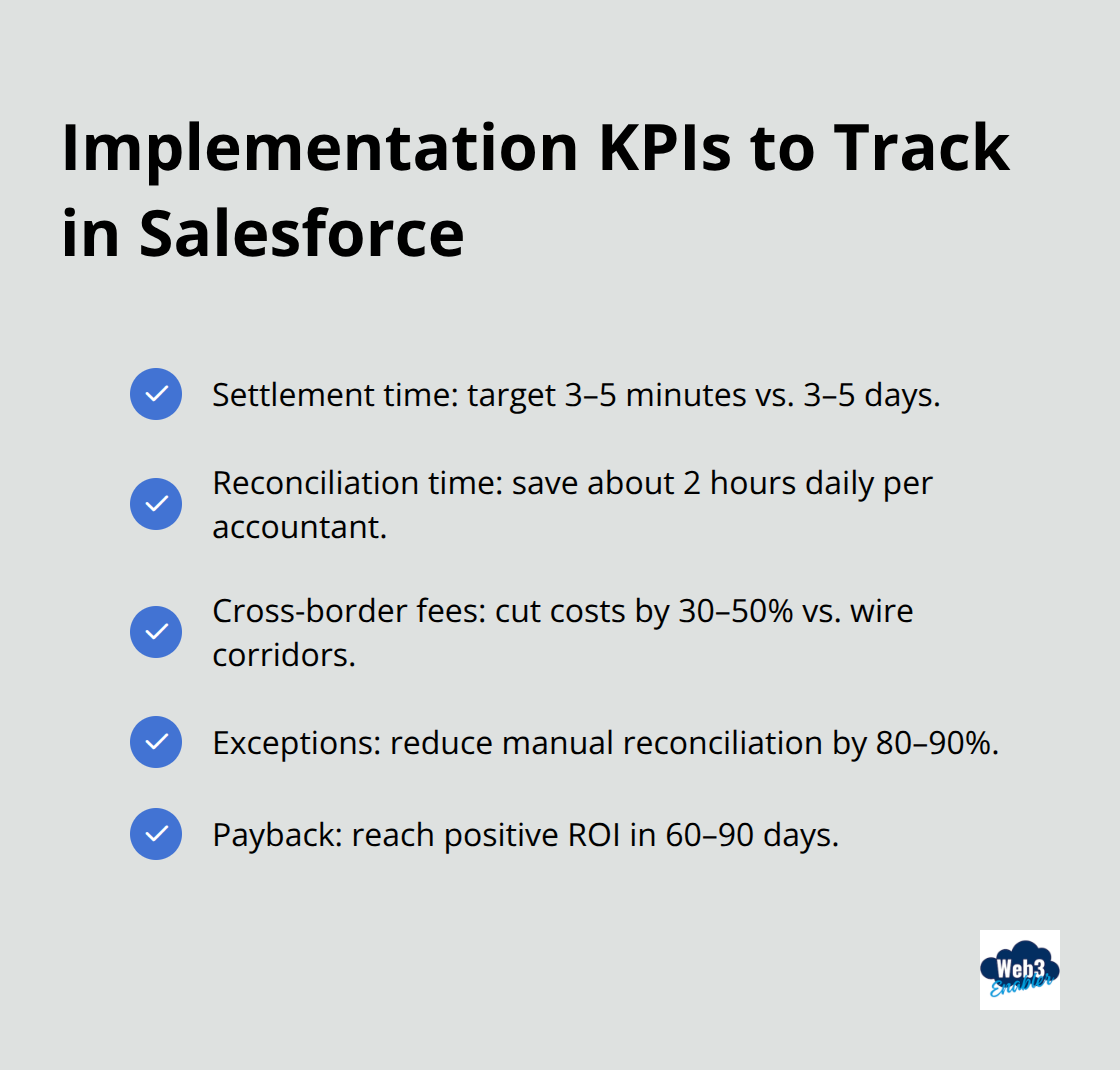
Your finance team measures success through concrete metrics: settlement time reduction (target three to five minutes versus three to five days), reconciliation time savings (target two hours daily per accounting staff member), and cross-border payment cost reduction (target thirty to fifty percent lower fees than wire transfer corridors). These numbers compound quickly. A company processing fifty thousand dollars in daily cross-border payments saves fifteen thousand dollars monthly in wire fees alone, which justifies blockchain infrastructure investment in under two months.
Track reconciliation error rates before and after implementation-most teams report eighty to ninety percent reduction in manual reconciliation exceptions because blockchain transactions create immutable audit trails that eliminate the matching games traditional banking requires. Revenue recognition acceleration matters equally. When settlement shifts from pending to confirmed in minutes rather than days, your revenue team recognizes cash faster, which improves cash conversion cycle metrics that directly impact working capital efficiency and investor valuations.
Phased Rollout Prevents Operational Chaos
Execution speed depends on whether your implementation requires custom development or uses out-of-the-box capabilities. Your implementation checklist includes three critical phases: first, configure payment acceptance for your highest-volume customer segments or regions where wire transfer delays cost the most money, second, integrate settlement confirmation into your revenue recognition workflows so your accounting team sees payment finality automatically, and third, establish wallet management and security protocols with your compliance team before processing volume.
Don’t attempt full rollout across all payment corridors simultaneously. Start with select customer segments where the blockchain advantage is most obvious-perhaps your highest-value customers in Southeast Asia or the Middle East where traditional wire transfers carry the most friction and cost. This phased approach lets your team learn the system, identify gaps, and build confidence before expanding. Your success metrics shift from implementation timelines to operational metrics that matter to your business.
Measuring What Actually Moves Your Business Forward
Measure settlement time reduction by tracking average days to cash for blockchain-enabled transactions versus traditional payments. Monitor reconciliation efficiency through hours spent on month-end close activities. Calculate cross-border payment cost savings by comparing wire fees paid versus stablecoin corridor costs. These metrics answer the only question that matters to your CFO: does blockchain-enabled revenue operations improve profitability and cash flow velocity enough to justify the investment.
Start measurement immediately after go-live rather than waiting for quarterly reviews. Your first thirty days reveal whether the system works in production or whether edge cases exist that your vendor’s sales team glossed over. Most companies reach positive ROI within sixty to ninety days after go-live, which makes blockchain revenue infrastructure one of the fastest-payback technology investments available.
Final Thoughts
Blockchain-enabled revenue operations transform how your business moves money globally while keeping everything inside Salesforce. Your sales team stops chasing wire transfer status updates and receives real-time payment confirmation instead. Your finance team abandons manual reconciliation spreadsheets and focuses on actual revenue strategy while your compliance team maintains immutable audit trails that satisfy regulatory requirements without extra work.
We at Web3 Enabler specialize in connecting blockchain technology with your existing corporate infrastructure through 100% Salesforce Native solutions that support stablecoin payments, global settlement, and financial visibility without forcing your team to learn crypto infrastructure. Your first step involves identifying your highest-volume payment corridors where wire transfer delays cost the most money and measuring settlement time reduction, reconciliation savings, and cross-border payment cost improvements. Most companies reach positive ROI within sixty to ninety days after go-live, which makes blockchain-enabled revenue cloud integration one of the fastest-payback technology investments available.
Visit Web3 Enabler to explore how blockchain integration accelerates your revenue operations and positions your business ahead of competitors still waiting for wire transfers to clear.