



Treasury teams waste millions annually on slow, expensive payment systems that drain working capital and create operational headaches.
Blockchain treasury solutions change this reality by enabling instant settlements, reducing transaction costs by up to 90%, and providing real-time visibility into every payment. At Web3 Enabler, we’ve seen companies transform their cash management from days-long processes into second-by-second operations.
The shift isn’t just about technology-it’s about competitive advantage.
Why Traditional Treasury Still Fails Companies
Treasury departments face a perfect storm of inefficiency that costs companies millions annually. Manual payment processes take 3-5 business days for cross-border transfers, while blockchain payments settle in under 3 minutes according to Visa data. This time gap creates massive working capital problems as funds sit locked in transit rather than earning returns or funding operations.
Cross-Border Payment Costs Drain Budgets
Traditional wire transfers charge between 4% and 18% in fees, while correspondent banks add hidden costs through unfavorable exchange rates. Companies that process $10 million in international payments annually lose significant amounts just in transaction fees. These costs multiply when treasury teams move money between subsidiaries or pay vendors across different currencies. Banks profit from this opacity while businesses absorb the expense.
Manual Reconciliation Creates Operational Chaos
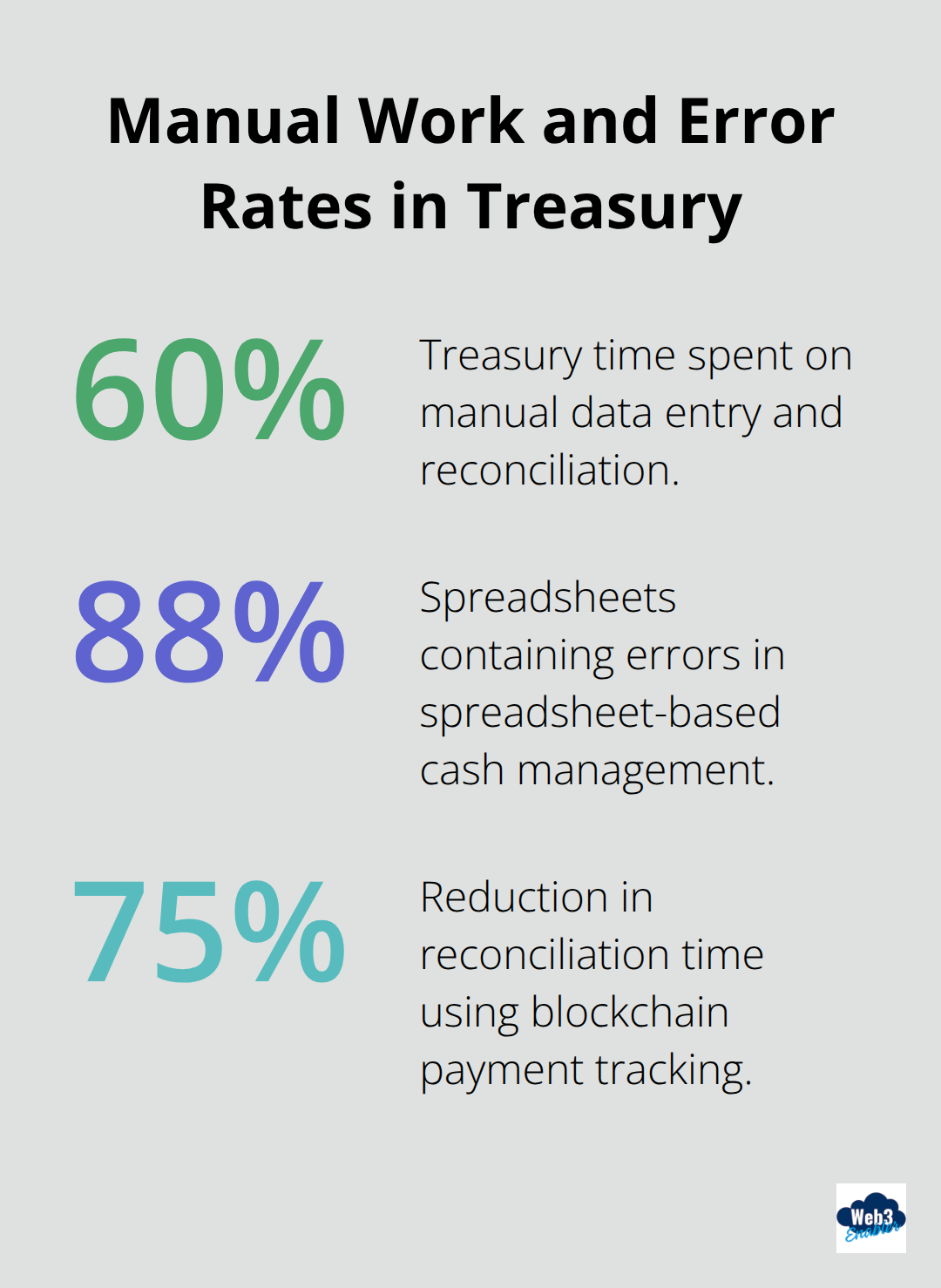
Treasury teams spend 60% of their time on manual data entry and reconciliation tasks instead of strategic financial planning. Spreadsheet-based cash management leads to errors in 88% of spreadsheets (according to research studies), which creates compliance risks and audit problems. When payments take days to clear and banks provide limited transaction visibility, finance teams cannot accurately forecast cash positions or optimize liquidity management.
Real-Time Visibility Remains a Distant Dream
This lack of immediate data forces companies to maintain larger cash reserves than necessary, which reduces investment opportunities and returns. Traditional banking systems operate on batch processing schedules that leave treasury teams blind to actual cash positions for hours or days at a time. The combination of slow settlements, high costs, and poor visibility creates the perfect environment for blockchain solutions to transform how companies manage their financial operations.
How Blockchain Transforms Treasury Operations
Blockchain technology eliminates the fundamental inefficiencies that plague traditional treasury management through three transformative capabilities. Settlement times drop from days to seconds, working capital requirements decrease as funds no longer sit trapped in correspondent banking networks, and transaction costs plummet to under 1% compared to traditional wire transfer fees of 4-18%. Companies that process $50 million annually in cross-border payments save $2-8 million in fees alone while they gain immediate access to transferred funds.

Instant Settlement Reduces Working Capital Requirements
Traditional treasury teams maintain cash reserves 30-40% higher than necessary because of unpredictable settlement delays. Blockchain payments confirm within minutes across any currency or geography, which means finance directors can optimize working capital with precision. Tesla reduced their payment processing time from 5 days to under 10 minutes for international supplier payments, which freed up millions in working capital for strategic investments. This speed advantage becomes exponential when companies manage multiple subsidiaries across different time zones and banking systems.
Transaction Transparency Eliminates Manual Reconciliation
Every blockchain transaction creates an immutable record with timestamp, amount, and participant details visible in real-time. Treasury teams gain complete visibility into payment status without phone calls to banks or waiting for batch updates. Visa reports that blockchain payment tracking reduces reconciliation time by 75% compared to traditional methods. Finance departments can automate reconciliation processes and eliminate the manual verification steps that consume 60% of treasury staff time (this transparency also simplifies audit processes and regulatory compliance reporting).
Direct Transfer Economics Cut Intermediary Costs
Peer-to-peer blockchain transfers bypass correspondent banking networks entirely, which eliminates intermediary fees and exchange rate markups. Companies save 2-6% per transaction while they gain control over exact transfer amounts and timing. The $32 trillion in stablecoin transaction volume processed in 2024 demonstrates enterprise adoption of this cost-effective approach. Treasury teams can move funds between global operations instantly without losing value to banking fees or unfavorable exchange rates.
These technical advantages create the foundation for practical treasury applications that transform how companies manage their daily financial operations across multiple currencies and jurisdictions.
How Do Treasury Teams Apply Blockchain Today
Treasury departments at Fortune 500 companies process multi-currency payments across 50+ countries daily, and blockchain technology transforms these operations from week-long processes into real-time financial management. Siemens successfully field-tested blockchain technology on money market operations alongside Continental and Commerzbank, while their treasury team reduced commercial paper settlement from days to 93 seconds with distributed ledger technology. Companies that manage global operations move funds between subsidiaries in different currencies within minutes instead of waiting 3-5 business days for traditional wire transfers to clear.
Global Payment Operations Without Banking Delays
Multinational corporations maintain separate treasury operations in each jurisdiction, which creates complex cash management challenges when they move funds between entities. Blockchain payments eliminate correspondent banking networks entirely, so treasury teams transfer funds directly between wallets in different countries without intermediary delays or fees. Companies save 4-7% on each international transfer while they gain immediate access to funds for local operations. Treasury managers can now optimize global liquidity in real-time rather than plan around unpredictable settlement schedules.
Vendor Payment Automation Through Programmable Money
Large enterprises process thousands of vendor payments monthly, and programmable blockchain payments trigger automatically when predefined conditions are met. Invoice approval workflows connect directly to payment execution, so approved invoices generate immediate transfers to supplier wallets without manual intervention. This automation reduces processing costs by 60% while it eliminates human errors in payment amounts and recipient addresses (treasury teams focus on strategic cash management instead of routine payment processing tasks).
Transaction Records That Eliminate Reconciliation Work
Blockchain creates immutable transaction logs with precise timestamps and participant details, which eliminates the manual reconciliation work that consumes 60% of treasury staff time. Every payment generates an auditable trail that regulatory authorities can verify instantly, which reduces compliance reporting from weeks to hours. Finance teams access complete transaction histories in real-time instead of waiting for monthly bank statements or calling correspondent banks for payment status updates (this transparency also streamlines audit processes and regulatory compliance reporting).

Final Thoughts
Blockchain treasury management delivers measurable results that traditional banking systems cannot match. Companies reduce cross-border payment costs from 4-18% to under 1%, eliminate 3-5 day settlement delays, and gain real-time visibility into every transaction. Treasury teams save 60% of their time previously spent on manual reconciliation while they optimize working capital through instant fund access.
Implementation starts with identification of high-volume payment corridors where blockchain delivers immediate cost savings. Treasury departments can begin with stablecoin payments for international suppliers, then expand to multi-currency operations as teams gain experience. The technology requires minimal infrastructure changes when teams work with experienced partners (who handle the technical complexity).
Digital assets will reshape treasury operations within the next five years as regulatory frameworks solidify and enterprise adoption accelerates. Companies that implement blockchain treasury solutions today gain competitive advantages through lower costs, faster settlements, and superior cash management capabilities. Web3 Enabler provides native Salesforce blockchain integration that treasury teams need to transform their payment operations without disruption to existing workflows.