



Your payment infrastructure is probably a mess. You’re juggling crypto wallets, traditional payment processors, and manual reconciliation across disconnected systems.
We at Web3 Enabler built Salesforce payment integrations to fix this. Accept both blockchain and traditional payments directly in your CRM, automate settlement, and eliminate the operational friction that’s costing you time and money.
Why Unified Payments Matter Now
Most enterprises run payments across 4-6 disconnected systems. Your sales team uses Salesforce, your accounting department manages QuickBooks or NetSuite, your payment processor sits elsewhere, and crypto wallets live in another silo entirely. This fragmentation doesn’t just waste time-it costs money.
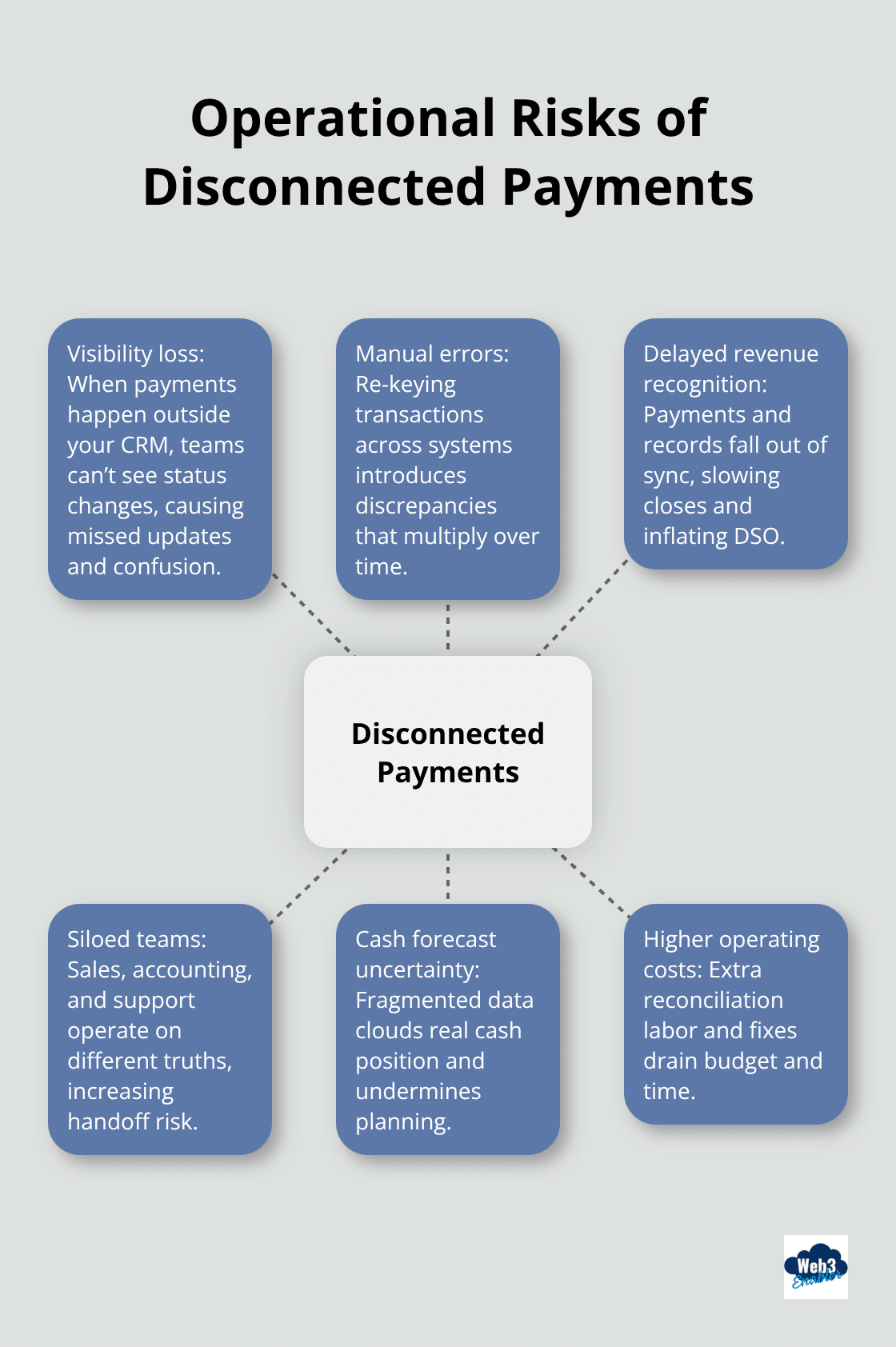
Gartner reports that companies with fragmented payment infrastructure spend 30-40% more on reconciliation labor than those with centralized systems. Real reconciliation gaps happen constantly. A customer pays in USDC on Monday, but the transaction doesn’t sync to your revenue records until Thursday. Your finance team can’t close the books. Your sales forecast is wrong. Your cash position is unclear. These aren’t theoretical problems-they’re operational bleeding that directly impacts your bottom line.
The Real Cost of Disconnected Systems
When payments happen outside your CRM, you lose visibility immediately. A customer sends a stablecoin payment via wallet, but your Salesforce revenue record still shows the invoice as unpaid. Your collections team doesn’t know payment arrived. Your accounting team manually enters the transaction into QuickBooks. Your support team can’t see the payment status when the customer calls. Each handoff introduces risk. Manual payment reconciliation errors create significant operational friction across enterprises. When traditional and blockchain payments exist in separate worlds, these errors multiply.
Customer Expectations Have Shifted
Customers now expect multiple payment options. A 2024 survey by Worldpay found that 73% of enterprise buyers want payment flexibility, including digital currencies for cross-border transactions. Your competitors are already offering this.
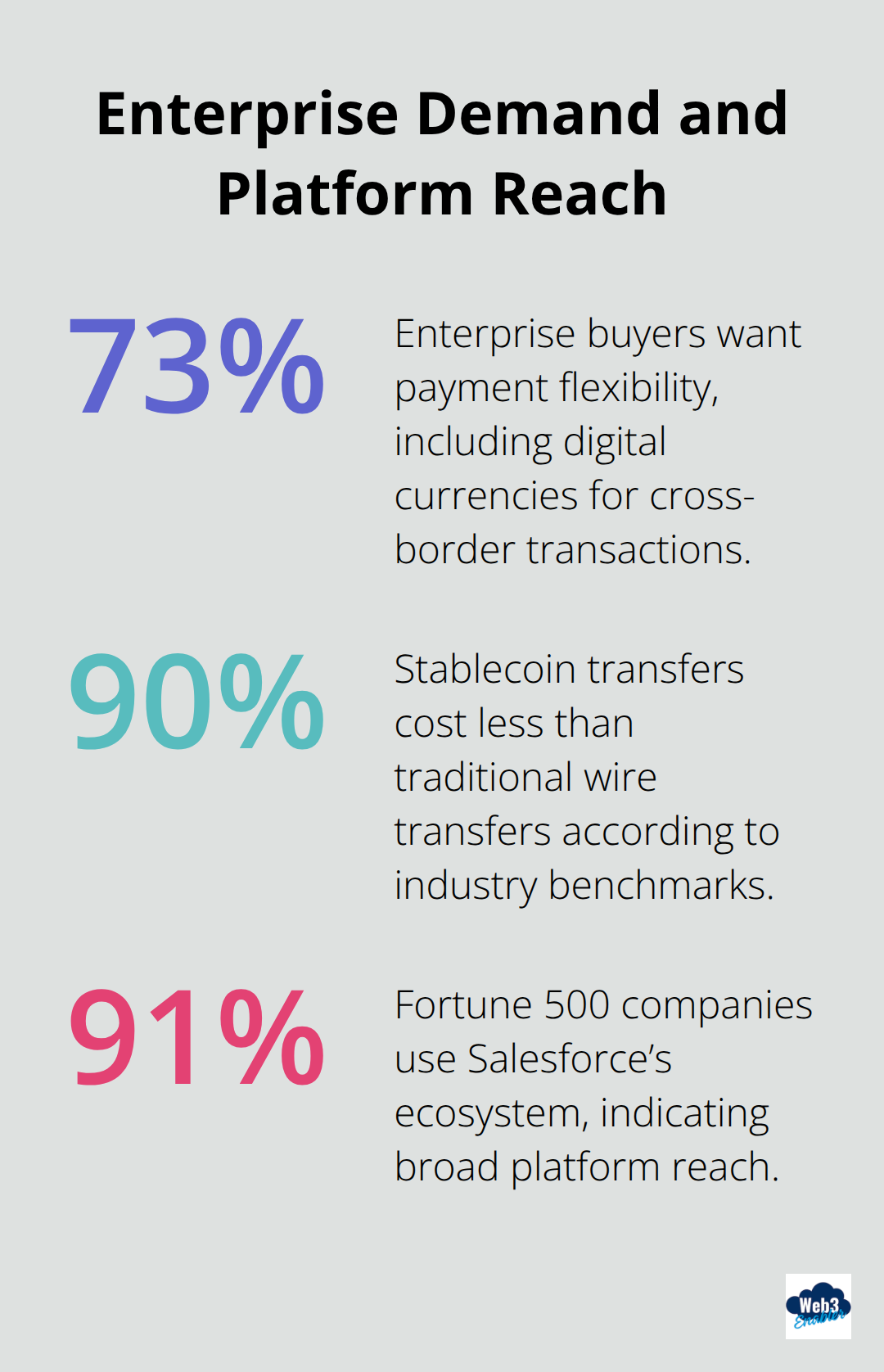
If you force customers into a single payment method, you lose deals. International customers particularly demand faster settlement. Cross-border stablecoin payments settle in minutes rather than days, and they cost 90% less than traditional wire transfers according to industry benchmarks. Your enterprise customers aren’t asking for crypto payments as a novelty-they’re demanding them as a cost-reduction tool. Salesforce’s ecosystem includes 91% of Fortune 500 companies using the platform, and many of those enterprises now want blockchain payment options integrated directly into their CRM workflows rather than bolted on as an afterthought.
Compliance Gets Easier With Centralization
Fragmented systems make audits a nightmare. Regulators want to see the complete transaction trail from order to payment to revenue recognition. When these steps live in different platforms, you manually stitch together evidence during compliance reviews. Centralized payments in Salesforce eliminate this friction. Real-time transaction visibility means your compliance team sees crypto and traditional payments in one place. Settlement data syncs instantly to your audit trail. On-chain transactions are immutable and timestamped automatically. You don’t store sensitive payment data across multiple systems where it can leak or get lost. One platform means one security posture, one encryption standard, one audit surface to defend.
What Unified Payments Enable
When you consolidate crypto and traditional payments into Salesforce, your teams move faster. Your finance team closes books on time. Your sales team sees accurate forecasts. Your collections team acts on payments instantly. Your compliance team passes audits without scrambling. The operational friction that consumed hours each week simply disappears. This foundation-unified visibility, real-time data, centralized security-is what makes the next step possible: actually integrating blockchain and traditional payment flows so they work together seamlessly rather than fighting each other.
Crypto Payments and Stablecoins in Salesforce
How Stablecoins Reduce Volatility and Settlement Risk
Stablecoins eliminate the volatility that makes crypto payments impractical for enterprise use. USDC maintains a 1:1 peg to the US dollar through Circle’s reserve backing, meaning your revenue recognition stays predictable and your finance team doesn’t wake up to a 15% swing in transaction value overnight. This stability matters operationally. When you accept a stablecoin payment today, you know exactly what it’s worth tomorrow. Your accounting team records revenue without hedging calculations. Your cash forecast doesn’t require constant recalibration.
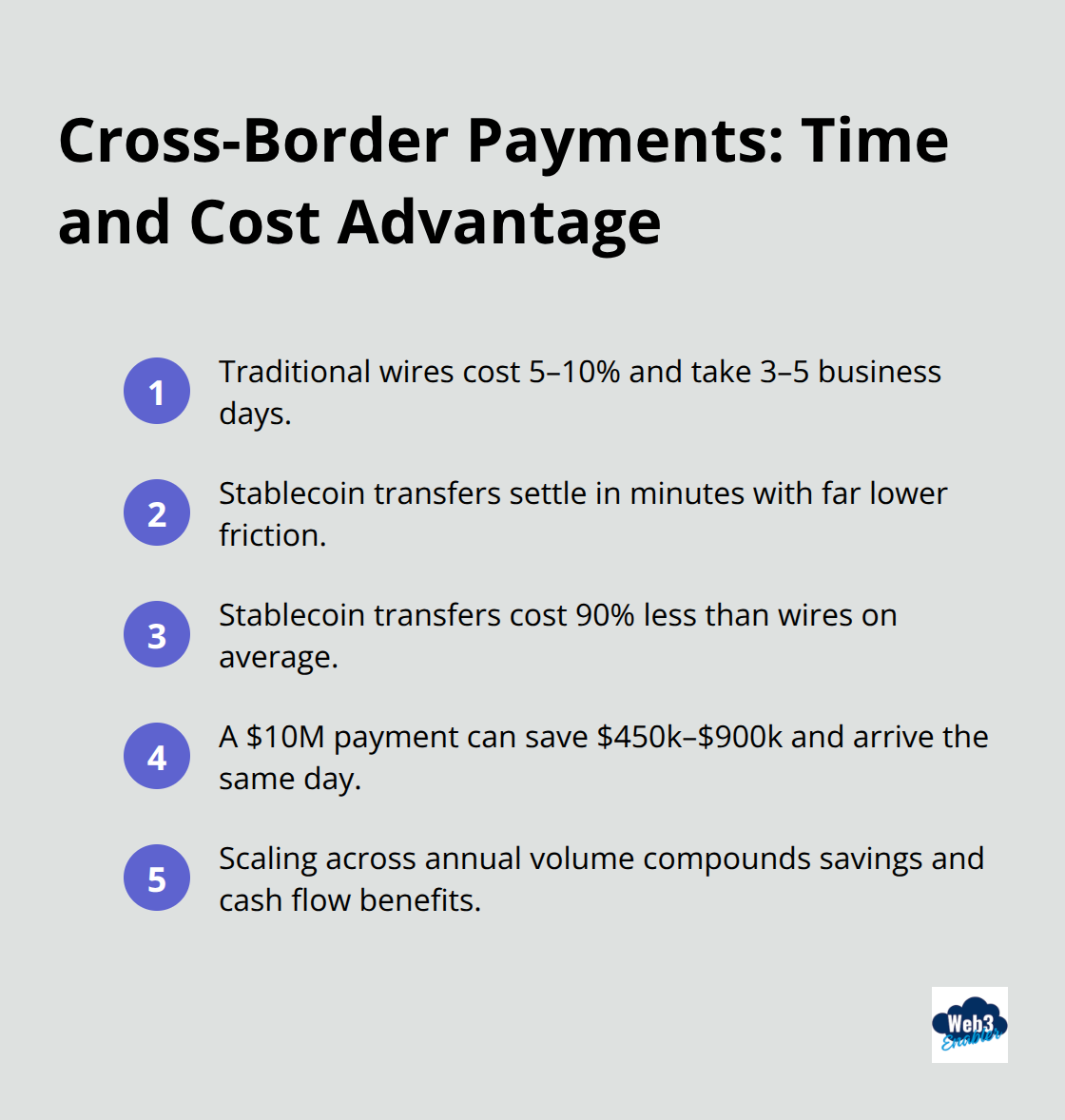
Traditional wire transfers for cross-border payments take 3-5 business days and cost 5-10% in fees. Stablecoin settlements on blockchain networks like Ethereum or BASE offer faster alternatives to traditional payments. This speed and cost advantage compounds across your payment volume. A mid-market company processing $50 million in annual cross-border payments gains significant savings plus cash flow acceleration through blockchain-based settlement.
Accepting Digital Currencies Directly Within Your CRM Workflows
The Salesforce ecosystem processes billions in transactions daily across 91% of Fortune 500 companies, and enterprises increasingly demand stablecoin payment options integrated directly into their CRM rather than managed through external wallets and spreadsheets. Web3 Enabler brings stablecoin acceptance directly into your Salesforce workflows through native integration with Financial Services Cloud, Commerce Cloud, and Revenue Cloud.
Your sales team accepts payments without leaving the platform. Your finance team sees settlement status in real-time without manual reconciliation. Your customers pay in stablecoins without friction. The transaction syncs instantly to your revenue records, your customer account, and your cash position dashboard. This native integration (available only on the Salesforce AppExchange through Web3 Enabler) eliminates the customization burden that traditional payment gateways impose on your IT team.
Real-Time Transaction Visibility and Instant Reconciliation
Real-time visibility transforms how your teams operate. When a customer sends a stablecoin payment, the transaction appears in Salesforce within seconds of blockchain confirmation, not hours or days later. Your collections team immediately marks the invoice as paid. Your accounting team closes the period without delays. Your sales forecast reflects actual cash received, not promised payments. This speed eliminates the guessing games that plague enterprises relying on traditional banking rails.
You also gain immutable, timestamped transaction records that satisfy audit requirements automatically. Every stablecoin payment carries on-chain proof of settlement that regulators can verify independently. Your compliance team stops manually gathering evidence from multiple systems and instead pulls a complete transaction trail directly from Salesforce. The audit surface shrinks. Risk exposure drops. Reconciliation errors disappear because the blockchain record of truth stays synchronized with your CRM record of truth (preventing the operational bleeding you experience today when crypto payments land in one system, traditional ACH payments in another, and manual entries in a third).
One platform, one source of truth, one audit trail. This foundation sets up your next challenge: actually integrating blockchain and traditional payment flows so they work together seamlessly rather than fighting each other.
Making Crypto and Traditional Payments Work Together
Your enterprise doesn’t accept one payment method and call it done. You need stablecoins for international customers, traditional ACH for domestic suppliers, credit cards for point-of-sale transactions, and wire transfers for large settlements. The problem isn’t choosing between them-it’s making them coexist without creating chaos in your Salesforce instance. Most enterprises solve this problem incorrectly: they accept payments everywhere and reconcile them nowhere, which is exactly how you end up with revenue leakage and cash visibility problems that last for weeks.
Choose the Right Integration Architecture
The technical architecture matters because selecting the wrong integration pattern costs you months of implementation time and thousands in unnecessary customization. A Hub-and-Spoke architecture routes all payments (crypto and traditional) through a central Salesforce instance, which works well for enterprises with 50+ payment channels and complex orchestration needs. Point-to-Point connections work for simpler setups where you connect Salesforce directly to two or three payment processors. Most mid-market enterprises benefit from Event-Streaming patterns that trigger instant actions when payments settle-your revenue record updates automatically when a stablecoin payment confirms on-chain, your collections team receives notification instantly, and your cash forecast recalculates without manual intervention.
Gartner projects that more than 60% of enterprise integration plans will rely on event-driven patterns to support AI and automation by 2026, and this applies directly to payments. When you accept stablecoin payments through native blockchain integration, the transaction appears in your revenue records within seconds of blockchain confirmation, not days later through batch reconciliation.
Unlock Cross-Border Settlement Advantages
Cross-border settlements demonstrate the operational advantage immediately. Traditional wire transfers cost 5-10% in fees and take 3-5 business days, while stablecoin transfers settle in minutes and cost 90% less according to industry benchmarks. A $10 million cross-border payment saves your enterprise $450,000 to $900,000 and arrives the same day instead of waiting a week. Scale that across your annual transaction volume and the cost advantage becomes undeniable.
Your compliance team gains immutable, timestamped records automatically because every stablecoin transaction carries on-chain proof of settlement that regulators can verify independently. You stop manually gathering evidence from multiple systems and instead pull a complete audit trail directly from Salesforce with full settlement data synchronized in real-time.
Native Integration Eliminates Customization Burden
The AppExchange generates about $140B in annual sales with 90% of Salesforce customers using one or more AppExchange applications, signaling that enterprises expect integrated solutions rather than disconnected point products. Traditional gateways like BitPay or Stripe require heavy customization that ties up your IT team for months. Native blockchain integration (available through Web3 Enabler on the Salesforce AppExchange) eliminates this friction entirely.
Your sales team accepts stablecoins without leaving the platform. Your finance team sees settlement status in real-time without reconciliation headaches. Your customers pay however they prefer without friction. The result is operational efficiency that compounds-fewer manual touches, faster close periods, cleaner audit trails, and cash positions that reflect reality instead of yesterday’s guesses.
Final Thoughts
Your Salesforce payment integrations now handle both crypto and traditional payments from a single platform. Your finance team closes books faster. Your collections team acts on payments instantly. Your customers receive the payment flexibility they demand.
Blockchain technology delivers what traditional payment systems cannot: speed measured in minutes instead of days, transparency that regulators verify independently, and cost efficiency that saves your enterprise hundreds of thousands annually on cross-border settlements. When stablecoin payments settle in minutes instead of days, your cash position reflects reality immediately. When settlement data syncs automatically to your revenue records, your sales forecast becomes accurate.
Web3 Enabler brings this capability to your Salesforce instance as the only native blockchain payments platform on the AppExchange. Your sales team accepts stablecoins without leaving the CRM, your finance team sees settlement status in real-time, and your customers pay however they prefer.