

Global sales teams lose money every day waiting for payments to settle. Traditional banking adds friction to international deals, creating delays that slow down cash flow and visibility into your pipeline.
We at Web3 Enabler built Sales Cloud payments automation to eliminate these bottlenecks. Stablecoin payments settle in minutes, not days, giving your team real-time clarity on deal status and cash position.
The True Cost of Waiting for Global Payments
International sales deals move at the speed of payment settlement, and traditional banking creates friction that slows your entire operation. When a customer in Singapore agrees to a contract, your finance team waits 5–7 business days to see cash. That delay compounds across your pipeline. A sales rep closes a deal on Monday, but revenue doesn’t hit your books until the following week. Finance struggles to forecast accurately. Your CFO can’t assess real cash position. Your team loses visibility into what’s actually funded versus what’s promised.
Stablecoin payments eliminate this problem. Settlement happens in minutes, not days. The moment a customer sends USDC or USDT, the transaction confirms on-chain and syncs directly into your Sales Cloud records. Your team sees immediate payment confirmation tied to the opportunity. Your cash flow forecasting shifts from guesswork to real-time data. A deal that closes Monday shows as paid Monday.
That speed advantage compounds across your organization. If your sales team closes 50 deals monthly with an average deal size of $50,000, waiting 5–7 days costs you roughly $8.3 million in float daily across your pipeline. That’s capital you can’t deploy for operations, product development, or growth. Stablecoin payments recover that time and capital immediately.
Real-Time Payment Status Transforms Operations
Real-time payment visibility changes how sales teams operate. Traditional banking leaves your team in the dark. You close a deal, send an invoice, and wait. The customer sends payment. Days pass. You check your bank. Money arrives. You manually update Salesforce. That lag between payment and visibility creates friction throughout your organization.
Sales reps chase customers asking if payment was sent. Finance chases reps asking about deal status. Your opportunities sit in closed-won but unconfirmed for days. With blockchain payments, that entire cycle vanishes. Payment confirmation becomes transparent and immediate. Your sales team sees the exact moment funds arrive. Dashboard views show payment status across every opportunity and account in real time.
Reps stop chasing customers. Finance stops chasing reps. Your team focuses on closing the next deal, not tracking the last one. That operational clarity directly impacts deal velocity and cash flow forecasting accuracy.
How Blockchain Payments Accelerate Your Sales Cycle
Blockchain payments remove the administrative burden that slows traditional sales operations. When you integrate stablecoin payments into Sales Cloud, payment reconciliation happens automatically. Transactions confirm on-chain and sync with your deal records without manual intervention. Your finance team no longer spends hours matching bank statements to invoices. Your sales team no longer waits for payment confirmation to move deals forward.
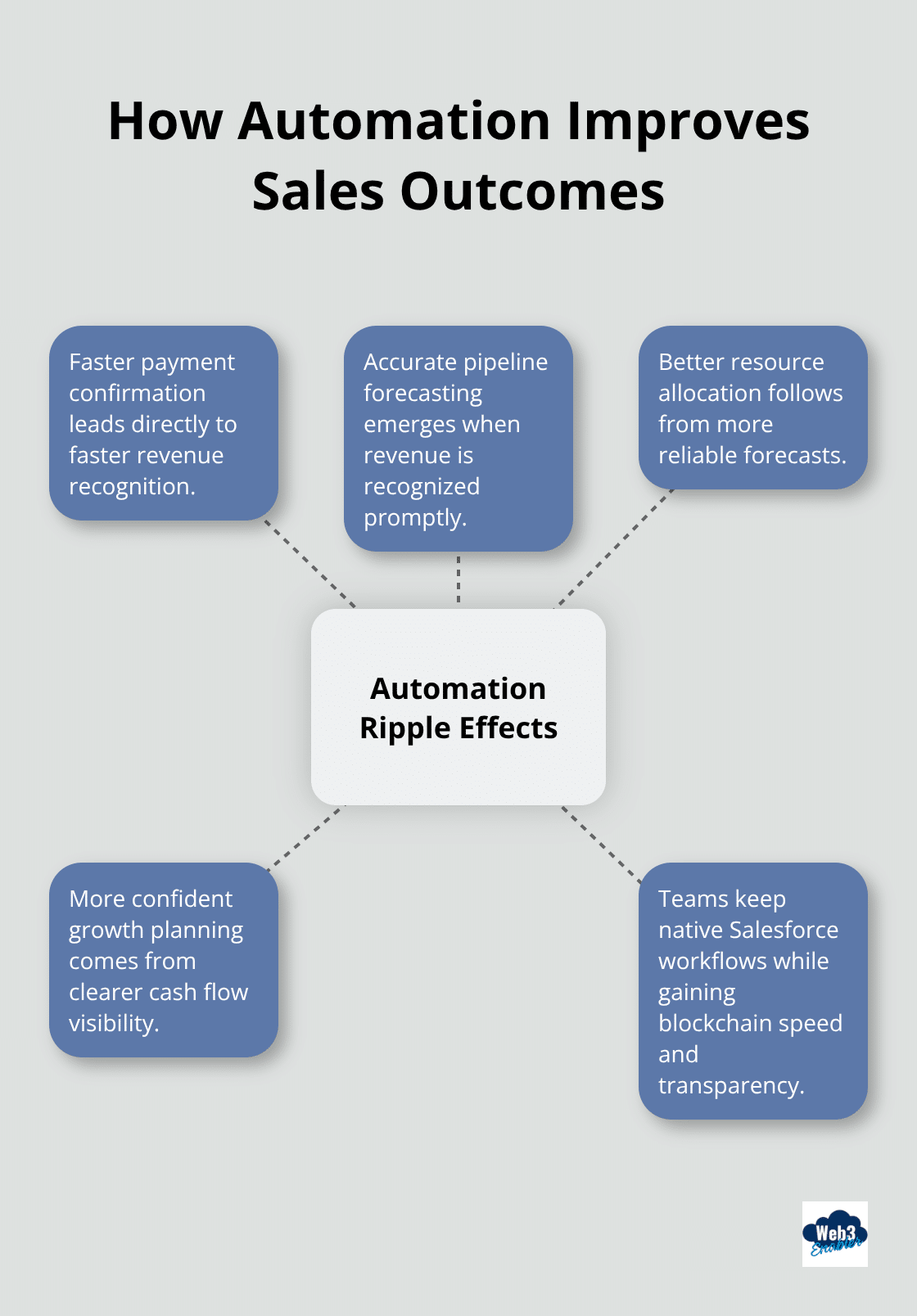
This automation creates a ripple effect across your entire sales organization. Faster payment confirmation means faster revenue recognition. Faster revenue recognition means more accurate pipeline forecasting. More accurate forecasting means better resource allocation and more confident growth planning. Web3 Enabler brings this capability directly into Salesforce, keeping your team in the workflows they already use while adding the speed and transparency that blockchain provides.
Building Blockchain Payments Into Your Sales Workflow
Your sales team lives in Salesforce. Your finance team lives in spreadsheets and bank dashboards. Blockchain payments eliminate that split by embedding stablecoin transactions directly into Sales Cloud, so payment confirmation, reconciliation, and revenue recognition happen where your team already works. No switching between systems. No manual data entry. No delays waiting for finance to update opportunity records after payment arrives.
The integration works because it sits native inside Salesforce, not bolted on as a third-party plugin. When a customer sends USDC or USDT from their wallet, the transaction confirms on-chain and automatically syncs with your opportunity record. Your sales rep sees the payment status update in real time. Your finance team sees the same data. Your revenue recognition happens instantly. Traditional payment gateways require you to jump between your bank portal, your accounting system, and Salesforce to stitch together what actually happened. Native blockchain integration keeps everything inside the CRM where it belongs.
Automatic Reconciliation Eliminates Manual Matching
Payment reconciliation traditionally consumes hours from your finance team’s week. A customer pays via wire transfer. The money lands in your bank account days later. Your team manually matches that deposit to an invoice. They hunt through transaction details, cross-reference amounts, and update Salesforce. If the payment comes from a subsidiary or through a third-party processor, the amount might not match exactly, creating more friction. International payments add currency conversion delays and fees that further complicate matching.
Blockchain payments eliminate this entirely. When a transaction confirms on-chain, the system automatically matches it to the correct opportunity and updates your revenue records without human intervention. The postback webhook confirms payment arrival and syncs the transaction directly to Sales Cloud. Your finance team stops hunting for payments and starts focusing on exceptions. That shift from manual matching to exception-based management frees up significant time for a finance team processing monthly transactions.
Multi-Currency Settlement Removes Conversion Friction
Global sales teams quote in different currencies depending on where the customer sits. A prospect in the UK wants pricing in GBP. A customer in Singapore wants pricing in SGD. Your finance team converts everything to USD for reporting and revenue recognition. Each conversion introduces a fee, a timing lag, and a reconciliation burden. Traditional payment processors charge 2–4% per cross-border transaction according to industry benchmarks. Those fees stack quickly across a global sales operation.
Stablecoin payments eliminate conversion complexity because USDC and USDT settle in the same asset everywhere. A customer in any region sends the same stablecoin. Settlement happens in minutes. No conversion delays. No intermediary banks taking fees. The platform accepts stablecoins across multiple blockchains (ERC-20, TRC-20, BEP-20, and Polygon), so your customers choose the network that works best for them. Your team receives the same asset regardless of which blockchain they use. Revenue recognition becomes straightforward because you’re always receiving the same currency, not managing dozens of payment rails and conversion rates.
Real-Time Visibility Transforms Deal Tracking
Your sales team needs to know payment status the moment it happens. Traditional banking leaves your team in the dark. You close a deal, send an invoice, and wait. The customer sends payment. Days pass. You check your bank. Money arrives. You manually update Salesforce. That lag between payment and visibility creates friction throughout your organization.
Blockchain payments make payment confirmation transparent and immediate. Your sales team sees the exact moment funds arrive. Dashboard views show payment status across every opportunity and account in real time. Reps stop chasing customers asking if payment was sent. Finance stops chasing reps asking about deal status. Your team focuses on closing the next deal, not tracking the last one. That operational clarity directly impacts deal velocity and cash flow forecasting accuracy.
Automation Accelerates Your Entire Sales Cycle
Blockchain payments remove the administrative burden that slows traditional sales operations. When you integrate stablecoin payments into Sales Cloud, payment reconciliation happens automatically. Transactions confirm on-chain and sync with your deal records without manual intervention. Your finance team no longer spends hours matching bank statements to invoices. Your sales team no longer waits for payment confirmation to move deals forward.
This automation creates a ripple effect across your entire sales organization. Faster payment confirmation means faster revenue recognition. Faster revenue recognition means more accurate pipeline forecasting. More accurate forecasting means better resource allocation and more confident growth planning. Native blockchain integration keeps your team in the workflows they already use while adding the speed and transparency that on-chain transactions provide. With these operational improvements in place, your organization is ready to configure the specific payment workflows and dashboard views that will give your sales team the real-time insights they need to accelerate deal closure.
Getting Started with Blockchain Payments in Sales Cloud
Your Sales Cloud instance already contains all the data you need to activate stablecoin payments: customer records, opportunity amounts, invoice details, and payment terms. The implementation approach matters more than the technical complexity. Start by mapping your actual payment workflows against your current Sales Cloud configuration, not the other way around. Most organizations process payments through a standard flow: opportunity closes, invoice generates, customer receives payment instructions, payment arrives, revenue recognizes. Blockchain payments slot directly into this flow without requiring process redesign. The key difference is that settlement happens in minutes instead of days, and confirmation arrives automatically instead of requiring manual bank checks.
Map Your Payment Workflows to Blockchain Settlement
Identify which opportunities trigger stablecoin payment requests. Not every deal needs crypto payments-some customers prefer traditional methods. Segment your opportunities by geography and customer type, then enable stablecoin options for international deals where settlement speed matters most. A software company selling to European prospects, for example, might offer USDC settlement to compress wire transfer windows into minutes. Your sales reps can present stablecoin payments as a faster alternative at contract signature, giving customers control over their preferred payment method while accelerating your cash position.
Configure Automated Notifications for Real-Time Reactions
Set up automated notifications so your team reacts to payment confirmation in real time instead of checking bank dashboards manually. When a blockchain transaction confirms on-chain, the postback webhook syncs directly to your Sales Cloud records and triggers notifications to relevant stakeholders. Your sales rep receives notification when payment arrives so they can immediately move the opportunity to a confirmed closed-won status. Your finance team receives notification so they can process revenue recognition without delay. Your account executive receives notification so they can prioritize onboarding or service delivery for a fully funded account. These notifications eliminate the back-and-forth messages asking about payment status.
Build Dashboard Views That Track Payment Status
Create dashboard views that display payment status across all open opportunities and active accounts. One view shows opportunities grouped by payment status: awaiting payment, payment confirmed, payment received, payment reconciled. Another dashboard shows accounts by settlement currency and settlement speed, helping your finance team forecast cash position by region. A third dashboard tracks days-to-settlement by payment method, giving your leadership team visibility into how blockchain payments compare to traditional banking.
These dashboards transform payment data from a finance reporting exercise into an operational tool that your entire sales organization uses daily. Your reps use them to follow up on overdue invoices. Your finance team uses them to forecast cash flow. Your CFO uses them to understand global payment patterns and optimize working capital. Native blockchain integration means these dashboards pull directly from on-chain transaction data without manual updates or reconciliation delays, so the numbers your team sees remain current.
Eliminate Manual Reconciliation Work
Payment reconciliation traditionally consumes hours from your finance team’s week. A customer pays via wire transfer. The money lands in your bank account days later. Your team manually matches that deposit to an invoice, hunts through transaction details, and cross-references amounts. If the payment comes from a subsidiary or through a third-party processor, the amount might not match exactly, creating more friction. International payments add currency conversion delays and fees that further complicate matching.
Blockchain payments eliminate this entirely. When a transaction confirms on-chain, the system automatically matches it to the correct opportunity and updates your revenue records without human intervention. The postback webhook confirms payment arrival and syncs the transaction directly to Sales Cloud. Your finance team stops hunting for payments and starts focusing on exceptions. That shift from manual matching to exception-based management frees up significant time for a finance team processing monthly transactions.
Final Thoughts
Sales Cloud payments automation transforms how global sales teams operate by eliminating the banking delays that compound across your pipeline. Traditional wire transfers cost you millions in float and visibility, while blockchain payments settle in minutes and confirm automatically inside Salesforce. Your sales reps stay in Sales Cloud, your finance team stays in Sales Cloud, and payment confirmation happens without manual intervention or system switching.
Organizations adopting blockchain payments gain measurable competitive advantages through faster cash flow forecasting, automated reconciliation that frees your finance team from hours of manual work, and real-time payment visibility that eliminates back-and-forth messages about deal status. Regulatory frameworks like the Genius Act and MiCA create the foundation for enterprise adoption right now, and your competitors are already exploring how blockchain accelerates their sales cycles. The organizations that move first capture the operational efficiency gains and cash flow advantages that come with settling payments in minutes instead of days.
Web3 Enabler makes this transition straightforward through native Salesforce integration that activates blockchain payments without redesigning your processes or training your team on new systems. Start by mapping your payment workflows to stablecoin settlement, configure automated notifications for payment confirmation, and build dashboard views that track payment status across your opportunities. Your sales organization will immediately feel the difference when payment confirmation becomes transparent and instant instead of hidden in banking delays.