


 Crypto subscription payments are transforming how businesses handle recurring revenue streams. Traditional payment methods often struggle with cross-border transactions and high processing fees.
We at Web3 Enabler see companies increasingly adopting blockchain-based subscription models for their predictable payment flows. This shift offers reduced costs, faster settlements, and global accessibility without traditional banking limitations.
Technical Requirements for Crypto Subscription Payments
Crypto subscription payments demand three core technical components that work together seamlessly. Your blockchain infrastructure forms the foundation, with Ethereum and Polygon standing out as the most reliable networks for recurring payments. Ethereum processes over 1.2 million transactions daily according to Etherscan data, while Polygon offers significantly lower gas fees that average $0.01 per transaction compared to Ethereum’s $2-15 range. Smart contracts automate subscription logic, eliminate manual processing, and reduce operational overhead by up to 80% based on DeFi protocol performance metrics.

Blockchain Infrastructure Setup
Ethereum mainnet provides the most mature ecosystem for subscription contracts, though high gas fees can impact profitability for smaller recurring payments. Layer 2 solutions like Polygon and Arbitrum solve this cost problem while maintaining Ethereum’s security guarantees. Polygon processes transactions efficiently with strong performance metrics. Your infrastructure choice affects both user experience and operational costs significantly.
Payment Gateway Integration
Modern payment gateways like Circle’s APIs and Coinbase Commerce provide middleware between your application and blockchain networks. These platforms handle multiple wallet types and cryptocurrency conversions automatically. Circle’s USDC payments settle within 15 seconds globally, while traditional ACH transfers take 3-5 business days according to Federal Reserve data. Integration requires REST API implementation with webhook support for real-time payment notifications.
Security Protocols and Wallet Management
Multi-signature wallets represent the gold standard for business crypto operations (requiring 2-of-3 or 3-of-5 signatures for transaction approval). Hardware security modules protect private keys with bank-grade encryption standards. Customer wallet integration should support major providers including MetaMask, WalletConnect, and Coinbase Wallet to maximize adoption rates.
Smart Contract Architecture
Subscription smart contracts must handle payment scheduling, grace periods, and automatic cancellations. OpenZeppelin’s subscription contract templates provide battle-tested code that reduces development time by 60-70%. These contracts should include pause functions for emergency stops and upgrade mechanisms for future improvements.
The technical foundation sets the stage for implementation, but the actual setup process requires careful planning and systematic execution to avoid common pitfalls.
Implementation Process and Best Practices
Crypto subscription payment setup demands a systematic approach that begins with smart contract deployment and concludes with comprehensive testing protocols. Your development team should start with testnet deployment on Goerli or Sepolia networks, where transaction costs remain negligible while you perfect the subscription logic. Circle’s developer documentation reveals that proper testnet validation reduces production bugs by 85%, which makes this step essential for success.
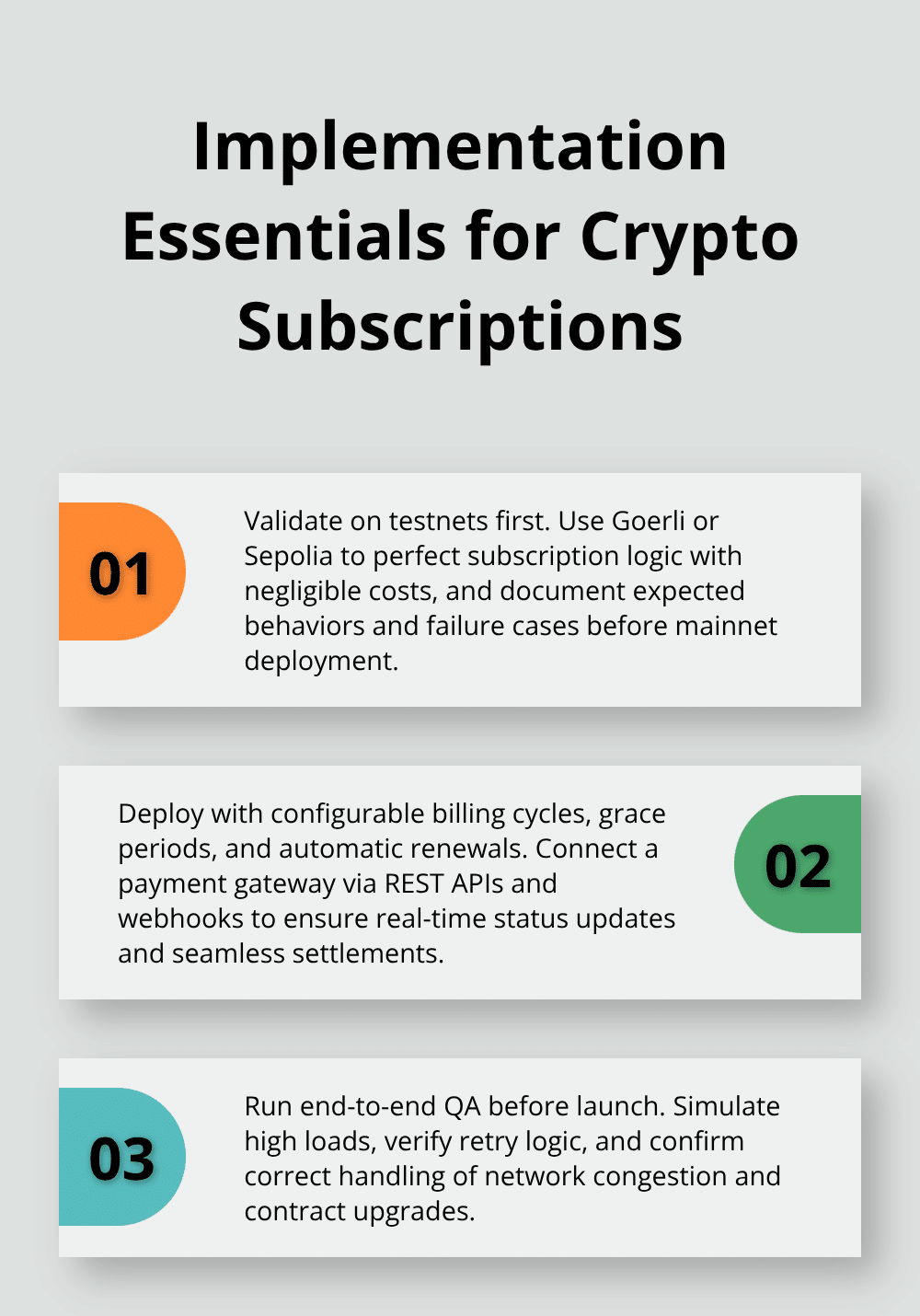
Deploy your subscription contract with configurable parameters for billing cycles, grace periods, and automatic renewals. Connect your payment gateway through REST APIs that support webhook notifications for real-time payment status updates. Stripe’s crypto integration handles USD to USDC conversions automatically while it maintains compliance with existing financial reporting standards.
Smart Contract Deployment Strategy
Production-ready subscription contracts require specific parameters that handle edge cases effectively. Configure billing cycles from weekly to annual intervals with precise timestamp calculations that account for leap years and timezone differences. Smart contracts should include emergency pause functions that allow administrators to halt subscriptions during security incidents or network upgrades.
OpenZeppelin’s subscription templates provide battle-tested code that reduces development time. These contracts handle payment scheduling, grace periods, and automatic cancellations without manual intervention. Your contract architecture must support upgrade mechanisms for future improvements while maintaining backward compatibility with existing subscriptions.
Regulatory Compliance Framework
Crypto subscription payments must comply with AML and KYC requirements that vary significantly across jurisdictions. European businesses operating under MiCA regulations need customer verification for transactions exceeding 1,000 EUR, while US companies follow FinCEN guidelines that require suspicious activity reports for amounts above $3,000.
Implement automated compliance checks that flag unusual payment patterns and maintain transaction records for seven years minimum. Your subscription platform should integrate with compliance providers like Chainalysis or Elliptic for real-time transaction monitoring. Tax reporting becomes complex with crypto subscriptions since each payment creates a taxable event that requires fair market value calculations at transaction time.
Testing and Quality Assurance
Production deployment demands rigorous testing across multiple scenarios including payment failures, network congestion, and smart contract upgrades. Load testing should simulate 10,000 concurrent subscription renewals to identify bottlenecks before launch. Implement automated retry logic for failed transactions with exponential backoff periods that start at 15 minutes and extend to 24 hours maximum.
Monitor gas price fluctuations that can cause transaction failures during network congestion periods. Ethereum gas prices can spike to 200+ gwei during high activity, which makes subscription renewals economically unfeasible for small amounts. Test your system’s response to these conditions before customers experience payment disruptions.
Once your technical infrastructure operates reliably, the focus shifts to customer experience and operational management that determines long-term subscription success.
Managing Crypto Subscription Operations
Customer onboarding for crypto subscriptions requires wallet verification and payment method setup that differs significantly from traditional credit card processing. Your customers need compatible wallets like MetaMask or Coinbase Wallet with sufficient stablecoin balances to cover subscription costs. Implement a streamlined verification process that checks wallet connectivity, confirms minimum balance requirements, and validates transaction history to prevent payment failures. Proper wallet verification significantly reduces failed payments, which makes this step essential for subscription success.
Customer Wallet Setup and Verification
Successful crypto subscription onboarding starts with clear wallet compatibility requirements and balance verification protocols. Your platform should automatically detect wallet types and guide customers through connection procedures that take under 90 seconds. Require minimum USDC balances equal to three subscription payments to prevent immediate failures when gas fees fluctuate. Customers with pre-funded wallets show significantly higher subscription retention rates compared to those who fund payment-by-payment.
Implement automated balance monitoring that sends notifications when customer wallets approach minimum thresholds. This gives customers 48-72 hours to add funds before the next billing cycle. Your verification system should also check transaction history to identify potential fraud patterns or wallet security issues before subscription activation.
Payment Failure Recovery Systems
Payment failures in crypto subscriptions demand sophisticated retry logic that accounts for network congestion and insufficient balances. Configure your system to attempt failed transactions three times with increasing delays: 15 minutes, 2 hours, and 24 hours. During high gas price periods (exceeding 50 gwei), pause retry attempts until costs normalize to prevent economic losses.
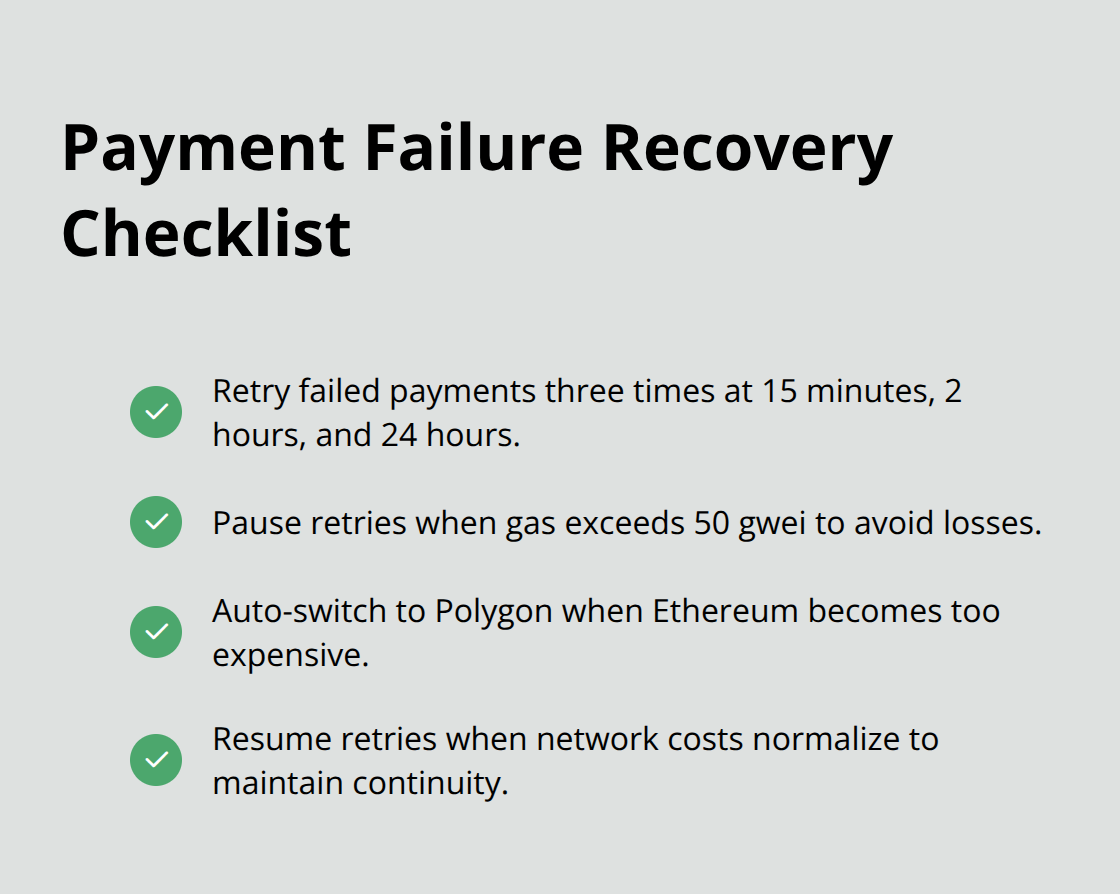
Network data shows that most failed transactions succeed within 24 hours when gas prices stabilize. Your retry system should automatically switch to alternative networks like Polygon when Ethereum becomes too expensive. This maintains subscription continuity while controlling costs for both your business and customers.
Transaction Monitoring and Reconciliation
Effective subscription management requires comprehensive transaction tracking that provides instant visibility into payment status and blockchain confirmations. Monitor pending transactions for unusual delays exceeding 10 minutes, which often indicate network congestion or insufficient gas fees. Implement automated reconciliation that matches blockchain transaction hashes with customer subscription records every 15 minutes.
Your dashboard should display real-time metrics including successful payments, pending transactions, and failed attempts with specific error codes. This monitoring approach significantly reduces customer service inquiries while maintaining accurate financial records for accounting teams. Set up automated alerts for transactions that remain pending beyond normal confirmation times to enable proactive customer support.
Final Thoughts
Crypto subscription payments deliver measurable advantages that traditional payment systems cannot match. Businesses reduce transaction costs by 60-80% while they achieve global payment settlements in under 15 seconds. Cross-border transactions eliminate banking intermediaries and their associated delays, which makes international subscription services economically viable for companies of all sizes.
Implementation challenges center around technical complexity and regulatory compliance requirements. Smart contract bugs represent the primary risk, though OpenZeppelin templates and thorough testnet validation mitigate most issues. Customer education remains essential since wallet management differs significantly from credit card workflows, and gas price volatility can disrupt payment schedules (though Layer 2 solutions like Polygon provide stable alternatives).
The future points toward mainstream adoption as regulatory frameworks mature globally. European MiCA regulations and evolving US guidelines create clearer compliance pathways for businesses. We at Web3 Enabler bridge this gap by providing native Salesforce integration for cryptocurrency operations, which enables businesses to manage digital assets and process international payments directly within existing Salesforce environments.