


Your Salesforce invoices are probably sitting in a payment limbo right now. Hidden fees stack up, settlement takes forever, and reconciliation is a manual nightmare that wastes your team’s time.
We at Web3 Enabler have seen this pain point kill finance operations at scale. A blockchain-enabled revenue cloud changes everything by putting your invoicing on an immutable, transparent ledger where payments settle instantly and disputes vanish.
Why Your Current Invoicing Setup Is Costing You Money
The Hidden Tax on Every Transaction
Your Salesforce invoicing system was built for a world that no longer exists. Traditional payment rails charge you at every step, and nobody tells you about it until the money lands in your account three to five business days later. International invoices? Worse. Wire fees, intermediary banks, currency conversion markups, and hidden spreads mean you lose 2-4% on every cross-border transaction.
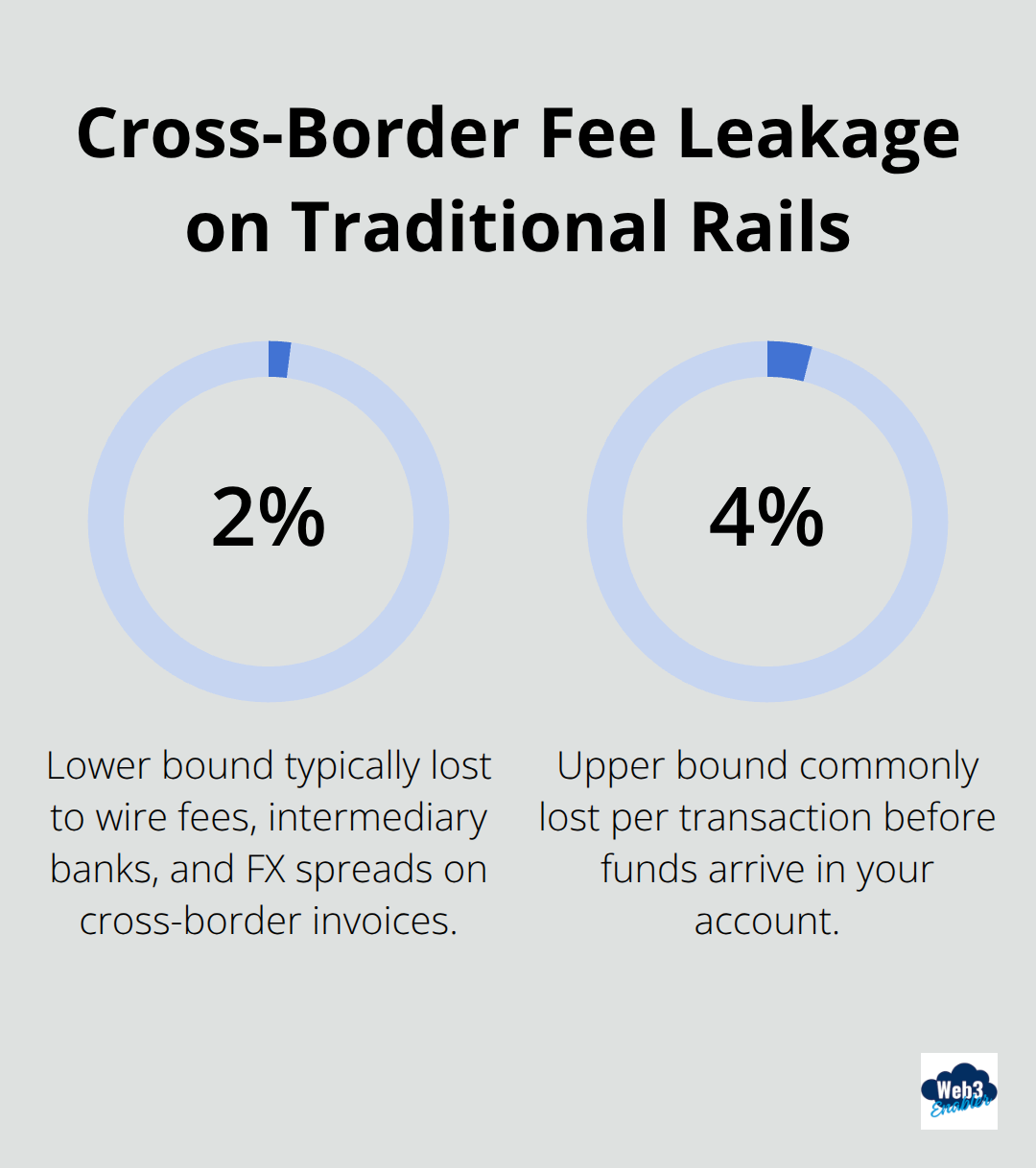
A $100,000 invoice to a European supplier costs you $2,000-$4,000 in invisible friction before anyone even sees the money move.
The Visibility Problem Nobody Talks About
The real problem isn’t just the fees. Your finance team has zero visibility into what happens between invoice creation and settlement. You send an invoice in Salesforce, it vanishes into the banking system, and your team spends hours chasing payment status across email threads and bank portals. Manual reconciliation against your general ledger becomes a weekly nightmare. Your team matches invoice line items to bank deposits by hand, hunts for discrepancies, and handles duplicate payments that slip through because nobody can see the transaction in real time.
The Reconciliation Drain
AR automation delivers a 384% ROI with a 9-month payback period. When you add up the hidden fees, the settlement delays, and the reconciliation overhead, traditional Salesforce invoicing silently drains profitability from every transaction. The worst part? This is so normalized that most finance teams think it’s just how business works.
This broken system creates the perfect opening for a better approach-one that puts your invoicing on a transparent, immutable ledger where payments settle instantly and disputes disappear.
How Blockchain Fixes Your Invoice Problem
Blockchain removes the intermediaries that create delays and hidden costs. When you put your Revenue Cloud invoicing on-chain, every transaction becomes immutable, instantly verifiable, and settled in minutes instead of days. Salesforce-native tools embed this transparency directly into your existing CRM, so your finance team sees real-time payment status without leaving the platform they already use. The moment an invoice hits the blockchain, it locks in place, gets timestamped, and becomes visible to both buyer and seller simultaneously. No more chasing payment confirmations across email and bank portals. Stablecoin settlements like USDC and USDT clear in seconds to minutes, which means your cash flow improves immediately. For cross-border invoices, the impact is dramatic: instead of losing 2-4% to wire fees and currency conversion spreads, you pay a fraction of a percent in blockchain transaction costs. Disputes vanish because both parties see the exact same transaction record in real time, eliminating the finger-pointing that normally wastes weeks of back-and-forth communication.
Real-Time Audit Trails That Actually Work
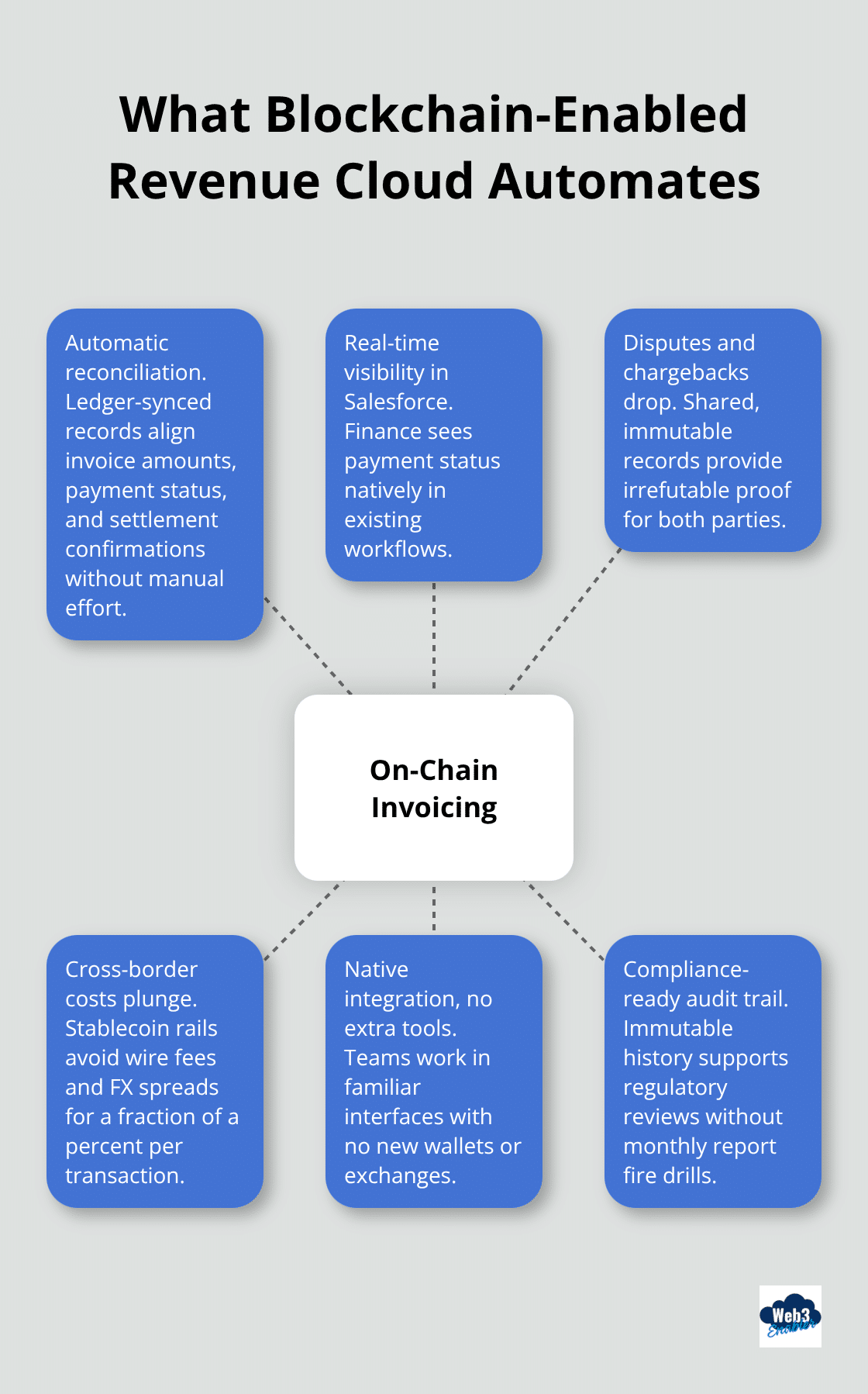
Traditional Salesforce invoicing creates an audit trail buried in system logs that nobody can access without IT support. Blockchain creates an immutable, publicly verifiable record that your auditors and regulators can inspect anytime. Every state change on an invoice-from creation to approval to payment-lives permanently on the ledger. This matters for compliance: instead of running monthly reconciliation reports and praying they match, you have a cryptographically verified history that satisfies PSD2, GDPR, and AML requirements automatically. Your finance team spends zero hours hunting for invoice discrepancies because the blockchain record is the single source of truth. When regulators ask questions, you pull the on-chain data instead of assembling spreadsheets. Chargebacks and payment disputes drop to near zero because both parties have signed, immutable proof of what was invoiced, when, and for how much. The compliance automation works because blockchain transactions embed these checks into their structure, which means your team stops performing manual compliance checks and starts focusing on actual revenue growth.
Settlement Speed Changes Everything
Stablecoin payments settle in minutes, compared to three to five business days for traditional banking. This isn’t just faster-it’s fundamentally different for your cash flow metrics. Days Sales Outstanding shrinks dramatically because money arrives in your account within hours instead of weeks. For companies managing large invoice volumes, this compounds fast: a business with 500 invoices per month worth $10 million in total volume cuts its DSO by 60-70 days just through on-chain settlement. That’s millions of dollars in working capital freed up immediately.
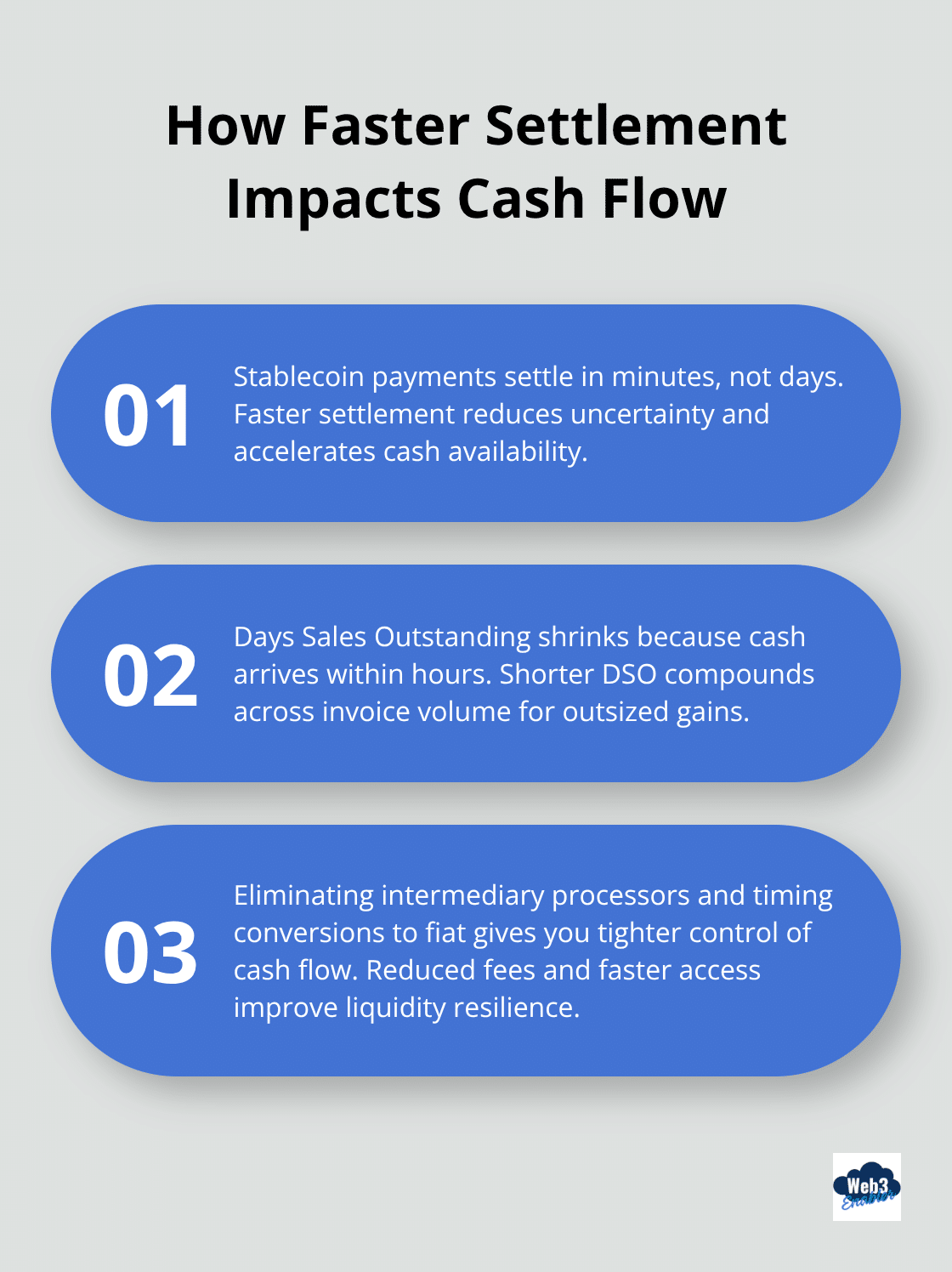
Your customers pay in stablecoins directly from within your Revenue Cloud workflows. No separate payment processor, no third-party markup, no integration fees stacking on top of each other. The payment lands in your wallet and converts to fiat whenever you choose, giving you complete control over timing and currency exposure.
Why Speed Matters for Your Bottom Line
A 60-70 day DSO reduction transforms your financial position. That freed-up capital funds growth initiatives, pays down debt, or strengthens your balance sheet without requiring external financing. Most finance teams treat DSO as a static metric, but on-chain settlement makes it a competitive advantage. Your competitors still wait five business days for payments to clear. You collect cash in minutes. Over a year, that difference compounds into substantial working capital gains that show up directly on your cash flow statement.
How Blockchain Cuts Your Finance Team’s Workload in Half
Your finance team currently spends 15-20 hours per week on invoice reconciliation, chasing payments, and handling disputes that shouldn’t exist in the first place. Blockchain-enabled Revenue Cloud eliminates most of this work immediately. When invoices live on an immutable ledger, reconciliation becomes automatic. Your accounting system syncs directly with the blockchain record, meaning the invoice amount, payment status, and settlement confirmation all match perfectly with zero manual intervention.
Your team stops hunting through email threads to confirm whether a payment cleared and starts focusing on actual revenue strategy.
Working Capital Transforms Overnight
The impact shows up in your financial metrics within the first month: Days Sales Outstanding improves because stablecoin settlements complete in minutes instead of three to five business days. For a company processing $10 million monthly in invoices, this translates to roughly $1.6-1.8 million in freed-up working capital. That capital immediately improves your cash conversion cycle and strengthens your balance sheet without requiring external financing. Your CFO sees the impact on cash flow statements, and your treasury team gains breathing room to handle strategic initiatives instead of payment chasing.
Disputes Become Nearly Impossible
Payment disputes and chargebacks currently cost U.S. businesses billions annually because traditional invoicing creates information asymmetry. The buyer claims they never received the invoice. The seller insists they sent it. The bank gets involved. Weeks pass. On-chain invoicing eliminates this entirely because both parties see the exact same transaction record simultaneously. The invoice timestamp, amount, terms, and payment confirmation all exist as cryptographically signed data that neither party can alter or deny. Chargebacks drop to near zero because the blockchain creates irrefutable proof of what happened and when. Your dispute resolution team stops managing arguments and starts handling legitimate exceptions.
Cross-Border Payments Lose Their Friction
Cross-border invoicing simplifies dramatically because stablecoin payments bypass wire fees, intermediary banks, and currency conversion markups. A $100,000 invoice to a European supplier that currently costs $2,000-4,000 in hidden fees costs less than $50 on-chain. Your team collects the full payment in minutes instead of waiting for international wire transfers that take 5-7 business days. The cost savings compound across your invoice volume, and your international customers appreciate the faster settlement because it improves their cash position too.
Native Integration Means No Extra Tools
Blockchain-enabled Revenue Cloud tools integrate directly into Salesforce, so your team accesses everything within the platform they already use daily. This eliminates the need for separate blockchain wallets or crypto exchanges. Your finance team works in familiar workflows while stablecoin payments settle in the background, creating a seamless experience that requires zero training or process changes.
Final Thoughts
Your finance team has spent years accepting that invoicing moves slowly, costs too much, and requires endless manual work. Hidden fees, payment delays, and reconciliation nightmares feel inevitable because that’s how the system has always operated. A blockchain-enabled revenue cloud changes that assumption entirely by removing the intermediaries that create friction at every step. Stablecoin payments settle in minutes instead of days, audit trails become automatic and immutable, and disputes vanish because both parties see the exact same transaction record.
The shift to on-chain invoicing isn’t theoretical anymore-companies are already moving this direction because the financial impact is too large to ignore. Your DSO shrinks, your working capital improves, and your finance team stops chasing payments and starts driving revenue strategy instead. Your competitors will follow eventually, but the question is whether you move first or play catch-up later.
We at Web3 Enabler have built Salesforce-native tools that make this transition seamless by integrating directly into your Revenue Cloud workflows. Your team works in familiar interfaces while stablecoin payments and transparent settlement happen in the background, with no separate wallets, no crypto exchanges, and no learning curve required. Explore how a blockchain-enabled revenue cloud can transform your business.