



Your Salesforce instance handles everything-customer data, deals, forecasts, the works. But when it comes to payments, you’re still bouncing between systems like it’s 1995.
We at Web3 Enabler believe Salesforce native payments with crypto change that. Stablecoins settle instantly, cross-border friction disappears, and your finance team actually knows what’s happening in real time.
Why Your Payments Still Feel Stuck in the Past
The Fragmentation Problem
Your finance team processes transactions across multiple systems every single day. ACH transfers take three to five business days. Wire fees eat into margins. International payments involve currency conversion spreads that nobody tracks properly.
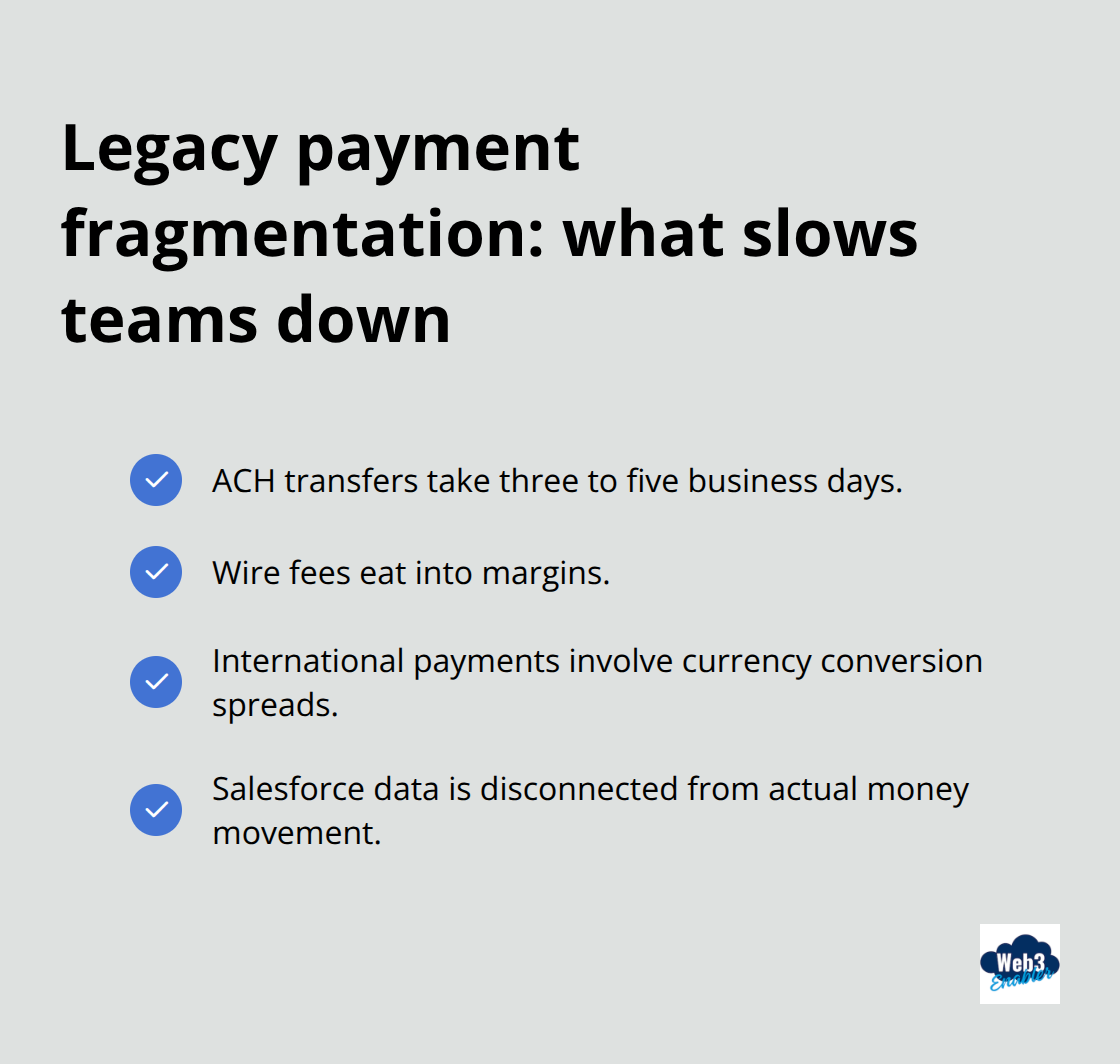
Meanwhile, Salesforce sits there holding all your customer and deal data, completely disconnected from the actual money moving in and out of your accounts.
This fragmentation costs real money. Companies that consolidate payment workflows into their core business systems unlock significant savings through reduced manual work and better visibility. That’s not theoretical-that’s what happens when you stop manually reconciling between platforms.
Why Legacy Systems Fail Modern Business
The problem isn’t that your current payment systems don’t work. They work fine if you have patience and don’t mind paying for the privilege. The problem is they were built before anyone expected businesses to move capital faster or across borders without friction.
Legacy wire networks charge flat fees regardless of transaction size. ACH batching creates delays that make real-time settlement impossible. International payments require correspondent banks, currency conversions, and holding periods that turn a simple transaction into a week-long ordeal. Every handoff between systems introduces reconciliation work, audit risk, and the chance that something gets lost in translation.
How Stablecoins Rewrite the Rules
Stablecoins and blockchain settlement solve these problems by design. Transactions settle in minutes instead of days, fees scale with transaction size instead of fixed rates, and your Salesforce instance can see the entire transaction lifecycle in real time. No separate crypto wallet interfaces. No manual data entry. No reconciliation spreadsheets.
When a customer pays via stablecoin, Salesforce knows about it instantly-the deal updates, the customer record updates, the revenue recognition happens automatically. For B2B operations paying international contractors or vendors, this cuts settlement time from five days to five minutes. For financial advisors managing client portfolios, this means finally seeing crypto holdings alongside traditional assets without logging into five different platforms.
Integration That Actually Works
The integration works because it doesn’t require you to rip out your existing infrastructure. Salesforce Native Payments sits on top of your current setup, connects to your existing workflows, and lets you add crypto payment rails without disrupting anything else. Your team keeps using Salesforce exactly as they do today. The difference is that now the system actually moves money in sync with the data.
Web3 Enabler builds Salesforce-native solutions that connect blockchain technology directly to your existing business processes. This means your finance, sales, and compliance teams work from a single source of truth-no separate platforms, no manual workarounds. When you’re ready to see how stablecoins actually move through your business workflows, the mechanics become clear.
How Stablecoins Actually Move Through Your System
Stablecoins aren’t crypto for speculators-they’re payment rails that behave like dollars, euros, or pounds but settle on blockchain. When you build stablecoin payments into Salesforce Native Payments, you eliminate the volatility problem that scares finance teams away from crypto. A stablecoin pegged to the US dollar stays at one dollar, regardless of market conditions. Your customer sends it, you receive it, and the value doesn’t fluctuate between the time they hit send and you confirm receipt.
Mainstream Adoption Is Already Here
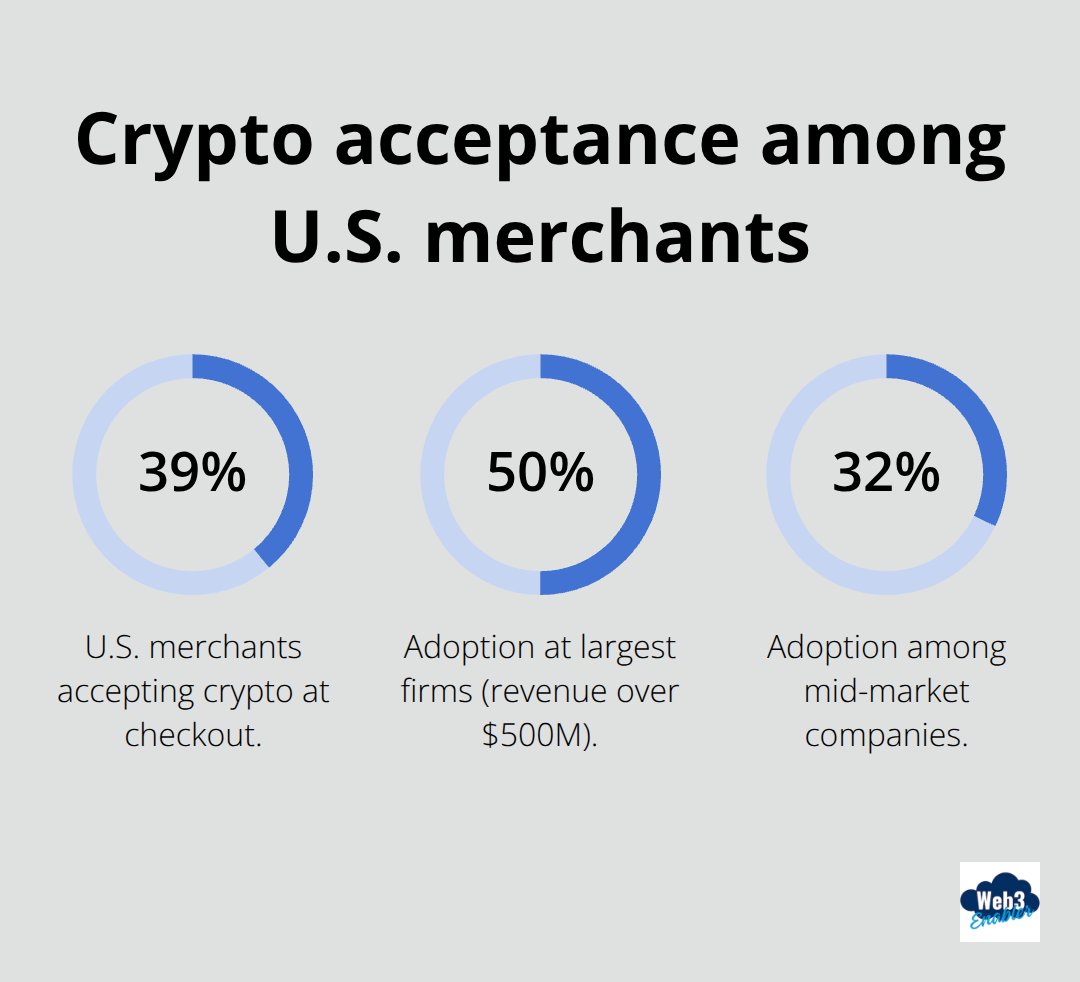
According to PayPal and the National Cryptocurrency Association, 39% of US merchants already accept crypto at checkout, with adoption highest among companies with revenue over $500 million. That’s not fringe behavior-that’s mainstream commerce moving faster than your legacy payment infrastructure can handle. The largest firms (revenue over $500 million) show 50% adoption, while mid-market companies sit at 32%. This gap matters: your competitors in the enterprise space are already moving.
How Transactions Flow Through Salesforce
When Salesforce Native Payments processes a stablecoin transaction, the entire flow stays inside your system. Your customer initiates payment through your Salesforce interface, the transaction settles on blockchain in minutes instead of days, and your revenue recognition, customer records, and deal forecasts all update automatically. No separate wallet logins. No manual reconciliation. No waiting for correspondent banks to shuffle money through three intermediaries. The fee structure also works differently-you pay based on transaction size, not fixed flat rates that penalize small payments or eat into margins on large ones.
Real-Time Settlement Changes Everything
Traditional ACH transfers take three to five business days because banks batch transactions and settle them on their schedule. Wire transfers move faster but cost $25 to $50 per transaction and require manual verification steps that create bottlenecks. Real-time settlement happens in seconds because blockchain doesn’t sleep, doesn’t batch, and doesn’t require intermediaries.
For B2B operations paying international contractors or vendors, this cuts settlement time from five business days to minutes. Your finance team stops tracking payments in transit and starts tracking actual received funds. Salesforce immediately reflects the transaction, which means your accounting closes faster, your cash flow visibility improves, and your forecasts stay accurate instead of carrying uncertainty about when money actually arrives.
Solving the Portfolio Visibility Problem
Financial advisors managing client portfolios face a different problem-they need visibility into crypto holdings without logging into five different wallet providers or crypto exchanges. Salesforce Native Payments solves this by bringing stablecoin and token holdings directly into the platform alongside traditional assets. An advisor sees a client’s portfolio (stocks, bonds, and stablecoins) in one place, updated in real time. This eliminates the spreadsheet tracking that creates audit risk and the manual data entry that introduces errors.
Automation Without Friction
Direct integration with your existing workflows means payment automation becomes possible. Set up approval rules in Salesforce, and stablecoin payments execute when conditions are met-no manual intervention, no separate payment platform, no delays waiting for someone to log in and click approve. Your operations team moves from reactive payment processing to proactive transaction management, freeing up hours each week that previously went to chasing down payment status or reconciling discrepancies between systems. This shift from manual oversight to automated execution is where the real efficiency gains appear, and it’s also where your team discovers what becomes possible when payments and business data finally speak the same language.
Where Salesforce Native Payments Actually Deliver Results
International Payments That Don’t Wait for Banks
Stablecoin payments stop being theoretical the moment your finance team stops waiting five business days for international wire transfers to clear. A B2B software company paying developers across Eastern Europe, Southeast Asia, and Latin America moves from weekly batch payments (processed Friday, received Wednesday) to same-day settlements that hit contractor wallets in minutes. The developer in Manila receives payment instantly when the invoice gets approved in your Salesforce instance. No correspondent banks.
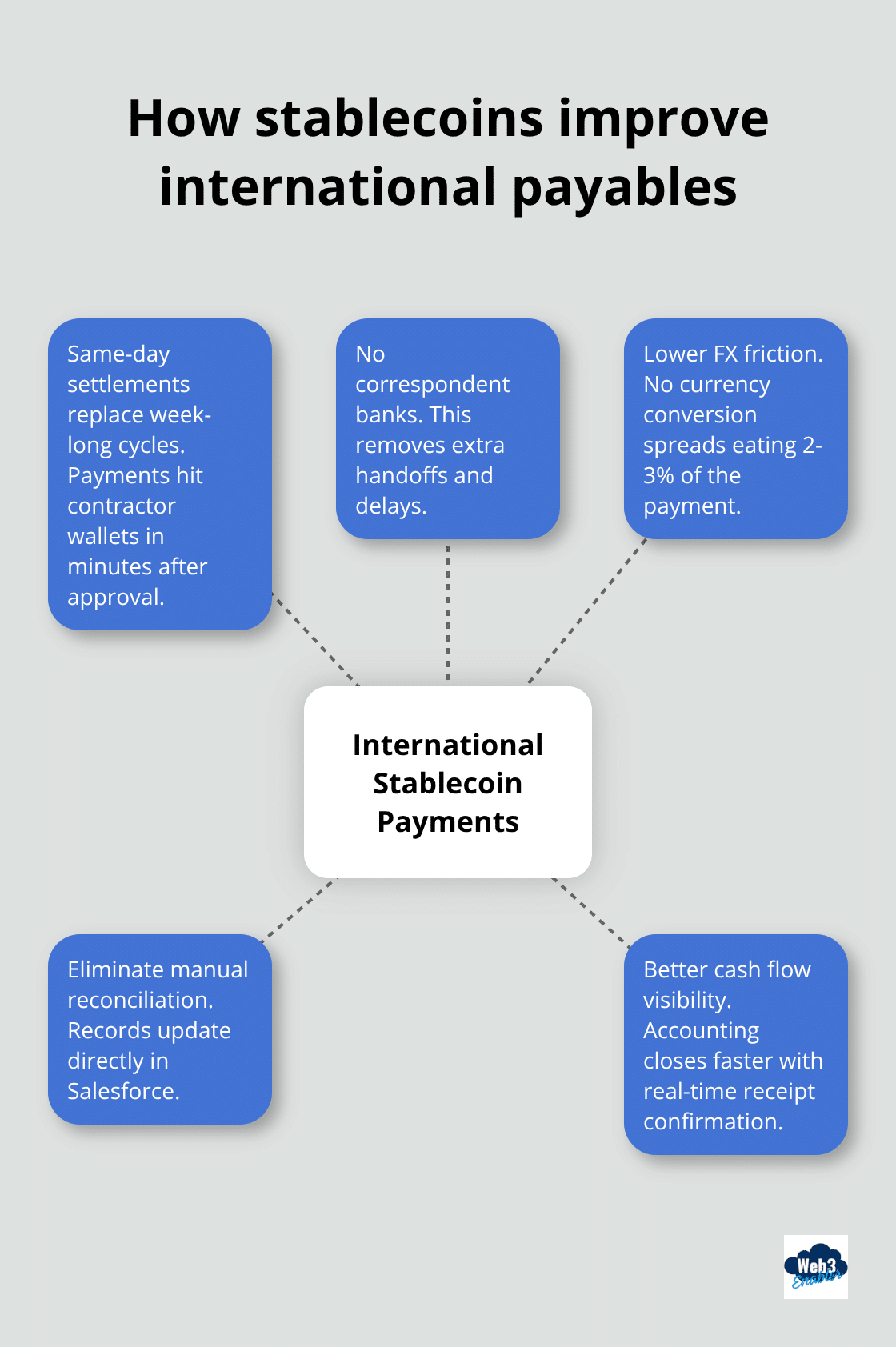
No currency conversion spreads eating 2-3% of the payment. No manual reconciliation between your accounting system and the bank statement that arrived three weeks late.
Your CFO stops managing cash flow around banking schedules and starts managing it around actual business events. The accounting closes faster because money actually arrives when Salesforce says it does. For companies with 50+ international payments monthly, this shift alone recovers 15-20 hours of finance team time every week that currently goes to payment status tracking and discrepancy resolution.
Compressing Payment Cycles Without Adding Headcount
A mid-market SaaS company paying vendors across eight countries compresses their payment cycle from weekly to daily without adding staff, which means better vendor relationships (contractors prefer getting paid faster) and tighter cash flow management. Your finance team approves a payment in Salesforce, the stablecoin transfers on blockchain, and your vendor’s bank account updates in minutes instead of days. Your accounting records the transaction instantly because Salesforce Native Payments integrates directly with your GL, eliminating the three-day lag where money is technically paid but not yet reflected in your books.
Portfolio Visibility for Financial Advisors
Financial advisors managing client portfolios face the opposite problem-too much fragmentation in the other direction. A wealth manager overseeing $50 million in client assets needs visibility into crypto holdings that currently requires logging into Coinbase, Kraken, and three different custodians, then manually tracking everything in spreadsheets. Stablecoin and token holdings now appear directly in the client record alongside equity positions, bonds, and real estate. An advisor sees that a client holds $200K in USDC across two wallets, $500K in traditional equities, and $150K in real estate-all in one view, updated in real time.
This eliminates the spreadsheet tracking that creates audit risk when regulators ask how you calculated net worth for suitability purposes. It removes the manual data entry that introduces errors when you copy holdings from five different sources into your CRM. Compliance teams stop requesting manual reports about crypto exposure and start pulling real-time dashboards directly from Salesforce.
Continuous Monitoring Replaces Quarterly Reviews
A registered investment advisor managing 200+ clients with crypto allocations saves 10-15 hours weekly on portfolio reporting and compliance documentation. The advisor can also set automated alerts when a client’s crypto allocation drifts beyond their target percentage, triggering rebalancing workflows that execute directly through Salesforce Native Payments without leaving the platform. This shifts portfolio management from quarterly reviews (where drift goes unnoticed for months) to continuous monitoring where allocation targets stay accurate.
For advisors building crypto-native strategies for high-net-worth clients, this capability becomes a competitive differentiator-you offer better visibility and faster execution than competitors still using manual processes.
Final Thoughts
Salesforce native payments with stablecoins aren’t a future concept anymore-they’re a practical shift happening right now. Your finance team stops managing payments across disconnected systems and starts managing them from the single platform that already holds all your business data. Settlement happens in minutes instead of days, international payments cost less and move faster, and financial advisors finally see their clients’ complete portfolio picture without logging into five different platforms.
The businesses winning right now aren’t waiting for perfect conditions. A company paying 50 international contractors monthly saves 15-20 hours of finance team time every week. A wealth manager tracking crypto allocations across 200 clients eliminates spreadsheet tracking that creates compliance risk. A SaaS company compressing payment cycles from weekly to daily improves vendor relationships without adding headcount-this isn’t theoretical efficiency, it’s what happens when you stop treating payments as a separate problem and start treating them as part of your core business system.
Your Salesforce instance already knows about every deal, every customer, every contract. We at Web3 Enabler build solutions that connect blockchain technology directly to your existing business processes, handling stablecoin payments and global payment execution all within Salesforce. If you’re ready to see how Salesforce native payments actually work in your operation, that’s where the conversation starts.