


Your Salesforce instance handles everything-CRM, orders, customer data, the works. But when it comes to payments, you’re still bouncing between legacy systems and third-party tools like you’re playing payment pinball.
What if your payments API could live right inside Salesforce and tap into crypto rails? No more context switching, no more manual reconciliation, no more watching international transfers crawl across the globe at a snail’s pace. We at Web3 Enabler have seen firsthand how native blockchain connectivity transforms payment workflows from painful to practical.
Why Traditional Rails Can’t Keep Up
The Speed Problem Nobody Talks About
International payments through traditional channels are a masterclass in inefficiency. A wire transfer from the US to Europe still takes three to five business days, even though we’ve had the internet for decades. ACH transfers in the US require one to three days minimum. Meanwhile, your customer waits, your cash flow freezes, and you pay $10 to $50 per wire just for the privilege of slowness.

Your Salesforce instance knows everything about the transaction-the customer, the amount, the invoice-but it can’t execute it directly. You remain trapped in a workflow that requires manual handoffs to payment processors, reconciliation spreadsheets, and days of settlement uncertainty.
Why Wallets Won the Payment Game
The Worldpay Global Payments Report 2024 shows that mobile wallets already account for more than 50% of global e-commerce transactions, yet most enterprise payment infrastructure hasn’t caught up with this reality. Your team still bounces between legacy systems and third-party tools like you’re playing payment pinball. Card networks, ACH, and SEPA remain useful for certain flows, but they can’t match the speed and cost efficiency that stablecoins deliver. A USDC transfer settles in minutes, 24/7, with no intermediary banks taking cuts along the way. A payment that would cost $30 and take five days via SWIFT costs pennies and completes before your next coffee break.
The Disconnect Between Your CRM and Your Payments
For businesses sending payouts to contractors in emerging markets or accepting payments from international clients, this isn’t theoretical-it’s the difference between competitive and obsolete. The real issue is that your Salesforce instance remains disconnected from faster rails. You’ve invested in Salesforce to centralize your business operations, yet payments still require you to step outside that ecosystem. Native Salesforce solutions eliminate this gap entirely, letting you accept stablecoin payments and execute global payouts without leaving your CRM. When your payment API lives inside Salesforce and connects directly to crypto rails, reconciliation becomes automatic, settlement times collapse to minutes, and your team stops playing payment pinball between disconnected systems.
How to Wire Crypto Rails Directly Into Salesforce
The moment your payment API lives inside Salesforce, everything changes. You stop treating payments as a separate system and start treating them as a native business process. A Salesforce native solution means your payment orchestration engine sits right where your CRM data lives, eliminating the context switching that costs your team hours each week. When you execute a payment from within Salesforce, your system already knows the customer, the invoice number, the contract terms, and the payment history. No more copying data between platforms. No more reconciliation spreadsheets that lag reality by hours.
Route Payments Intelligently Across Multiple Rails
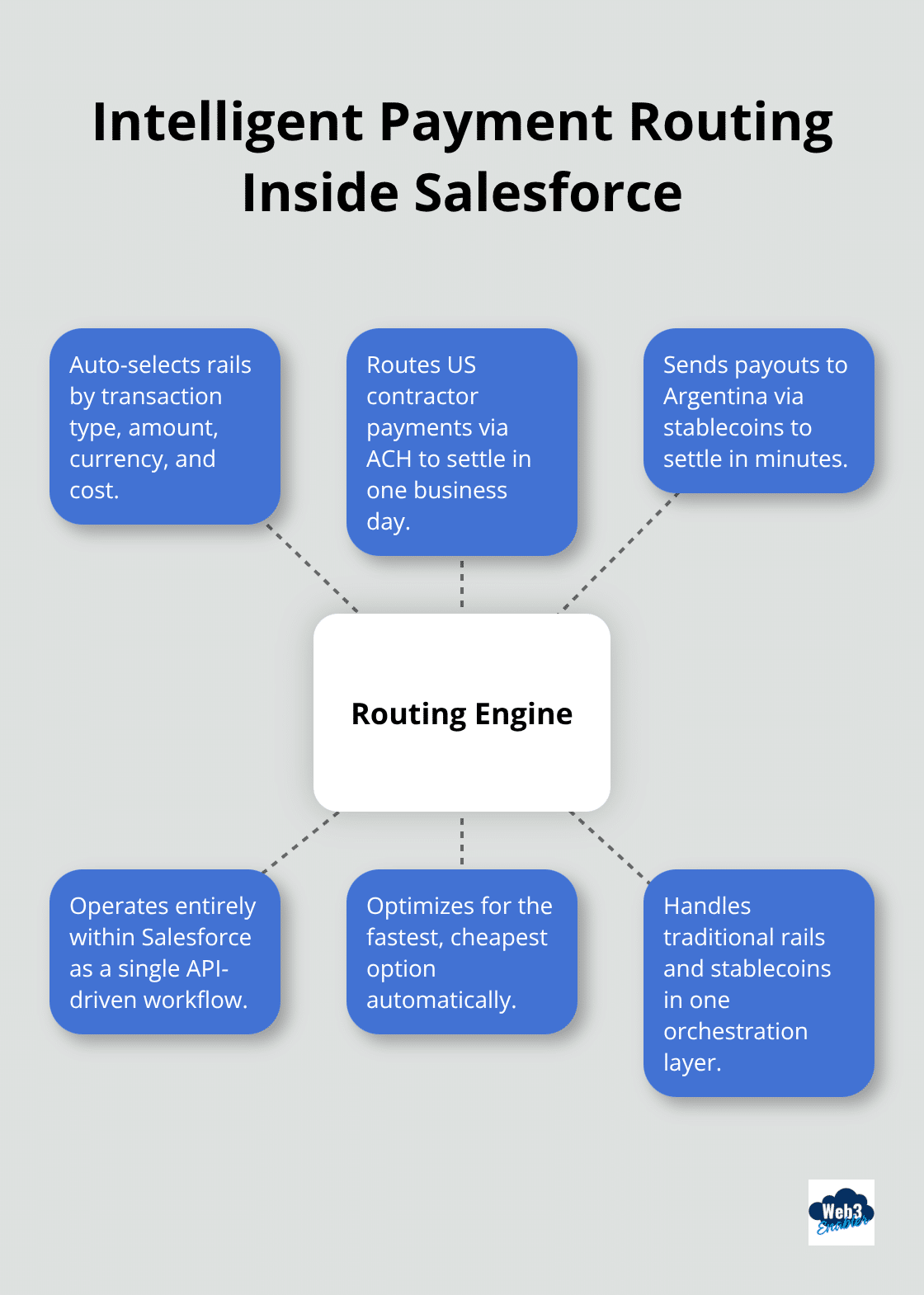
An API that handles both traditional rails and stablecoins means you can route a payment to the fastest, cheapest option automatically. Wire transfers for high-value settlements? The system handles it. Stablecoin transfers for international vendor payments? They complete in minutes at a fraction of the cost. Your orchestration layer sits inside Salesforce and decides which rail to use based on transaction type, amount, currency, and cost. A payment to a US contractor might route through ACH and settle in one business day. The identical workflow to a contractor in Argentina routes through stablecoins and settles in minutes. Your Salesforce instance handles both with a single API call.
Protect Payment Data Without the Compliance Headache
A production-ready payment API inside Salesforce requires your tokenization and encryption layer to ensure payment data never touches your core systems unencrypted. This keeps you compliant with PCI DSS Level 1 standards without the operational burden. Your settlement engine connects directly to multiple rails simultaneously, whether that’s traditional ACH for US payroll, SEPA Instant for European transfers, or stablecoins like USDC for cross-border speed. The beauty here is that your team only sees one interface. Behind the scenes, the system is intelligent enough to choose the right tool for each job.
Reconciliation Becomes Automatic, Not Manual
Real-time transaction visibility means you see the exact moment a payment clears, not three days later when your bank statement arrives. When reconciliation happens automatically instead of manually, your accounting team reclaims hours each week. Traditional payment workflows require someone to match outgoing transactions against bank statements, handle discrepancies, and update records. With native Salesforce integration, every payment records in real-time, matches to the corresponding invoice or vendor record, and your general ledger updates automatically. Most businesses still reconcile manually, even as digital payment adoption accelerates. That’s not a process problem. That’s a connectivity problem.
See Settlement Status Without Leaving Your CRM
When your payment system knows exactly which customer, which project, and which cost center a payment belongs to, reconciliation becomes a solved problem. You see settlement status within Salesforce the moment it completes. You can audit the entire payment history without leaving your CRM. Your finance team stops chasing payment status updates and starts focusing on strategy instead. Native Salesforce integration closes the gap between payments and operations entirely, transforming how your organization moves money across borders and currencies. With this foundation in place, the next step is understanding exactly which real-world scenarios benefit most from this native connectivity-and how to implement them without disrupting your existing operations.
Where Crypto Payments Actually Make Business Sense
Your international clients want to pay you in stablecoins. Your contractors in Southeast Asia ask why you can’t send them USDC instead of waiting five days for a wire transfer. Your finance team resents reconciling payments that vanish into the banking system for days. These aren’t edge cases anymore-they’re the workflows that separate competitive businesses from ones trapped in legacy infrastructure.
Accept Stablecoin Payments Without the Intermediary Tax
When your Salesforce instance connects directly to stablecoin rails, you stop treating crypto payments as an experiment and start treating them as standard business operations. A client in Singapore pays you in USDC and the settlement completes in minutes, not days. Your Salesforce instance records the transaction instantly, matches it to the corresponding invoice, and your general ledger updates in real-time. No intermediary bank fees. No multi-day settlement windows.
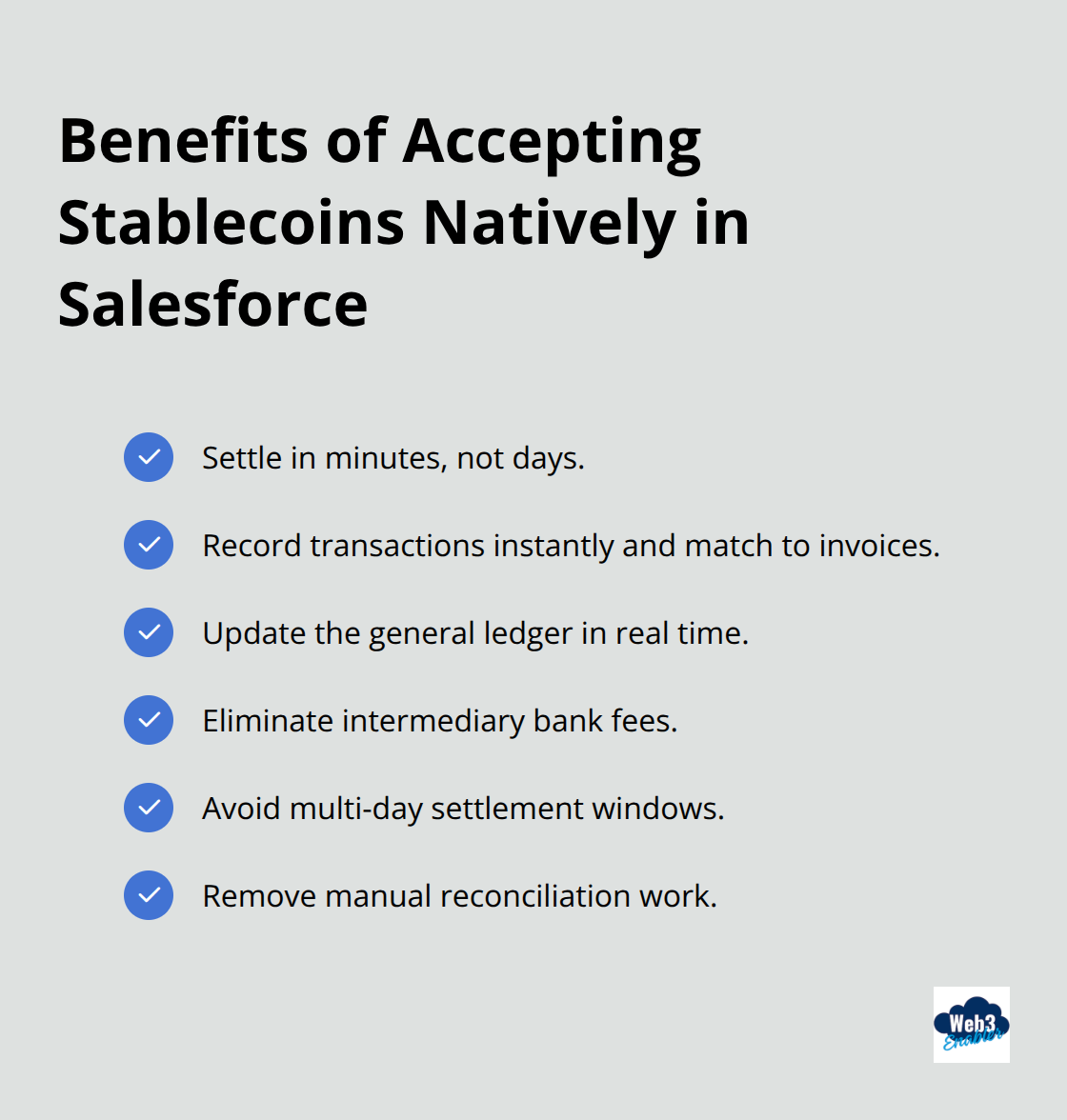
No manual reconciliation work.
Traditional wire transfers demand a tax for the privilege of slowness. Your Salesforce dashboard shows the exact moment the payment arrives, eliminating the uncertainty that comes with legacy banking rails. When a customer in London pays you in USDC, the payment settles and reconciles automatically-all without your team touching it.
Send Global Payouts at a Fraction of Traditional Cost
Vendor payments through stablecoins cost pennies instead of $30 per wire transfer. A contractor in Brazil receives payment in minutes at a fraction of the cost of SWIFT or traditional rails. Your Salesforce dashboard shows the exact moment the payout clears, eliminating the guesswork that comes with multi-day settlement windows.
Automation handles the reconciliation that typically consumes hours of manual work each week. Your finance team focuses on strategy instead of spreadsheet management. The speed advantage matters most when you operate across multiple time zones-a payment that would require three business days through traditional channels completes before your next meeting ends.
Gain Real-Time Visibility Across All Payment Rails
Native Salesforce integration provides visibility and speed that disconnected payment systems cannot match. Your entire organization sees payment status in real-time. Currency conversions happen transparently. Settlement confirmations arrive instantly instead of days later. When your payment API lives inside Salesforce and connects to crypto rails, you stop bouncing between legacy systems and third-party tools. A single interface handles both traditional ACH transfers for US payroll and stablecoin transfers for international vendors. Your team executes real transactions with real speed and cost advantages, transforming how your organization moves money across borders and currencies.
FAQ: Salesforce Payments API & Native Crypto Rails
How does the 2026 GENIUS Act change how my Salesforce API handles stablecoins?
The Guiding and Establishing National Innovation for U.S. Stablecoins (GENIUS) Act reached a major milestone on April 7, 2026, when the FDIC approved a notice of proposed rulemaking. For your Salesforce-integrated payments, this means the API now connects with Permitted Payment Stablecoin Issuers (PPSIs) that are FDIC-supervised. These PPSIs are now required by federal law to redeem stablecoins within two business days, providing the predictable liquidity and federal oversight that enterprise treasury teams previously lacked.
Can my Salesforce instance handle AML/KYC for crypto payments automatically?
Yes. Under a joint proposed rule issued by FinCEN and the Treasury on April 8, 2026, stablecoin issuers are now officially subject to the same anti-money laundering (AML) and sanctions compliance program requirements as traditional financial institutions. By using a Salesforce-native payment API, your CRM can automatically trigger these identity verification and sanctions screening workflows before a transaction is broadcast to the blockchain, ensuring your global payouts to contractors in regions like Latin America or Southeast Asia remain fully compliant with the latest US and international standards.
Why is 2026 considered the tipping point for B2B crypto commerce?
Institutional infrastructure and regulatory clarity have finally converged. According to market data from 2026, stablecoins like USDT and USDC now facilitate over 70% of B2B crypto commerce due to their price parity with the US Dollar. The SEC also took a massive step forward on March 17, 2026, by allowing broker-dealers to treat payment stablecoins as ready market assets with only a 2% capital haircut. This makes holding stablecoins on a balance sheet nearly as liquid as cash or Treasury bonds, encouraging large enterprises to integrate these rails directly into their ERP and CRM systems.
Does a native Salesforce API mean I have to manage private keys?
No. Modern enterprise-grade APIs, like those offered by Web3 Enabler, use a precise request-response cycle that eliminates the need for you to interact with raw blockchain nodes or manage private keys manually. The API generates unique, one-time deposit addresses for every order in Salesforce, monitors the blockchain for confirmations, and triggers automated fiat settlement. This layer of institutional security protects your business while providing the instant gratification of real-time payment confirmation within your CRM.
How does tokenization help with PCI compliance in Salesforce?
Even when dealing with crypto rails, security standards remain paramount. A production-ready payment API inside Salesforce uses a tokenization layer to ensure that sensitive payment data never touches your core CRM unencrypted. This setup allows you to maintain PCI DSS Level 1 standards for your traditional card flows while using the same secure orchestration layer for your stablecoin transfers. Your team sees a single, unified interface, while the underlying API handles the encryption and intelligent routing between ACH, SEPA, and blockchain rails.
Final Thoughts
The infrastructure for global payments shifts beneath your feet whether you acknowledge it or not. Stablecoins have moved beyond speculative assets and become the standard rail that businesses use to move money across borders without traditional banking friction. Your competitors already accept USDC payments from international clients, and your vendors in emerging markets already ask why you cannot send them crypto instead of waiting five days for wire transfers. The question is not whether crypto rails will become standard business infrastructure-the question is whether your organization moves first or plays catch-up.
A Payments API Salesforce solution that connects directly to crypto rails eliminates the context switching that wastes your team’s time and the manual reconciliation that drains your finance department’s resources. When your payment system lives inside the CRM where your customer data already lives, everything becomes faster and cheaper. Settlement times collapse from days to minutes, costs drop from dollars per transaction to pennies, and reconciliation shifts from manual spreadsheet work to automatic real-time matching.
This is not about betting on blockchain technology or chasing crypto hype-it is about recognizing that modern business operations require modern payment connectivity. Your Salesforce instance already centralizes your customer relationships, orders, and financial data, so your payment infrastructure should live there too, with direct access to the fastest and most cost-effective rails available. We at Web3 Enabler have built exactly this solution, and if you are ready to stop bouncing between disconnected payment systems, explore what Web3 Enabler can do for your organization.