



Your customers want faster checkouts and lower fees. Stablecoin acceptance in eCommerce delivers both, plus it opens doors to buyers worldwide who can’t access traditional payment methods.
At Web3 Enabler, we’ve seen retailers boost conversion rates by removing friction from the payment process. The best part? Setting this up is far simpler than most business owners assume.
Why Stablecoins Matter for Online Retailers
A Customer Base You’re Currently Ignoring
Approximately 700 million people worldwide owned cryptocurrency as of 2025, according to the Crypto.com Global Crypto Market Sizing Report. That’s not a niche audience-that’s a massive customer segment your checkout currently ignores. More than 36,000 businesses accepted Bitcoin in 2025, including Subway, Starbucks, BMW and Microsoft, proving that crypto payments aren’t fringe anymore.
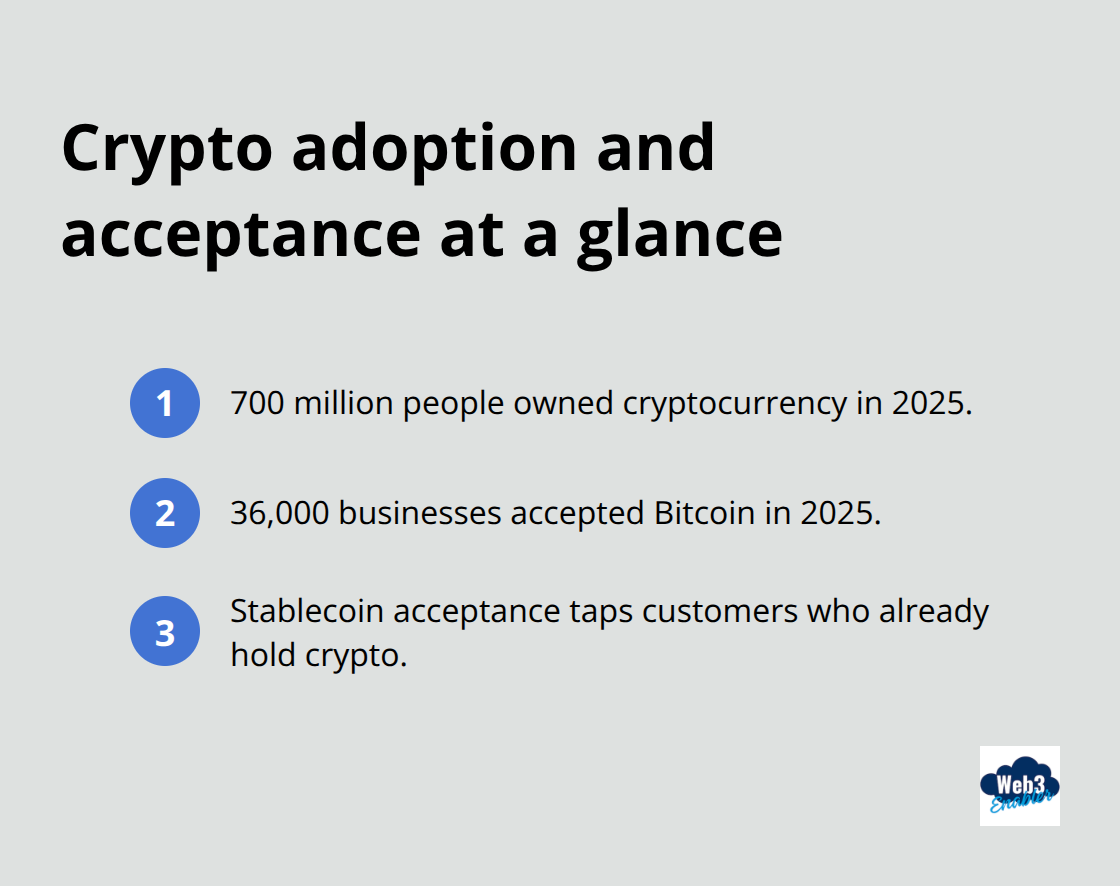
The real opportunity isn’t adopting stablecoins to look trendy. It’s accepting them because your customers already hold them, and they want to spend them with you instead of your competitors.
Stability Meets Speed
Stablecoins eliminate the volatility problem that makes Bitcoin and Ethereum unsuitable for shopping. USDC and USDT maintain a 1:1 peg to the USD, backed by real assets like US Treasuries, so customers don’t worry about price swings between clicking checkout and confirming purchase. For your business, this means predictable pricing and instant value certainty.
Settlement arrives in minutes, not days. Stablecoin payouts land directly into your account in your chosen currency, with no manual conversion delays. That speed matters enormously when cash flow determines whether you can restock inventory or meet payroll.
The Fee Advantage That Compounds
Cross-border transactions illustrate the gap most sharply. Card networks charge up to 3% per transaction, while stablecoin settlements often cost below 0.1%. For a retailer processing $100,000 monthly in international orders, that’s a $3,000 monthly fee versus potentially $100. Stablecoins eliminate the final-mile waiting period entirely.
Reaching Customers Traditional Payment Systems Lock Out
In Southeast Asia and Latin America, limited banking infrastructure traps millions of shoppers outside traditional payment systems. Stablecoins function as digital bearer instruments that bypass bank accounts entirely, enabling direct wallet-to-wallet transfers globally. Your reach expands when crypto rails get enabled. That’s not incremental growth-that’s market expansion into customers who literally cannot buy from you today.
This customer expansion directly impacts how you’ll experience the checkout process itself. The next section shows exactly how stablecoin payments transform the buying journey for both you and your customers.
How Stablecoin Payments Transform Your Checkout
The Friction Your Customers Face Right Now
Your checkout page displays USD pricing. Your customer holds USDC in their wallet. They now face a choice: convert stablecoins to fiat through a crypto exchange (fees, delays, compliance friction), or abandon cart and shop elsewhere. Stablecoin acceptance eliminates this decision entirely. Customers spend what they already hold, instantly, without currency conversion delays or middleman fees eating into their purchase.
Payment choice acts as a strategic gatekeeper. Enabling crypto expands access, while inability to accept it excludes buyers. Stripe’s implementation data shows that when merchants add stablecoin payments alongside traditional methods, checkout completion improves measurably. Crypto rails expand your customer reach significantly when stablecoin acceptance gets enabled, according to payment infrastructure analysis. That’s not incremental growth-that’s market expansion built into your checkout flow.
Settlement Speed That Actually Matters
Traditional card networks process transactions within an hour, but final credit to your account still gets delayed by bank routing, time zones, and intermediary holds. Stablecoin payments settle faster, 24/7, even when a customer in Tokyo orders from your US warehouse at 3 AM. Your funds arrive quickly. No waiting for Monday morning. No currency conversion uncertainty.
Chargebacks destroy revenue predictability. Blockchain settlements offer finality, meaning once the transaction confirms on-chain, it’s irreversible. This eliminates the fraud costs and dispute overhead that plague traditional card processing.

Stablecoin payments settle in minutes or hours instead of days, closing the gap completely. Your working capital cycles compress, inventory turnover accelerates, and you can reinvest faster.
Geographic Expansion Without Payment Barriers
Approximately 700 million people worldwide held cryptocurrency as of 2025, yet most live in regions where traditional card infrastructure remains unreliable or nonexistent. Stablecoins function as digital bearer instruments requiring no bank account, enabling direct wallet-to-wallet transfers globally. You stop losing sales to payment method unavailability.
Customers in Southeast Asia, Latin America, and other underbanked regions now complete purchases with the same speed as US-based buyers. That geographic expansion directly impacts your inventory planning, supplier relationships, and revenue predictability-all flowing from a single checkout improvement. These operational gains create new challenges around payment processing and reconciliation that the next section addresses head-on.
Getting Stablecoins Live Without the Headache
Setting up stablecoin payments doesn’t require ripping out your existing infrastructure or hiring a blockchain team. Most retailers go live within weeks, not months. Stripe’s stablecoin implementation takes a few clicks in the dashboard-no custom coding needed for basic setup.
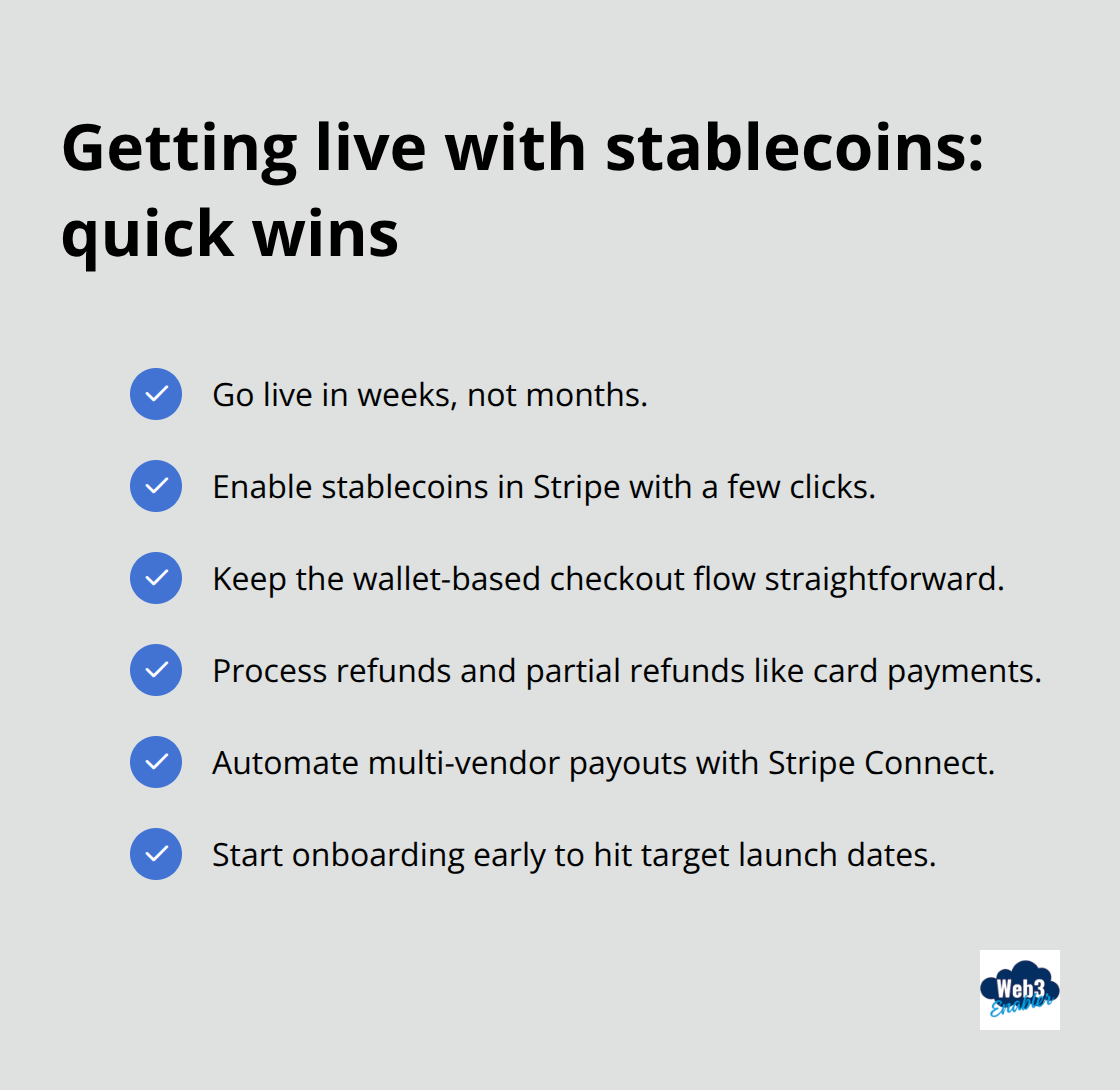
If you run Salesforce, Web3 Enabler offers native Salesforce apps that integrate stablecoin acceptance directly into your existing CRM and order management systems, so your team sees everything in one place instead of juggling separate dashboards. The wallet-based checkout flow stays straightforward: customers select crypto at payment method selection, connect their wallet, sign the transaction, and payment completes. Refunds and partial refunds work just like traditional card payments. For platforms and marketplaces, Stripe Connect supports stablecoin payouts to multiple vendors simultaneously, automating settlement across your seller network. Onboarding verification typically takes weeks, so contact providers early if you’re targeting a specific launch date.
Picking a Partner That Actually Fits Your Business
Not all stablecoin providers work the same way. Stripe focuses on simplicity and works best for straightforward eCommerce with standard payment flows. Web3 Enabler specializes in deeper Salesforce integration, custom implementations, and businesses that need compliance-grade infrastructure built into their existing systems. Evaluate providers based on which currency their stablecoins track (USDC and USDT dominate, but options vary), how funds get backed and held, conversion costs to local currency, custody arrangements, and how reporting integrates with your accounting software. ISO 27001:2022 certification signals enterprise-grade security controls. Direct SEPA access matters for EU merchants needing instant euro payments. Ask specifically about API reliability, settlement speed to your bank account, and whether they handle KYC/AML compliance on your behalf. The cheapest provider isn’t always the best-a provider that settles reliably and integrates seamlessly with your existing tools saves far more than a few basis points in fees.
Making Reconciliation Painless
Blockchain settlements create immutable records that simplify reconciliation compared to traditional card networks. Every transaction appears on-chain with full transparency, reducing trust overhead and making anti-fraud monitoring straightforward. Set up automated reporting within your payment platform so stablecoin transactions flow directly into your accounting system alongside traditional card payments. Global presentment currency support lets you display pricing in local terms while customers pay in USDC, so a customer in Mexico sees MXN pricing but settles in stablecoins at the current rate. Standard payout timing applies to stablecoin settlements just like card payments, so funds arrive on your normal settlement schedule. Robust accounting processes matter here-track which stablecoin payments convert to fiat immediately versus those you hold temporarily, as this affects your balance sheet and tax reporting. Most payment providers offer unified reporting across all payment methods, so you manage everything from one dashboard rather than reconciling stablecoin transactions separately from cards and other methods.
Final Thoughts
Stablecoin acceptance in eCommerce transforms your business from day one-it’s not a future trend, it’s a competitive advantage you activate today. Retailers who move first capture the 700 million crypto holders worldwide that traditional payment systems exclude entirely, while more than 36,000 businesses already proved the model works at scale. You expand into markets where competitors haven’t shown up yet, and your conversion rates respond immediately as customers complete purchases faster without payment friction.
Implementation happens quickly because the infrastructure already exists. Stripe gets you live in weeks with minimal engineering, while Web3 Enabler offers native Salesforce solutions that integrate stablecoin payments directly into your existing systems so your team manages everything from one dashboard. Your reconciliation simplifies, settlement times compress, and cash flow improves as chargebacks drop and underbanked regions gain access to your store.
We at Web3 Enabler help retailers connect blockchain technology with their existing infrastructure and capture this growth before competitors do. Visit Web3 Enabler to discuss a custom implementation that matches your specific needs, or explore our Salesforce solutions on the AppExchange.
Frequently Asked Questions
What is stablecoin acceptance in eCommerce?
Stablecoin acceptance in eCommerce allows online retailers to accept payments using digital currencies that are pegged to fiat currencies like the U.S. dollar. Common examples include USDC and USDT, which maintain a 1:1 value with USD and provide faster settlement than traditional card payments.
Why should online retailers accept stablecoins?
Retailers accept stablecoins to reduce payment friction, lower transaction fees, and reach customers who already hold digital currencies. Stablecoins enable faster settlement, predictable pricing, and access to global buyers who may not have traditional banking access.
How many customers use cryptocurrency today?
As of 2025, approximately 700 million people worldwide owned cryptocurrency. This represents a large and growing customer base that many traditional checkout systems do not currently serve.
Are stablecoins volatile like Bitcoin or Ethereum?
No. Stablecoins such as USDC and USDT are pegged to the U.S. dollar and backed by real-world assets. This removes price volatility and makes them suitable for everyday purchases and predictable pricing.
How do stablecoin payments affect checkout conversion rates?
Stablecoin payments allow customers to spend assets they already hold without converting to fiat first. Removing this friction improves checkout completion and reduces cart abandonment, especially for international and crypto-native customers.
How fast do stablecoin payments settle?
Stablecoin payments typically settle in minutes, 24/7, regardless of banking hours or time zones. This is significantly faster than traditional card and wire transfers, which may take days.
Do stablecoin payments reduce transaction fees?
Yes. Traditional card networks may charge up to 3 percent per transaction, especially for cross-border payments. Stablecoin settlements often cost well below 0.1 percent, reducing payment processing expenses.
Can stablecoins help retailers reach international customers?
Yes. Stablecoins work globally without requiring customers to have a bank account. This enables retailers to sell to customers in regions where card infrastructure is unreliable or unavailable, such as parts of Southeast Asia and Latin America.
Is it difficult to set up stablecoin payments for an online store?
No. Most retailers can enable stablecoin payments within weeks. Providers like Stripe offer simple setup for standard eCommerce, while Web3 Enabler provides deeper Salesforce-native integrations for businesses with more complex needs.
How do stablecoin payments integrate with existing systems?
Stablecoin payments can integrate directly with existing checkout, CRM, and order management systems. Web3 Enabler offers native Salesforce apps so stablecoin transactions appear alongside traditional payments in a single dashboard.
How do refunds and reconciliation work with stablecoins?
Refunds and partial refunds function similarly to card payments. Blockchain transactions create transparent, immutable records that simplify reconciliation, and most providers offer unified reporting across all payment methods.
What should retailers look for in a stablecoin payment provider?
Retailers should evaluate supported stablecoins, settlement speed, conversion to fiat, custody arrangements, compliance handling, reporting integration, and security certifications such as ISO 27001.
How does Web3 Enabler support stablecoin acceptance in eCommerce?
Web3 Enabler provides Salesforce-native blockchain solutions that integrate stablecoin payments directly into existing systems, helping retailers accept global payments faster while maintaining compliance, visibility, and operational simplicity.