



Your payment system is stuck in 2005. Wire transfers take days, international payments cost a fortune, and your finance team spends half their time chasing receipts.
Crypto payments within Salesforce change that. At Web3 Enabler, we’ve seen businesses cut payment processing costs by half and settle transactions in minutes instead of weeks. Your CRM becomes your payment hub-no new tools, no blockchain headaches, just faster money moving through your existing workflow.
Why Crypto Payments Actually Make Business Sense
The Problem With Banking in 2026
Traditional banking hasn’t changed much since the 1970s, and it shows. A wire transfer still takes three to five business days, even now. International payments? Add another week and a 2-4% processing fee.
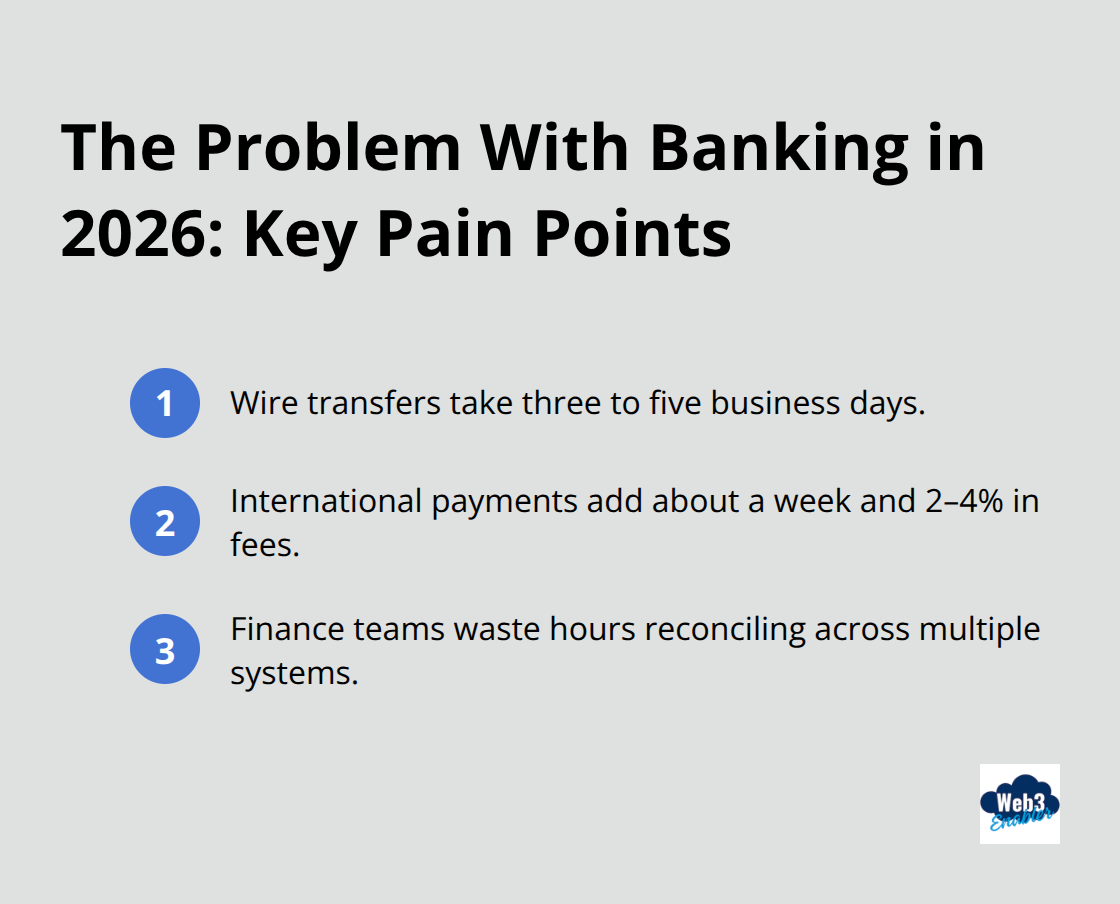
Your finance team wastes hours reconciling transactions across multiple systems, chasing down confirmations, and managing currency conversion delays. The problem isn’t just slow-it’s expensive.
A McKinsey study found that generative AI could add between $150 billion and $275 billion to the fashion industry alone in the next five years, yet payment processing remains one of the most friction-filled parts of any transaction. That gap reveals the real issue: your payment infrastructure hasn’t kept pace with the rest of your business.
Stablecoins Eliminate the Volatility Excuse
Stablecoins eliminate the volatility excuse; by offering different trade-offs in speed, cost, and control compared to traditional banking rails. Unlike Bitcoin or Ethereum, stablecoins like USDT and USDC maintain a 1:1 reserve with actual dollars, so you get the speed of blockchain without the volatility that keeps CFOs awake at night. The Genius Act of 2025 established strict reserve requirements and AML/CFT compliance standards, which means stablecoins now function as enterprise-grade rails rather than speculative assets.
Companies report cutting payment processing costs significantly when they move to stablecoin settlement, because no middleman takes a cut and no multi-day clearing period exists. You stop losing money to exchange rate fluctuations during the clearing period, and your vendors stop waiting for payment to actually land in their accounts.
Global Payments Become Genuinely Borderless
Global payments become genuinely borderless when you settle in stablecoins on Salesforce. A vendor in Singapore, a partner in Frankfurt, and a contractor in São Paulo all receive payment in the same hour instead of waiting for correspondent banks to shuffle money through three different countries. B2B enterprises sending international payments report settlement in hours instead of weeks.
Financial advisors now see their clients’ crypto holdings in real time within their portfolio dashboard, alongside traditional investments. This visibility transforms how advisors manage client assets and spot opportunities that traditional systems miss.
Your Customers Already Expect This
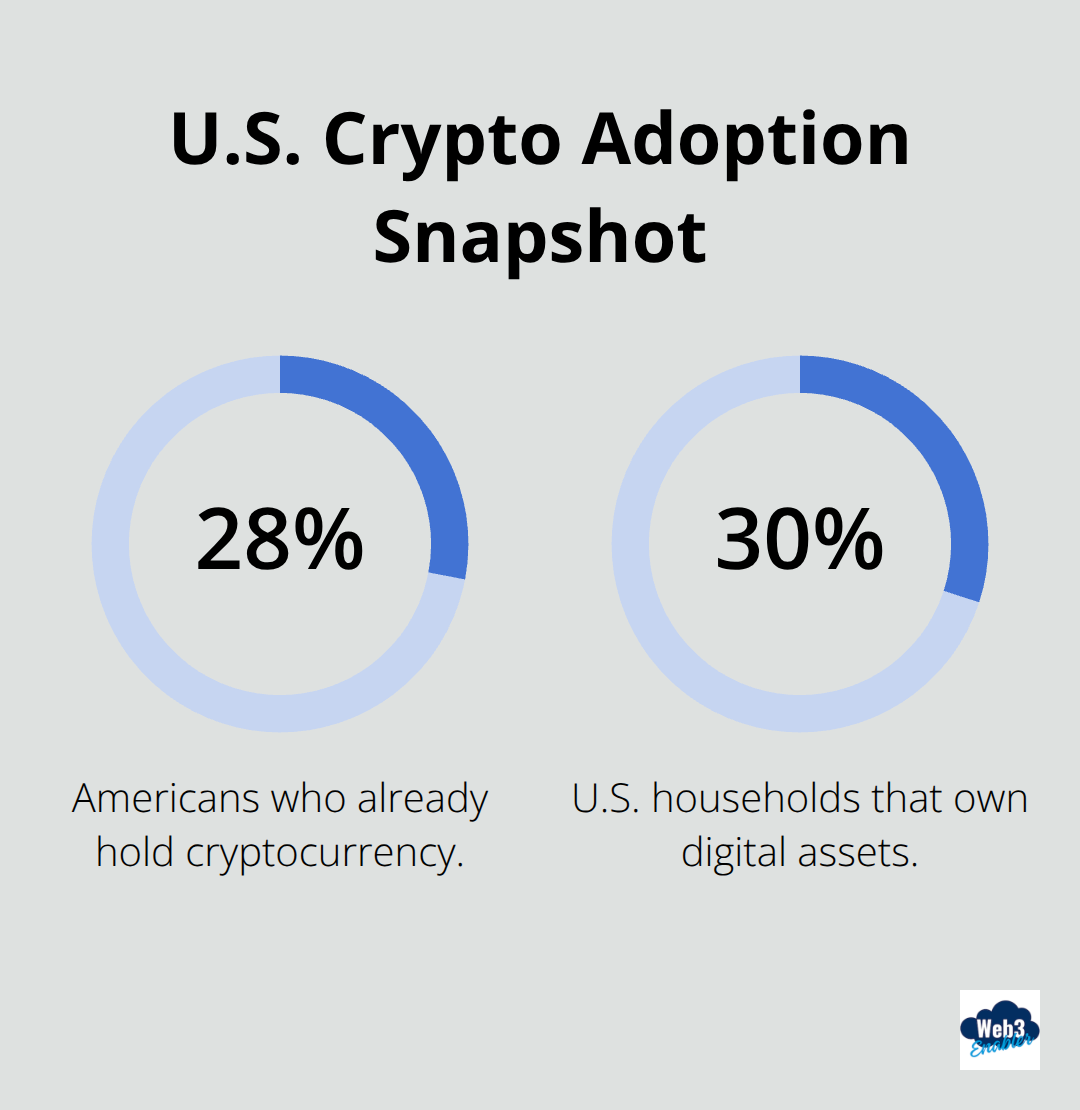
About 28% of Americans already hold cryptocurrency, and 30% of households own digital assets, which means your customers and partners increasingly expect payment flexibility. When you accept stablecoins directly in Salesforce, you respond to where business is already moving-not where it was five years ago. The infrastructure exists. The regulatory clarity exists.
What’s missing is the integration that makes it simple for your team to actually use it.
Getting Crypto Payments Live in Salesforce
Native Integration Eliminates the Friction
The setup process matters less than the outcome: payments that actually land in minutes instead of days, with compliance baked in rather than bolted on. We at Web3 Enabler built our Salesforce integration to sit natively inside your existing workflow, which means your finance team stops juggling systems and starts moving money. Installation takes hours, not months. You activate stablecoin acceptance for USDT, USDC, and XRP directly within Salesforce, then payments flow through the same CRM that manages your customer relationships. No separate blockchain wallets to monitor, no third-party gateways taking a margin on every transaction, no waiting for settlement confirmations to appear in a different system three days later.
Compliance and Security Built Into Your Workflow
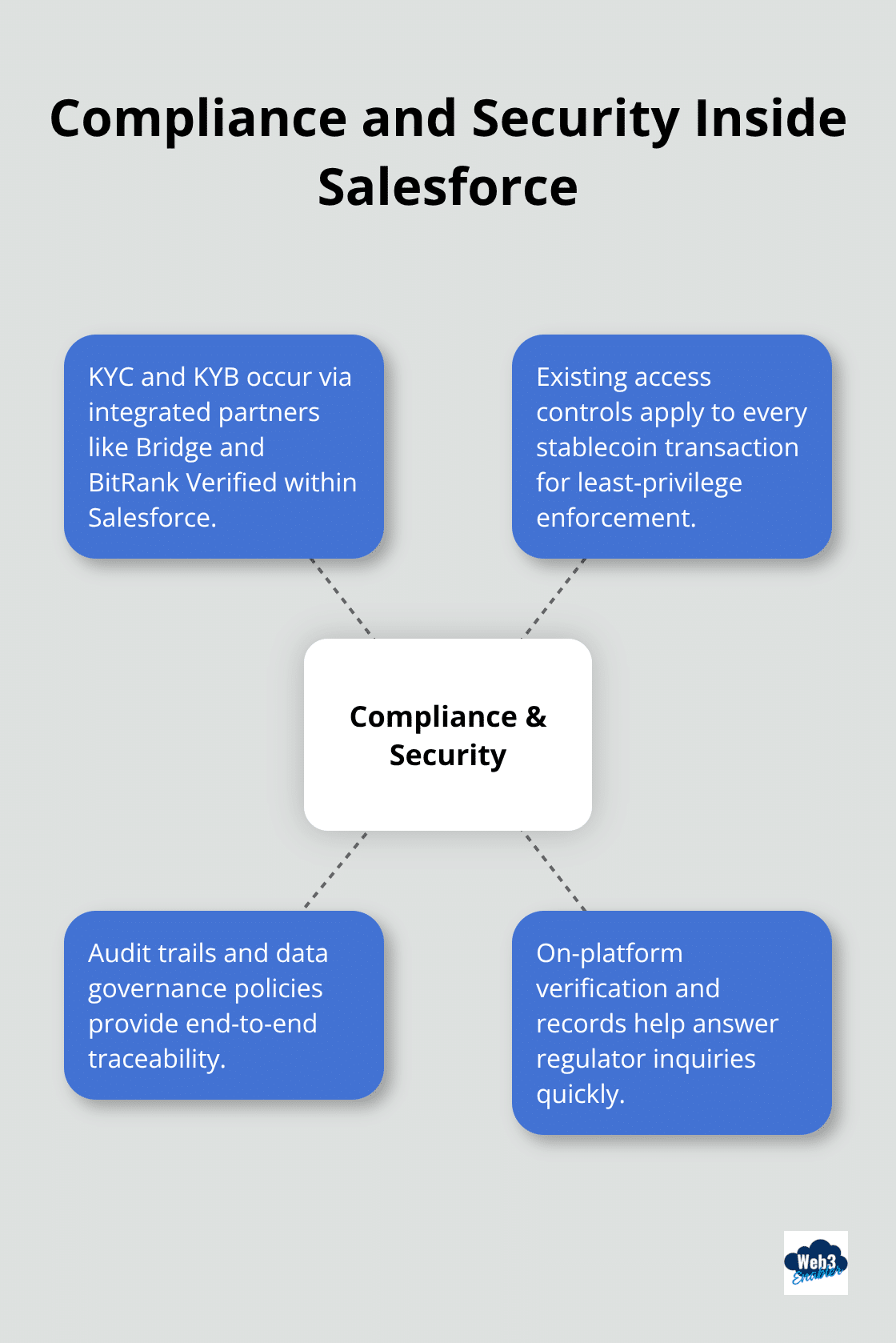
The compliance and security infrastructure that Salesforce built for handling sensitive financial data applies to your crypto payments from day one. KYC and KYB verification happens through integrated partners like Bridge and BitRank Verified, so you verify counterparties without leaving Salesforce. Your existing access controls, audit trails, and data governance policies extend to every stablecoin transaction. That matters when regulators ask questions, because you have a complete record of who paid whom, when, and why-all within the system your finance team already uses daily.
Settlement Speed Transforms Your Cash Flow
Settlement speed transforms how your business operates. A B2B enterprise sends international payments to vendors in hours instead of weeks, which means suppliers receive payment faster and your cash flow forecasting becomes predictable rather than speculative. Financial advisors using our Digital Asset Wallet for Salesforce Financial Services Cloud gain real-time visibility into client crypto holdings directly alongside traditional portfolios, eliminating the friction of checking three different platforms to understand a client’s total assets. Your team stops reconciling payments across multiple spreadsheets because Salesforce becomes the single source of truth for both traditional and blockchain-based transactions.
Cost Reduction Hits Your Bottom Line
Companies report reducing payment processing costs by 40 to 60 percent when they move settlement to stablecoins, because correspondent banking fees disappear, currency conversion delays evaporate, and you stop losing money to multi-day clearing periods. The infrastructure to make this work exists today through partnerships with Circle and other Web3 infrastructure providers. Your payment system doesn’t need to wait for blockchain to mature-it can start moving faster this quarter, which means your next international payment could land before your team finishes their morning coffee.
How Businesses Actually Use Crypto Payments Today
The Math Behind Cost Reduction
Companies moving stablecoin settlement through Salesforce cut payment processing costs by 40 to 60 percent, and the numbers tell the story clearly. A mid-market B2B enterprise sends ten international wire transfers monthly at $25 per transfer plus 2% currency conversion fees. That same money now moves through stablecoins for under $10 total per batch. The savings compound when finance teams stop performing repetitive tasks: no more chasing wire confirmations across multiple banks, no more reconciling currency fluctuations that landed three days after the invoice date, no more explaining why a $100,000 payment arrived as $97,400 after hidden fees. One manufacturing company sent vendor payments to suppliers across five countries and cut their monthly payment processing overhead from $8,000 to $2,400 just by settling in USDC instead of wire transfers. That’s not theoretical savings-that’s money staying in their operating budget instead of disappearing into correspondent banking fees.
Portfolio Visibility for Financial Advisors
Financial advisors managing client portfolios now access crypto holdings directly within Salesforce Financial Services Cloud alongside traditional stocks and bonds. They stop toggling between three different platforms to answer the question every client asks: what do I actually own? An advisor at a wealth management firm can see that a client holds $250,000 in Bitcoin, $150,000 in Ethereum, and $400,000 in traditional equities all on one dashboard without logging into a separate crypto exchange or wallet platform. This matters operationally because advisors spend less time gathering information and more time performing actual advisory work, while clients receive faster responses when they ask about their total portfolio value or want to rebalance across asset classes.
The visibility also surfaces opportunities that advisors would otherwise miss. An advisor might notice a client’s digital assets are concentrated in one token and recommend diversification, or spot that crypto holdings have become 40% of a portfolio when the client’s risk tolerance suggests 15%. These insights happen faster because the data sits in the system advisors already use daily instead of buried in external platforms they check occasionally.
International Payments at Speed
B2B enterprises sending stablecoin settlement report dramatic operational improvements, with payment settlement shrinking from two to three weeks down to hours. A software company with contractors across Europe, Asia, and the Americas used to batch payments monthly because wire transfer delays made weekly payments impractical. Now they settle vendor payments daily in stablecoins, which means contractors receive compensation faster and the company’s cash management becomes predictable instead of speculative. One logistics company reduced their accounts payable processing time from eight days to under four hours by moving international supplier payments to Salesforce-native stablecoin settlement. This freed their AP team to focus on vendor relationship management instead of chasing payment status updates.
The Future Starts Now
Stablecoin adoption across enterprise isn’t coming-it’s already happening. JP Morgan launched blockchain-based client services, major corporations test settlement on-chain, and regulatory frameworks like the Genius Act of 2025 removed the legal uncertainty that kept CFOs on the sidelines. Your competitors are already moving, which means your payment infrastructure either evolves or becomes a competitive liability.
The real shift happens when blockchain disappears into the background of how business actually works. You don’t need to understand how the internet works to send an email, and you shouldn’t need to understand blockchain to send a payment across borders in minutes instead of weeks. Crypto payments within Salesforce make this possible by letting your team focus on moving money faster instead of managing blockchain complexity.
Your Salesforce instance already handles customer relationships, revenue tracking, and financial workflows, so layering in native stablecoin settlement means your payment system evolves without a rip-and-replace project that costs millions and takes eighteen months. You activate crypto payments within your existing CRM, your team starts moving money faster this quarter, and your infrastructure grows with your business instead of constraining it.